What Is Long Division?
Taught in US schools

Key Takeaways
- Long division solves division problems with large numbers using four repeated steps: Divide, Multiply, Subtract, Bring Down (DMSB).
- Estimation skills help students choose good trial quotients before multiplying.
- Remainders represent the leftover amount after dividing as evenly as possible.
- Long division is the standard algorithm for multi-digit division and connects multiplication and subtraction.
What Is Long Division?
Long division is the standard algorithm for dividing a multi-digit number (the dividend) by another number (the divisor) to find the quotient and remainder. Unlike short division (which keeps work mental), long division writes out every step, making the process transparent and checkable.
Long division is a landmark skill in 4th and 5th grade mathematics.
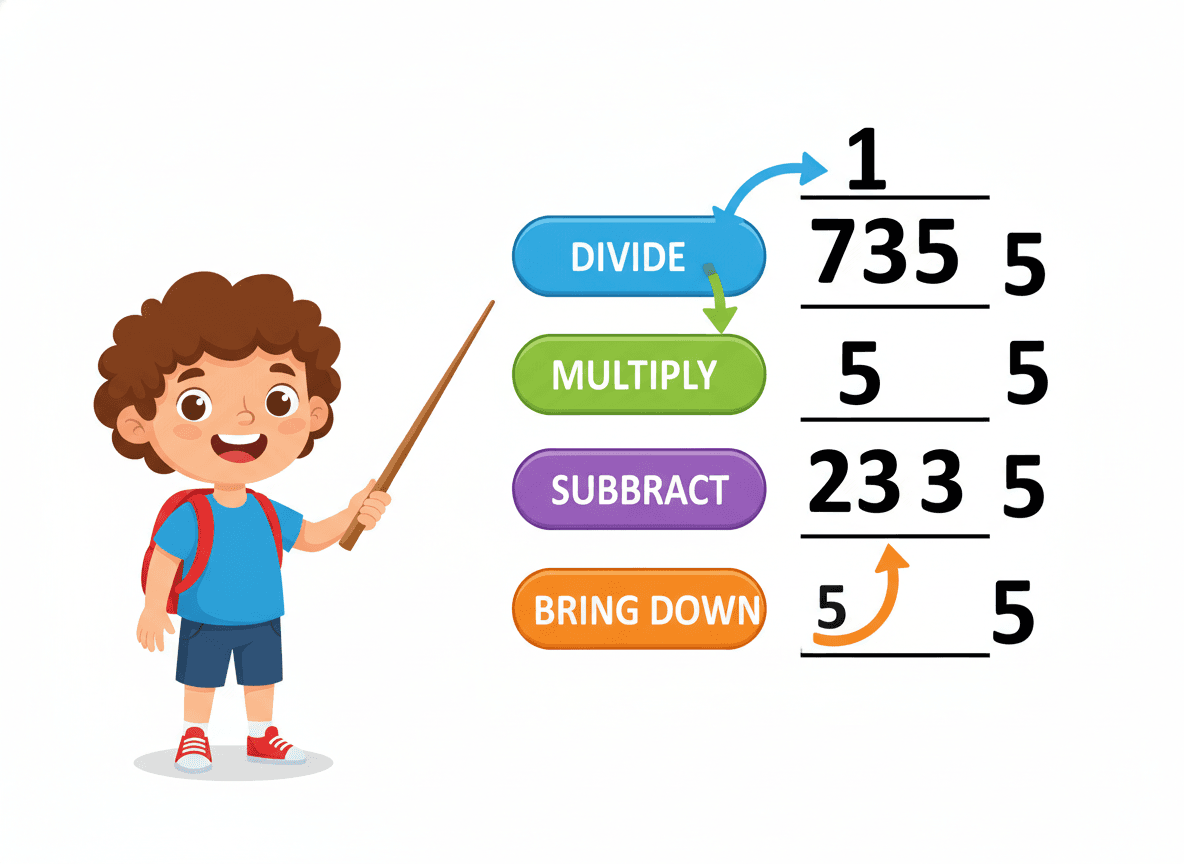
The Four Steps: DMSB
D - Divide: How many times does the divisor fit into the working portion of the dividend?
M - Multiply: Multiply the quotient digit by the divisor.
S - Subtract: Subtract the product from the working portion.
B - Bring Down: Bring down the next digit of the dividend.
Repeat until there are no more digits to bring down.
Mnemonic: Does McDonald's Sell Burgers? or Dirty Monkeys Smell Bad.
Worked Example: 952 ÷ 4
-
Divide: 9 ÷ 4 = 2 (place 2 above the 9)
-
Multiply: 2 × 4 = 8
-
Subtract: 9 - 8 = 1
-
Bring Down: bring down the 5 → working number is 15
-
Divide: 15 ÷ 4 = 3 (place 3 above the 5)
-
Multiply: 3 × 4 = 12
-
Subtract: 15 - 12 = 3
-
Bring Down: bring down the 2 → working number is 32
-
Divide: 32 ÷ 4 = 8 (place 8 above the 2)
-
Multiply: 8 × 4 = 32
-
Subtract: 32 - 32 = 0
Answer: 238
What Grade Do Kids Learn Long Division?
4th grade (4.NBT.B.6): Students divide up to 4-digit numbers by 1-digit divisors using strategies, beginning to use the standard algorithm.
5th grade (5.NBT.B.6): Students divide multi-digit whole numbers by up to 2-digit divisors, finding whole number quotients and remainders using the standard algorithm.
Common Misconceptions
Forgetting to bring down: Students perform subtract and then write the next quotient digit without bringing down the next digit from the dividend. Color-coding the bring-down arrows helps.
Putting the quotient digit in the wrong place: Students may write the quotient digit directly above the working portion rather than above the correct place-value digit of the dividend.
Remainder larger than divisor: If the subtraction result is larger than the divisor, the quotient digit was too small - go back and increase it by 1.
Practice Activities
-
Step-by-step color code: Each DMSB step gets its own color on the page.
-
Fact fluency first: Ensure students can quickly recall multiplication facts before long division - fluency dramatically reduces errors.
-
Check with multiplication: Verify answers: quotient × divisor + remainder should equal the dividend.
-
Real-world contexts: 364 students going on a field trip in vans of 8 - how many vans? How many students in the last van?
-
Error analysis: Show worked long division problems with common mistakes; students find and correct them.
Frequently Asked Questions
What is long division?
Long division is the standard written method for dividing multi-digit numbers. It breaks the division into manageable steps: divide a portion of the dividend by the divisor, multiply to find that partial product, subtract it from the working dividend, and bring down the next digit. These steps repeat until there are no more digits to bring down.
What are the steps of long division?
The four steps, repeated until the dividend is exhausted: (1) Divide - how many times does the divisor go into the current working portion? (2) Multiply - multiply that number by the divisor. (3) Subtract - subtract the product from the working portion. (4) Bring Down - bring down the next digit of the dividend. Remember with the mnemonic: Does McDonald's Sell Burgers? (Divide, Multiply, Subtract, Bring Down).
What is a remainder in long division?
A remainder is the amount left over after dividing as evenly as possible. For example, 29 ÷ 6 = 4 remainder 5 (since 6 × 4 = 24, and 29 - 24 = 5). The remainder must always be less than the divisor. If the remainder equals or exceeds the divisor, the quotient digit should be increased.
What are common estimation strategies for long division?
Students estimate to choose a good trial quotient before multiplying. Strategies include: rounding the divisor to the nearest ten, using multiplication facts you know, and thinking 'how many groups of the divisor fit in this portion?' For 243 ÷ 7, think: 7 × 3 = 21, so the first digit is in the tens place.
How does long division connect to multiplication?
Division is the inverse of multiplication, and long division makes this visible. Each 'multiply' step in long division is multiplication. Students who know their multiplication facts fluently make long division significantly faster and more accurate. Fact fluency is the biggest factor in long division success.
Free Long Division Worksheets
Curriculum-aligned printable worksheets for 4th – 5th Grade. Download free.