What Are Number Patterns?
Taught in US schools
Key Takeaways
- A number pattern is a sequence of numbers that follows a consistent rule.
- Students identify the rule, continue the pattern, and explain why it works.
- Number patterns connect to multiplication, skip counting, and early algebraic thinking.
- Patterns appear everywhere in math - recognizing them is a foundational mathematical habit.
What Are Number Patterns?
A number pattern is a sequence of numbers that follows a consistent rule. Every term in the sequence relates to the previous or next term in the same way - and a student who understands the rule can continue the pattern indefinitely.
Number patterns build mathematical thinking at every level: from kindergartners skip-counting by 2s to 5th graders generating patterns and analyzing relationships between two sequences.
Types of Number Patterns
Arithmetic (Add/Subtract) Patterns Each term is found by adding or subtracting the same number.
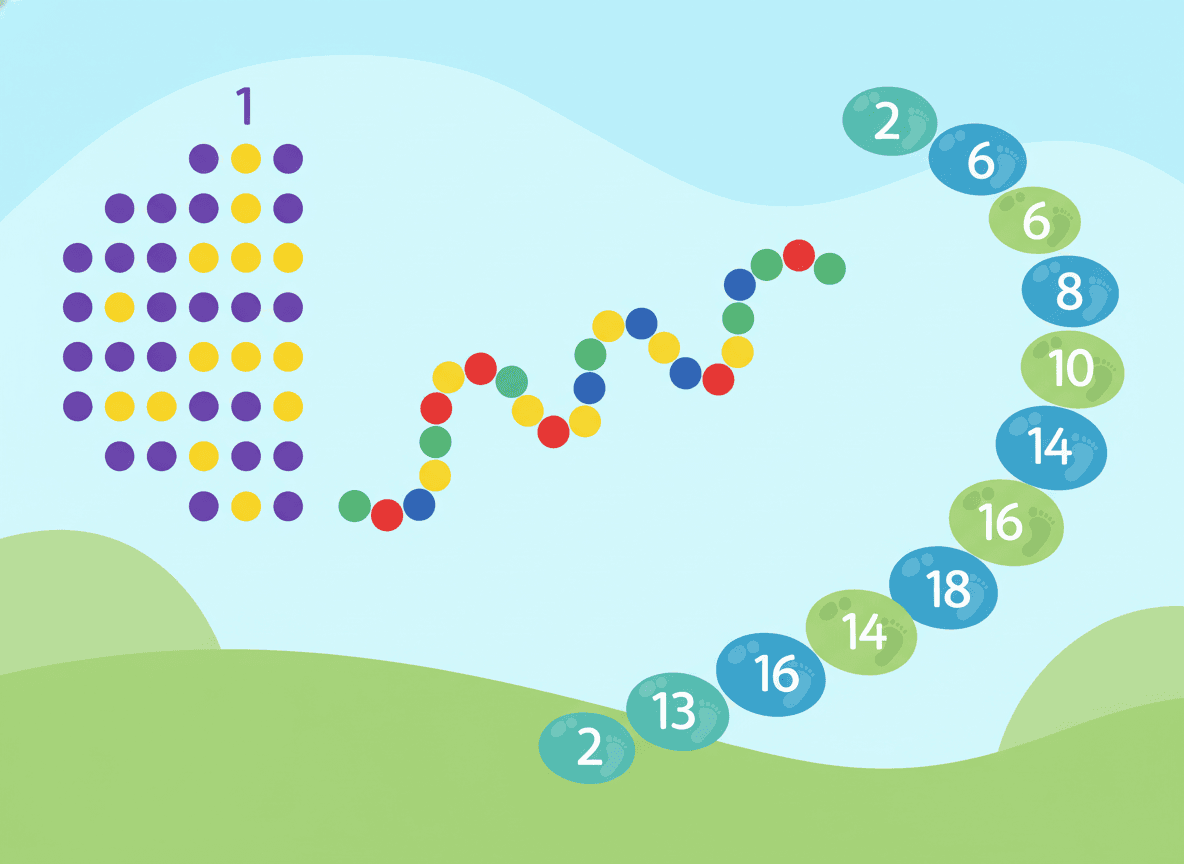
5, 10, 15, 20, 25... (rule: +5) 100, 90, 80, 70... (rule: -10)
Skip Counting Patterns A special case of arithmetic patterns - counting by a fixed number.
2, 4, 6, 8, 10... (skip count by 2) 3, 6, 9, 12, 15... (skip count by 3)
Geometric Patterns Each term is found by multiplying or dividing by the same number.
2, 4, 8, 16, 32... (rule: ×2) 81, 27, 9, 3, 1... (rule: ÷3)
Growing Patterns The amount added or subtracted changes, but in a predictable way.
1, 3, 6, 10, 15... (add 2, then 3, then 4, then 5...)
Patterns in Multiplication Tables Multiples of any number form a pattern:
Multiples of 9: 9, 18, 27, 36... (digits always add to 9) Even numbers always end in 0, 2, 4, 6, or 8
Working with Patterns: A Three-Step Process
- Find the rule - Look at two consecutive terms. What operation was applied to get from one to the next?
- Verify the rule - Check it across more terms. Does the same rule work every time?
- Extend the pattern - Use the rule to add new terms; predict terms far down the sequence ("What is the 10th term?")
Patterns and Algebraic Thinking (Grades 4-5)
In upper elementary, students move from describing patterns verbally ("add 4 each time") to representing them in tables and using informal algebraic notation.
A function table shows the relationship between inputs and outputs:
1: 4
2: 7
3: 10
4: 13 Rule: multiply n by 3, then add 1. Or: output = 3n + 1.
This is algebra - students are finding and expressing a function rule.
Practice Activities
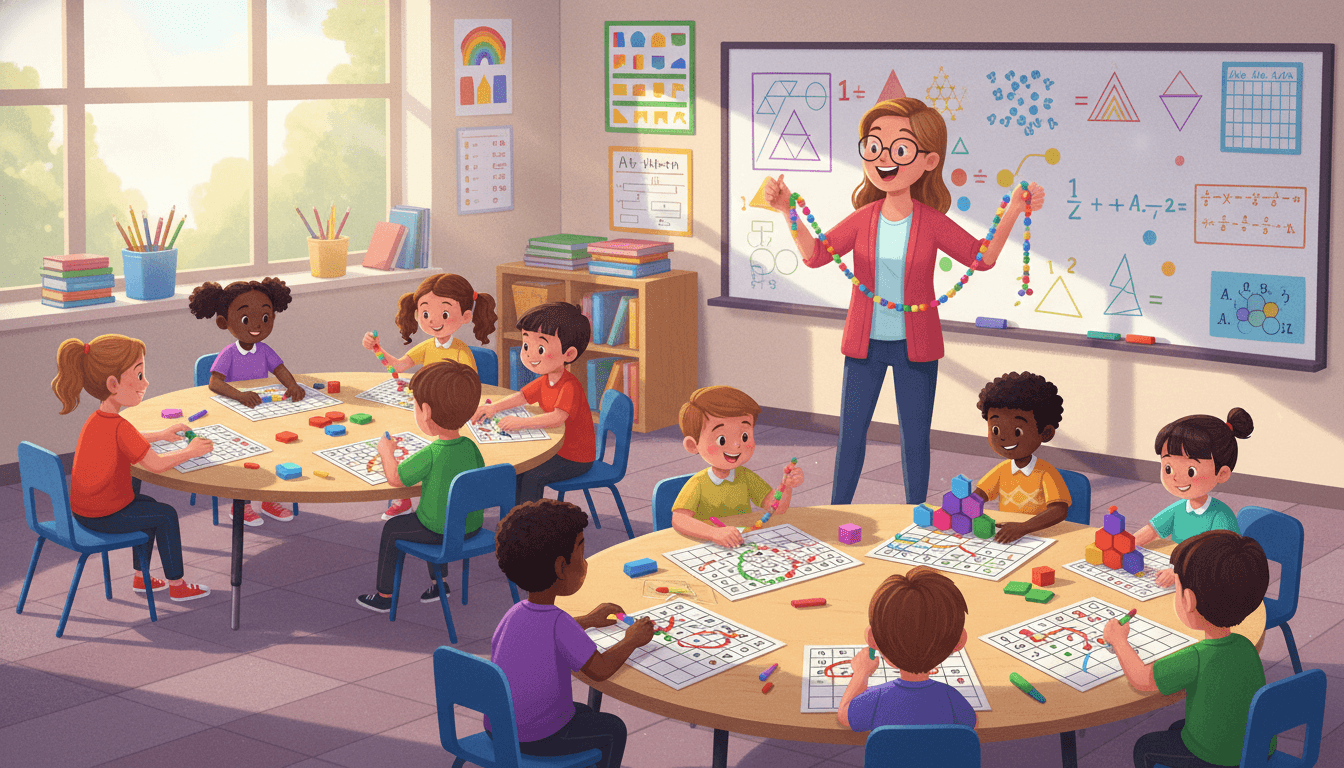
- "What's my rule?" - teacher writes the beginning of a pattern on the board; students figure out the rule and continue it.
- 100 chart patterns: shade all multiples of 3, 4, or 7 on a hundreds chart. What patterns appear visually?
- Growing pattern challenge: use color tiles or drawings to build a growing geometric pattern (1, 4, 9, 16...) and connect it to the numeric sequence.
- Input/output tables: give students a rule without naming it; students complete the table and then describe the rule in words.
Frequently Asked Questions
What is a number pattern in math?
A number pattern is a sequence of numbers that follows a specific rule consistently. Examples: 2, 4, 6, 8, 10 (add 2 each time); 3, 6, 9, 12 (skip count by 3); 1, 2, 4, 8, 16 (multiply by 2 each time). Students learn to identify the rule governing a pattern, extend it, and explain why the rule works.
What are the types of number patterns?
Common types include: arithmetic patterns (add or subtract a constant amount: 5, 10, 15, 20); geometric patterns (multiply or divide by a constant: 1, 3, 9, 27); growing patterns (the amount added changes in a predictable way: 1, 3, 6, 10); and patterns in multiplication tables (multiples of 9 always have digits that add up to 9: 9, 18, 27, 36...).
How are number patterns connected to algebra?
Number patterns are the foundation of algebraic thinking. When students identify that 'add 3 each time' describes a pattern, they are discovering a function rule. In grades 4-5, students begin to express rules using variables (if the input is n, the output is n + 3), connecting pattern recognition to formal algebraic notation and function tables.
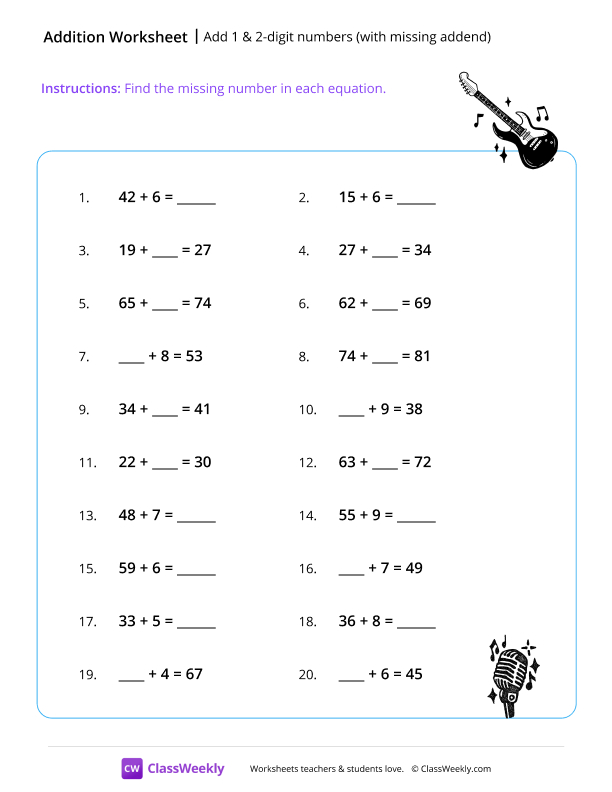
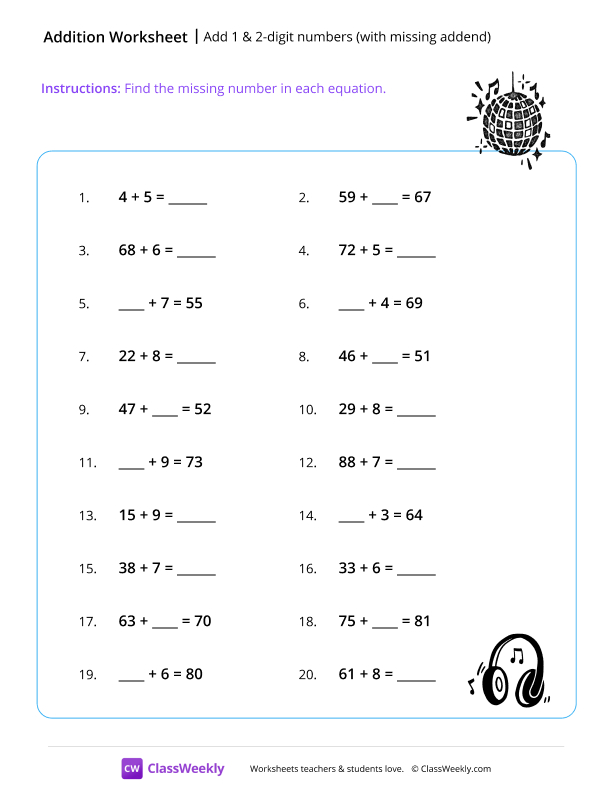
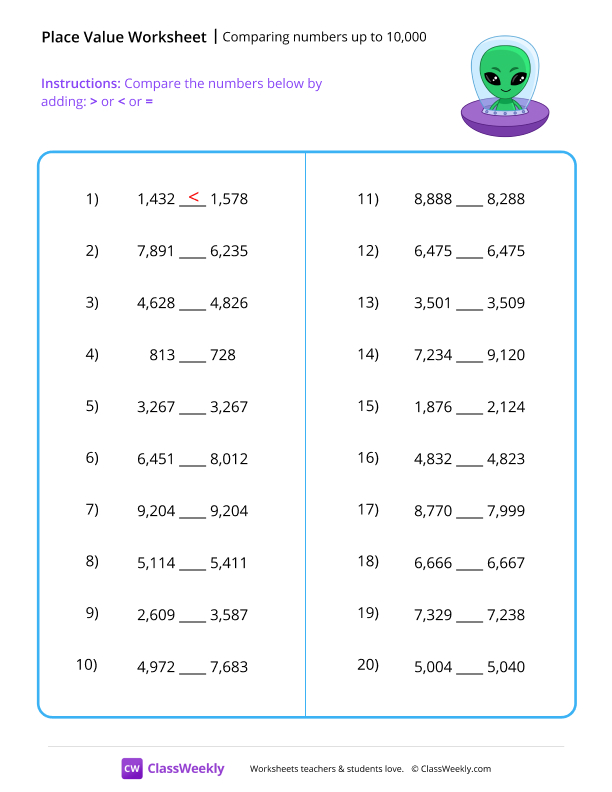
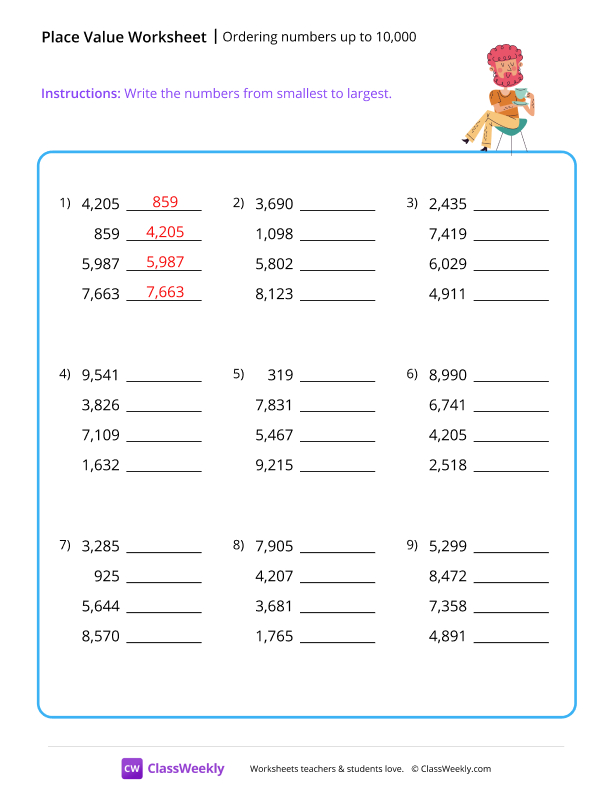
Free Number Patterns Worksheets
Curriculum-aligned printable worksheets for Kindergarten – 5th Grade. Download free.