What Are Patterns in Math?
Taught in US schools
Key Takeaways
- A pattern is a sequence that follows a rule - number patterns, shape patterns, and color patterns are all common in elementary math.
- Identifying patterns is a foundation for algebraic thinking and mathematical reasoning.
- Growing patterns change by a fixed amount; repeating patterns cycle through the same core.
- In 4th and 5th grade, patterns involve rules with multiple operations and are plotted as coordinate pairs.
What Are Patterns?
A pattern is a sequence of numbers, shapes, colors, or objects that follows a consistent rule. Patterns are everywhere - in nature, art, music, and mathematics. In elementary school, recognizing and extending patterns is the first step toward algebraic thinking.
When students can identify the rule behind a pattern, they can predict future terms, find missing values, and begin to generalize mathematical relationships.
Types of Patterns
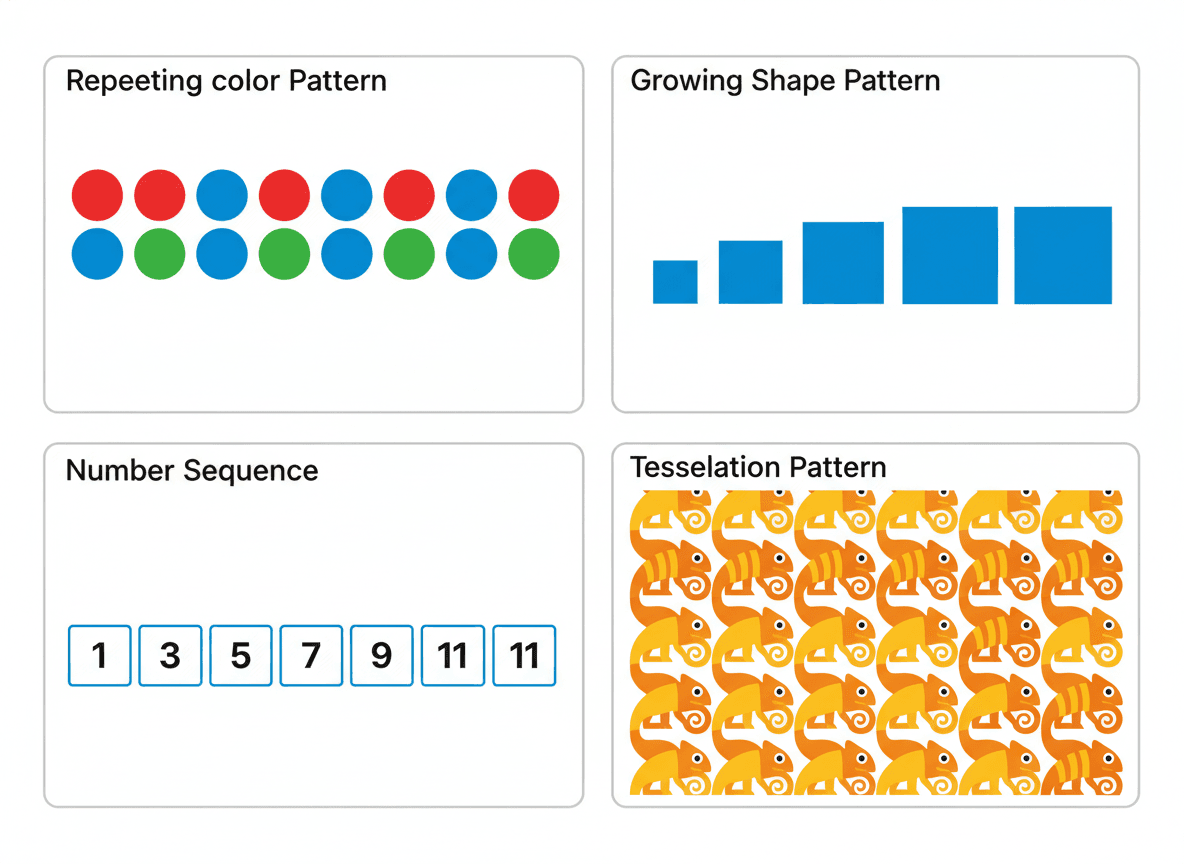
Repeating patterns: A core sequence that cycles.
- Example: A, B, B, A, B, B, A, B, B...
- Core: A, B, B (repeats)
Growing patterns: A sequence that increases or decreases by a fixed rule.
- Example: 5, 10, 15, 20... (add 5 each time)
- Example: 1, 4, 9, 16... (perfect squares, more complex)
Shape/geometric patterns: Visual arrangements that grow according to a rule.
- Example: 1 square, 4 squares (2×2), 9 squares (3×3)...
Number Patterns and Rules
A rule tells you how to get from one term to the next:
-
Add 3: 1, 4, 7, 10, 13...
-
Multiply by 2: 2, 4, 8, 16, 32...
-
Subtract 5: 50, 45, 40, 35...
Rules can involve one or two operations. In 5th grade, students work with rules like "multiply by 3 and then add 1."
What Grade Do Kids Learn Patterns?
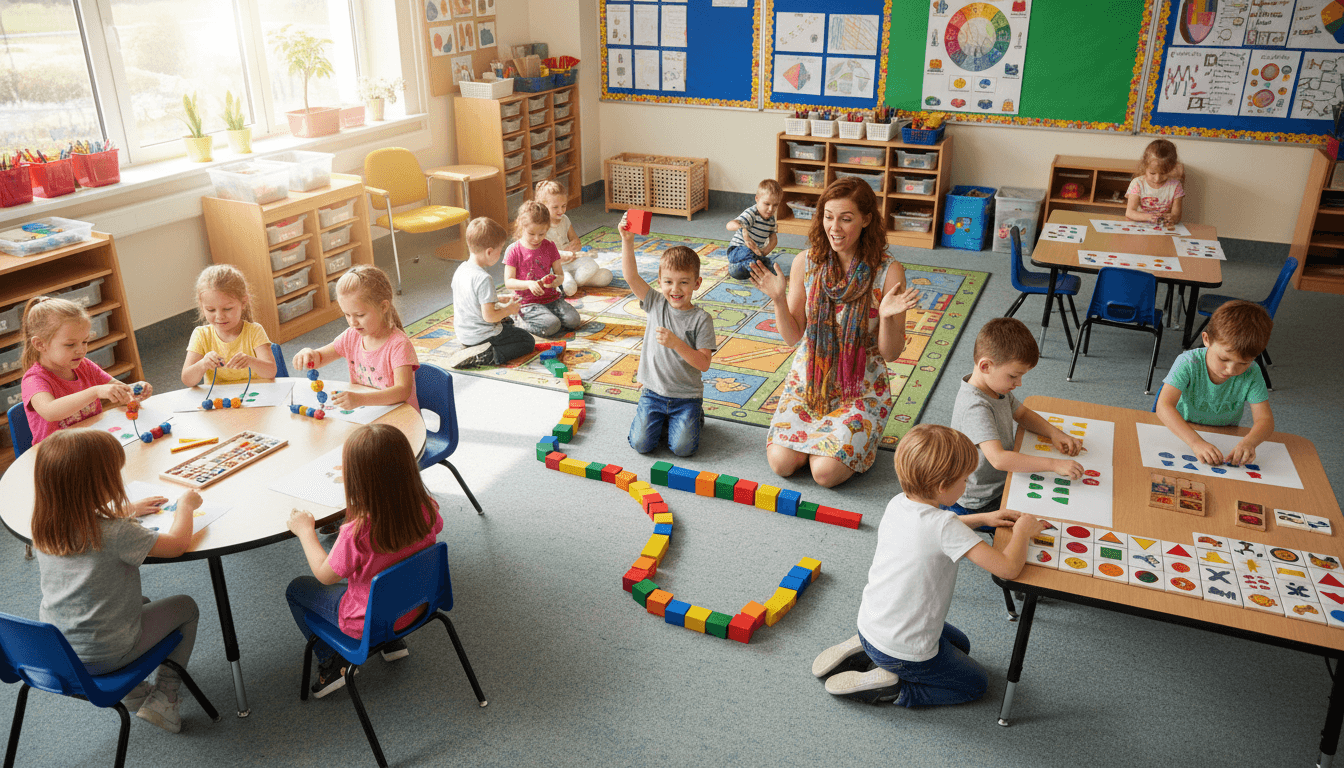
Kindergarten–1st grade: Repeating patterns with shapes, colors, and sounds (AB, AAB, ABB patterns).
2nd–3rd grade (3.OA.D.9): Number patterns in addition and multiplication tables; identifying even/odd patterns.
4th grade (4.OA.C.5): Generating and describing number patterns from a given rule; identifying features of a pattern not explicit in the rule.
5th grade (5.OA.B.3): Generating two numerical patterns from two rules, forming ordered pairs, and graphing them on the coordinate plane.
Common Misconceptions
Any sequence is a pattern: Students sometimes describe random sequences as patterns. Reinforce that a true pattern has a consistent, predictable rule.
The rule is always "add something": Students default to additive rules. Expose them to multiplicative patterns, alternating patterns, and more complex rules.
Missing terms can only be found by extending: Students who can only extend from the last known term may struggle with finding a term far into the sequence. Encourage students to express the rule as a formula.
Practice Activities
-
Pattern block extensions: Lay out a growing shape pattern and have students predict the next 3 figures.
-
100-chart patterns: Color multiples of 3, 4, or 7 on a 100 chart and describe the visual pattern.
-
Rule writing: Display a number sequence and ask students to write the rule in words.
-
T-chart + coordinate graph: Generate input/output pairs from a rule, record in a T-chart, and plot on the coordinate plane.
-
Pattern creation: Students create their own pattern with a written rule and challenge a partner to extend it.
Frequently Asked Questions
What is a pattern in math?
A pattern is a sequence of numbers, shapes, colors, or objects that follows a predictable rule. Number patterns might add or multiply by a fixed amount. Shape patterns might repeat the same sequence of shapes. Recognizing and extending patterns is one of the first steps toward algebraic thinking.
What is the difference between a repeating pattern and a growing pattern?
A repeating pattern cycles through the same core sequence over and over (e.g., circle, square, triangle, circle, square, triangle...). A growing pattern increases or decreases by a fixed rule each time (e.g., 2, 4, 6, 8... growing by 2 each step). Growing patterns connect directly to multiplication and linear relationships.
How do number patterns connect to multiplication?
Skip-counting sequences are growing patterns: 3, 6, 9, 12... follows the rule 'add 3 each time.' This is the same as multiplying 3 by 1, 2, 3, 4... Recognizing this connection helps students see multiplication as a pattern and builds fluency with times tables.
What are patterns used for in upper elementary school?
In 4th and 5th grade, patterns extend to two-rule relationships and coordinate graphs. Students generate two number sequences from two different rules, form ordered pairs, and plot them. Patterns also appear in geometry (number of sides growing as polygons gain sides) and in data and graphing.
How do teachers assess pattern understanding?
Teachers assess patterns by asking students to extend a pattern (what comes next?), identify the rule, find a missing term, and create their own pattern with a stated rule. Students who can articulate a rule using words or an equation demonstrate algebraic thinking.
Free Patterns Worksheets
Curriculum-aligned printable worksheets for Kindergarten – 5th Grade. Download free.
Common Core Standards