What Is Scientific Observation?
Taught in US schools

Key Takeaways
- A scientific observation uses the senses to gather accurate, factual information about the world.
- Observations are facts; inferences are conclusions drawn from observations.
- Qualitative observations describe qualities (color, texture, shape); quantitative observations include measurements.
- Good scientific observation is purposeful, specific, and recorded carefully.
What Is Scientific Observation?
Scientific observation is the careful, purposeful use of the senses to gather factual information about an object, event, or phenomenon in the natural world. It is the foundation of scientific inquiry - you cannot form a hypothesis, conduct an experiment, or draw a conclusion without accurate observations to work from.
Observation seems simple, but teaching students to observe scientifically - specifically, accurately, and without jumping to conclusions - is a real skill that develops with practice.
Observation vs. Inference
This is the most important distinction in early science education:
What you directly perceive through your senses: A conclusion or interpretation drawn from observations
Factual - can be verified: Logical - but may be wrong
"The footprints are large and deep.": "A large, heavy animal made these footprints."
"The liquid turned blue when I added the drops.": "The liquid contains a base." Scientists make both observations and inferences - but they always distinguish between them. Inferences must be based on evidence, and they can be revised when new observations change the picture.
Qualitative vs. Quantitative Observations
Qualitative observations describe qualities:
- Color: bright orange
- Texture: smooth and waxy
- Smell: sharp, like vinegar
- Shape: oval
Quantitative observations include measurements and numbers:
- Length: 7.5 centimeters
- Mass: 32 grams
- Temperature: 18°C
- Count: 6 seeds
Quantitative observations are more precise and easier to compare across trials or between groups.
The Habits of a Good Scientific Observer
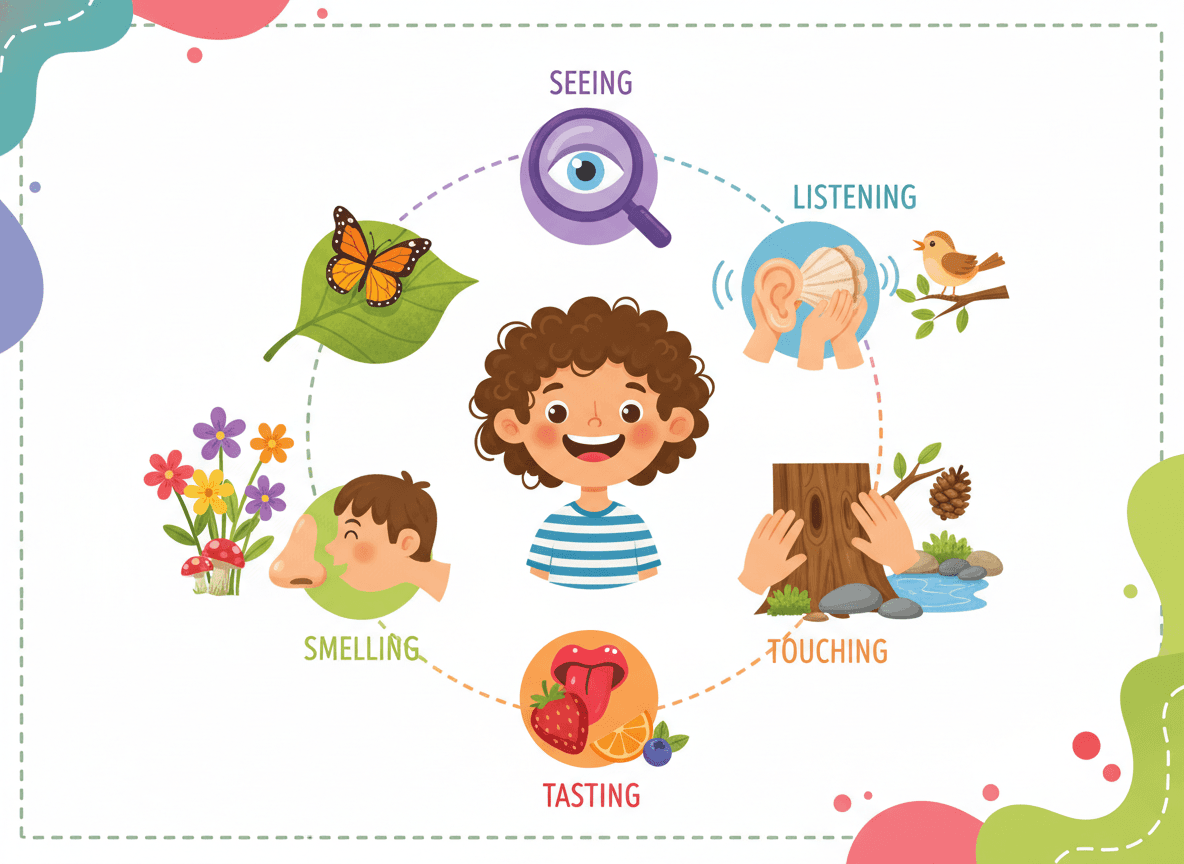
- Use multiple senses - don't just look; listen, smell, and touch (when safe)
- Be specific - "red" is less useful than "dark crimson with orange spots"
- Record immediately - memory fades; data should be recorded as it is observed
- Be objective - describe what IS, not what you think it means
- Repeat and verify - one observation can be misleading; multiple observations are more reliable
Practice Activities
- Place an ordinary object (a pinecone, a rock, a leaf) on each desk and ask students to spend 5 minutes writing everything they can observe about it using all five senses. Count the observations - most students can generate 15-20 with practice.
- "Observation vs. Inference" sorting cards: give students statement pairs and ask them to sort into observation or inference.
- Mystery liquids: give students several clear liquids and ask them to record qualitative and quantitative observations (color, clarity, viscosity, smell, volume). Do not yet hypothesize what they are.
- Outdoor observation journals: students sit in one spot for 10 minutes and record everything they can observe - sounds, sights, smells, movement.
Frequently Asked Questions
What is a scientific observation?
A scientific observation is the use of one or more senses - sight, hearing, smell, touch, and sometimes taste (when safe) - to gather information about an object, event, or phenomenon. Scientific observations are factual, specific, and recorded carefully. They describe what can be directly perceived, not what is guessed or interpreted.
What is the difference between an observation and an inference?
An observation is a direct, factual record of what you perceive through your senses. An inference is a conclusion drawn from observations - an interpretation or explanation of what the observations might mean. Example: 'The rock is dark gray and shiny' is an observation. 'The rock is probably obsidian' is an inference based on that observation. Both are valuable in science, but they are different kinds of thinking.
What is the difference between qualitative and quantitative observations?
Qualitative observations describe qualities that cannot be measured in numbers: color (bright red), texture (rough), smell (sweet), shape (triangular). Quantitative observations include measurements and numbers: 12 centimeters long, 45 grams, 24°C, 3 seeds. Both types are useful in science. Quantitative observations are generally more precise and easier to compare.
Free Observation Worksheets
Curriculum-aligned printable worksheets for Kindergarten – 5th Grade. Download free.


