What Are Odd and Even Numbers?
Taught in US schools

Key Takeaways
- Even numbers: can be split into two equal groups with nothing left over. End in 0, 2, 4, 6, 8.
- Odd numbers: one is always left over when split into pairs. End in 1, 3, 5, 7, 9.
- The ones digit determines odd/even - regardless of how large the number is.
- Even + even = even. Odd + odd = even. Even + odd = odd. These patterns extend to multiplication.
What Are Odd and Even Numbers?
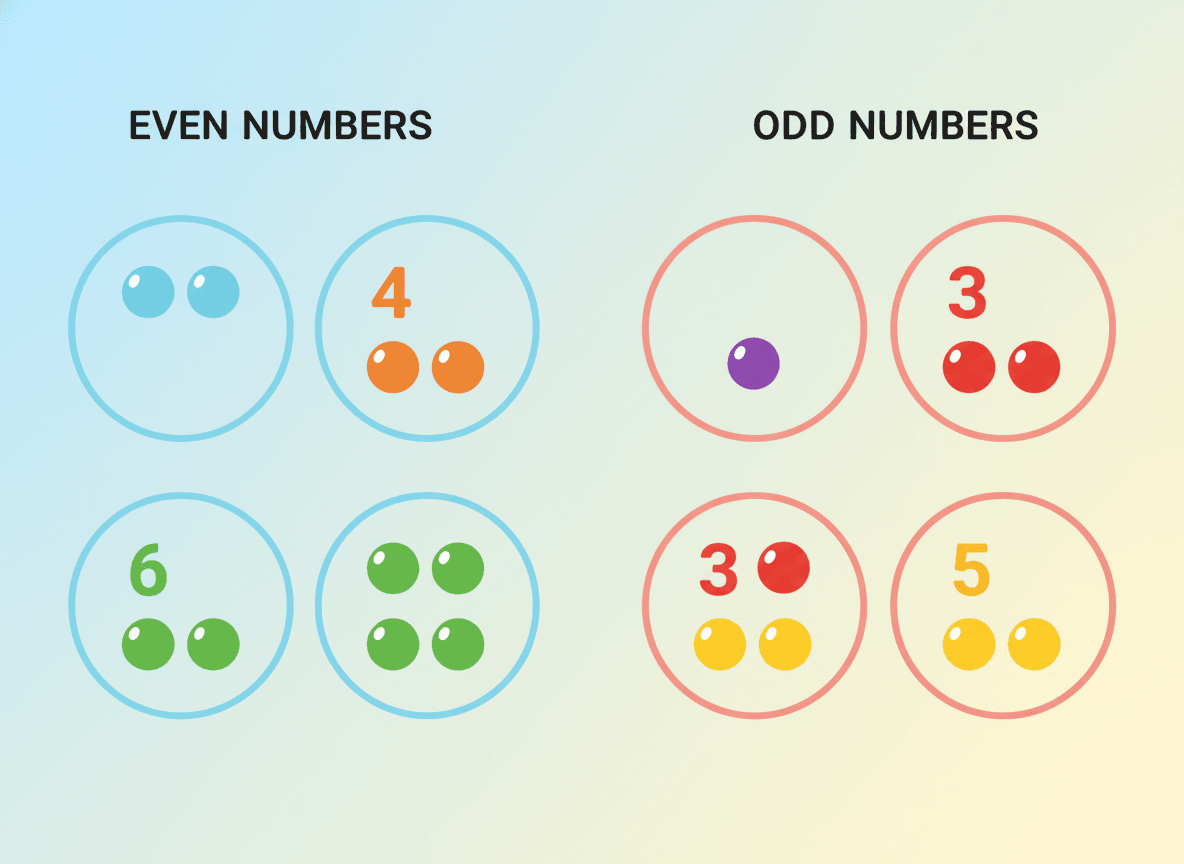
Even numbers can be arranged into two equal groups with nothing left over. They are divisible by 2.
Odd numbers always have one left over when you try to split them into two equal groups.
8 objects → 4 and 4 (equal groups, none left) → even 7 objects → 3 and 3 with 1 left over → odd
The Quick Rule: Look at the Ones Digit
Regardless of how large a number is, only the ones digit determines whether it's odd or even:
ends in 0: ends in 1
ends in 2: ends in 3
ends in 4: ends in 5
ends in 6: ends in 7
ends in 8: ends in 9
4,386 is even (ends in 6). 97,253 is odd (ends in 3).
Pairing Model
The most concrete way to understand odd and even is pairing:
-
Group a set of objects into pairs
-
Even: all objects paired up, no leftovers
-
Odd: one object is always the leftover
This model - used in 2nd grade - builds understanding before the "ends in 0/2/4/6/8" rule.
Odd and Even Number Patterns
In addition:
- Even + Even = Even (4 + 6 = 10)
- Odd + Odd = Even (3 + 5 = 8)
- Even + Odd = Odd (4 + 3 = 7)
In multiplication:
- Even × anything = Even
- Odd × Odd = Odd
In skip-counting:
- Skip-count by 2 → all even numbers (2, 4, 6, 8...)
- The number line alternates: even, odd, even, odd...
What Grade Do Kids Learn Odd and Even?
2nd Grade: Determine whether a group of objects (up to 20) has an odd or even number of members; write an equation to express an even number as a sum of two equal addends (2.OA.C.3).
3rd Grade: Odd/even patterns appear in multiplication tables and skip-counting sequences.
Common Misconceptions
"Big numbers can't be checked easily." The ones digit is all that matters - 1,002 is even; 9,999 is odd. The hundreds and thousands are irrelevant to odd/even.
"Zero is neither odd nor even." Zero is even - it can be split into two equal groups (0 and 0) with nothing left over, and 0 ÷ 2 = 0 with no remainder.
"Odd + odd should be odd." The pairing model clarifies why two odd numbers add up to an even: each odd number has one "lonely" object - when you combine two, the two lonely objects pair up, making the total even.
Practice Activities
-
Pairing objects: Students pair up counters, cubes, or pennies to determine odd or even.
-
Odd/even number line walk: Call out a number; students step to "odd" or "even" side of the room.
-
Pattern hunt: In a hundreds chart, circle all even numbers; look for the pattern.
-
Sorting game: Sort number cards (1-20) into odd and even columns.
-
Addition pattern practice: Complete a chart of even+even, odd+odd, even+odd sums; describe the pattern.
Frequently Asked Questions
What makes a number even or odd?
A number is even if it can be divided into two equal groups with nothing left over - equivalently, if it is a multiple of 2. 6 chairs can be arranged in 3 pairs: even. 7 chairs leave one without a partner: odd. The quickest test: look at the ones digit. Even numbers end in 0, 2, 4, 6, or 8. Odd numbers end in 1, 3, 5, 7, or 9. This works for any whole number regardless of size: 4,386 is even (ends in 6); 1,277 is odd (ends in 7).
Why is zero even?
Zero is even because it fits the definition: it can be split into two equal groups of zero with nothing left over. Alternatively, 0 = 2 × 0, so it is a multiple of 2. Zero ends in 0, which follows the even-number pattern. Students are sometimes confused because zero seems like 'nothing' and therefore neither odd nor even - but by both the pairing definition and the mathematical definition, zero is even. This is consistent across all of mathematics.
What patterns do odd and even numbers create in addition?
Even + even = even (4 + 6 = 10). Odd + odd = even (3 + 5 = 8). Even + odd = odd (4 + 3 = 7). Odd + even = odd (3 + 4 = 7). These rules are provable (not just memorizable) using the pairing model: two groups without remainders added together still have no remainder. Understanding these patterns helps with number sense and is a precursor to divisibility rules in later grades.
How does even/odd connect to multiplication?
Even numbers are multiples of 2. So any number multiplied by an even number is always even (because you're adding groups of 2). Odd × odd = odd. Even × anything = even. These patterns emerge naturally when students start multiplication in 3rd grade. Identifying even and odd in skip-counting sequences (2, 4, 6, 8... = all even; 3, 6, 9, 12... = alternating pattern; 5, 10, 15, 20... = alternating) helps reinforce both skip-counting and odd/even concepts together.
Is there a simple way to check if any large number is even or odd?
Yes - only the ones digit matters. To determine if 4,738 is even or odd, look at the 8. Since 8 is even, the whole number is even. To determine if 5,901 is even or odd, look at the 1. Since 1 is odd, the whole number is odd. This works because any number can be decomposed into thousands + hundreds + tens + ones, and all the thousands/hundreds/tens components are multiples of 10 (which is even), so only the ones digit determines even/odd status.
Free Odd and Even Numbers Worksheets
Curriculum-aligned printable worksheets for 2nd – 3rd Grade. Download free.
Common Core Standards