What Is Onomatopoeia?
Taught in US schools
Key Takeaways
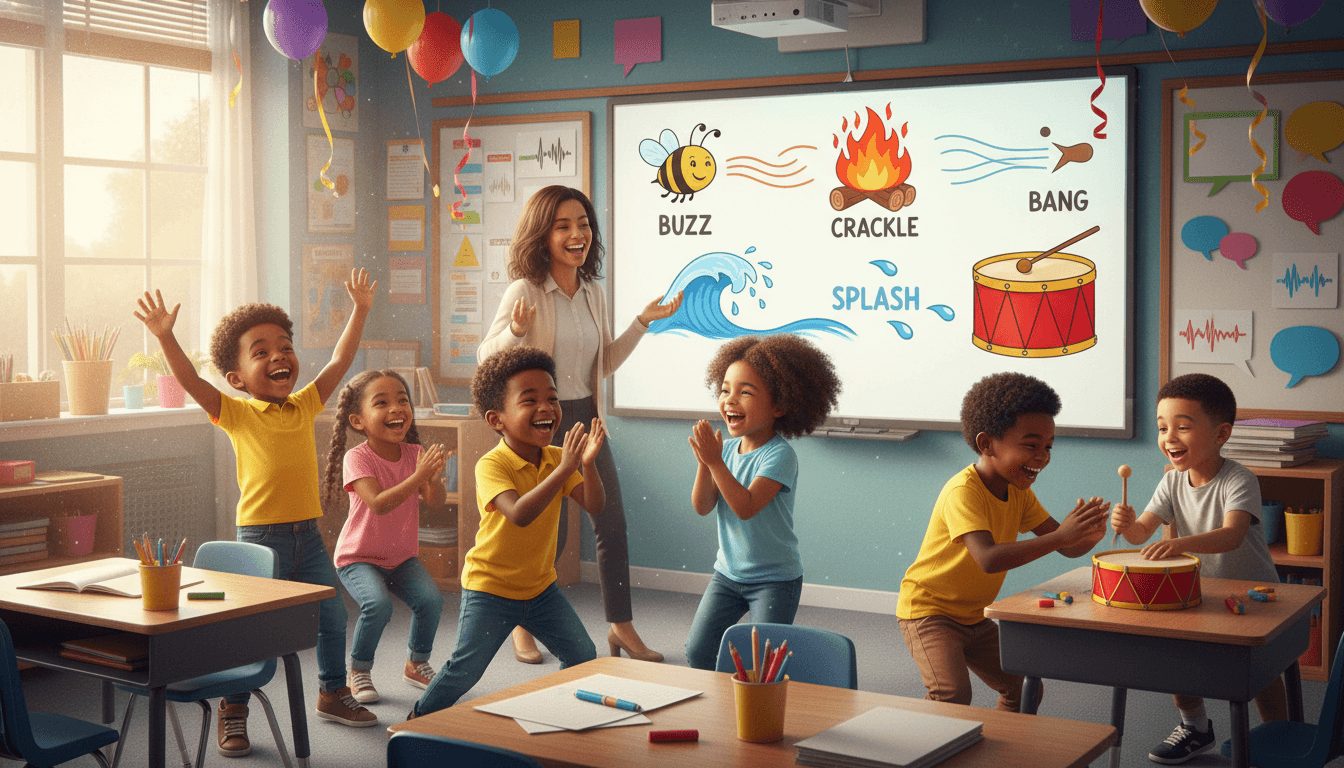
- Onomatopoeia words sound like what they name: buzz, crack, sizzle, whoosh, thud.
- Onomatopoeia makes writing more vivid and sensory by connecting readers to actual sounds.
- It is widely used in poetry, comics, picture books, and descriptive writing.
- English has hundreds of onomatopoeic words - students encounter them in everyday reading long before they learn the term.
What Is Onomatopoeia?
Onomatopoeia is a word that phonetically imitates, resembles, or suggests the sound it describes. Buzz, splash, sizzle, crash, whoosh, moo - these words don't just name sounds; they replicate them. When you read "the bees buzzed," your mind hears the sound.
Onomatopoeia is a figurative language device that adds sensory richness, especially auditory experience, to writing.
Examples by Category
Animal sounds: moo, oink, woof, meow, hiss, chirp, neigh, cluck, croak, howl
Water/nature sounds: drip, splash, trickle, thunder, crackle, rustle, gust, gurgle
Action sounds: bang, pop, snap, thud, crunch, slurp, whoosh, zoom, clang, thwack
Comic/dramatic sounds: POW! BAM! BOOM! ZAP! CRASH! SIZZLE! SPLAT!
Subtle sounds: whisper, murmur, hum, sigh, patter, tinkle
Onomatopoeia in Different Types of Writing
Poetry: Sound is essential to poetry, and onomatopoeia is one of its key tools. Edgar Allan Poe's "The Bells" is a famous example, with words like tinkle, jingle, clang, and clanging creating an auditory progression from delicate to alarming.
Comic books/graphic novels: Large, dramatic onomatopoeia (KA-BOOM! SPLASH!) is a defining visual feature.
Picture books: Authors use onomatopoeia extensively to engage young readers: "spaghetti flopped and plopped..."
Descriptive writing: In student writing, onomatopoeia brings scenes to life: "the door creaked open" is more evocative than "the door made a sound."
What Grade Do Kids Learn Onomatopoeia?
2nd grade (L.2.5a): Students explore real-life connections between words and their use, including sound words.
3rd grade (L.3.5a): Students identify figurative language, including onomatopoeia.
4th grade (RL.4.4): Students determine the meaning of words and phrases as used in a text, including figurative language.
Common Misconceptions
Onomatopoeia is only found in poetry: It appears in prose, comics, picture books, advertising, song lyrics, and everyday speech.
Animal sounds are the only examples: While animal sounds are the most familiar examples, onomatopoeia covers all categories of sounds - mechanical, natural, emotional, and more.
Hard to spell = hard to use: Onomatopoeia is one of the hardest literary terms to spell, but it's one of the easiest to understand and enjoy. Don't let the spelling discourage exploration.
Practice Activities
-
Onomatopoeia hunt: Students highlight all sound words in a picture book or poem.
-
Sound story: Write a 5-sentence scene using at least 5 different onomatopoeia words.
-
Sounds of school: Brainstorm all the onomatopoeia words associated with a school day (bell, squeak, shuffle, clap, crunch).
-
Comic creation: Students draw a 3-panel comic and add onomatopoeia speech/action bubbles.
-
Cross-language comparison: Research how the same animal sound is represented in 3 different languages.
Frequently Asked Questions
What is onomatopoeia?
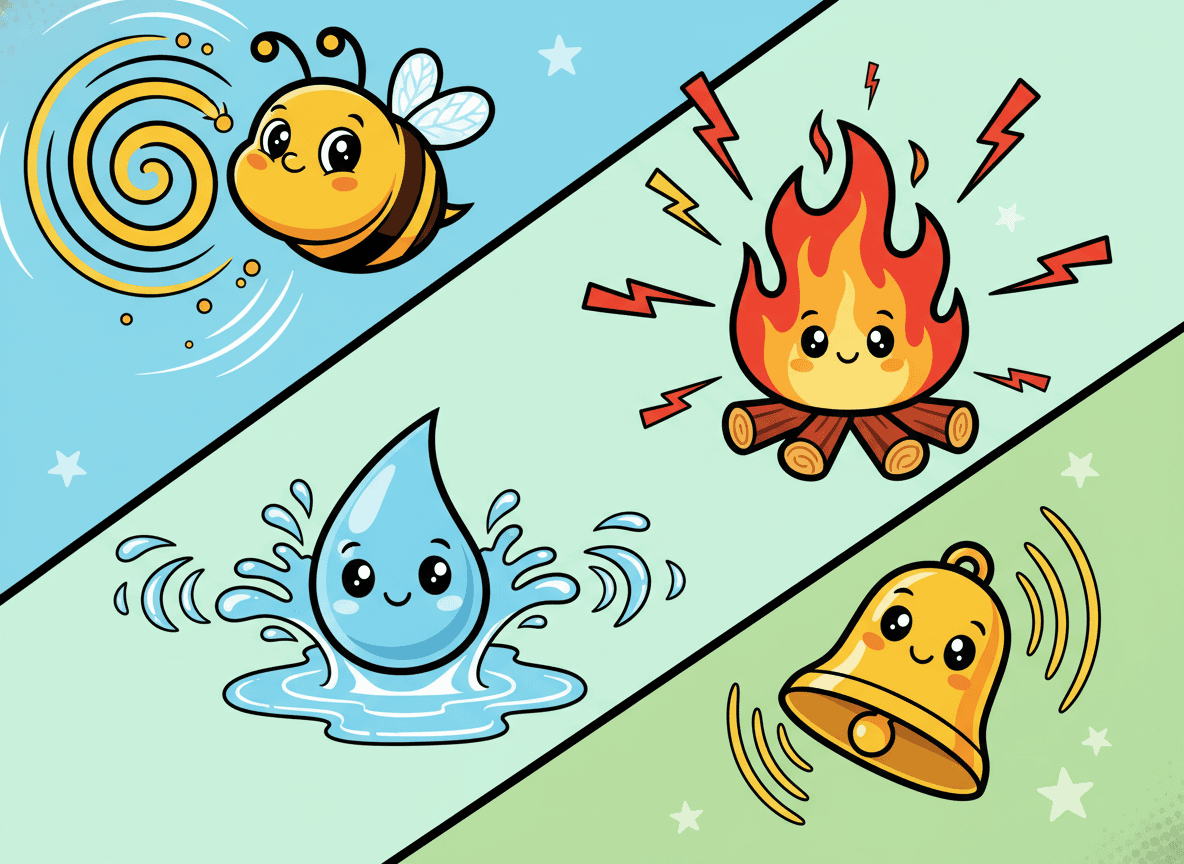
Onomatopoeia (on-oh-MAT-oh-PEE-ah) refers to words that phonetically imitate the sounds they describe. When you say 'buzz,' your voice makes a sound similar to a bee. When you say 'crash,' the hard consonant sounds evoke the sharp sound of breaking. These words add sonic dimension to writing, connecting readers to the world through sound.
What are common examples of onomatopoeia?
Common examples: Animal sounds (moo, oink, woof, meow, hiss, chirp, howl), Nature sounds (thunder, splash, drip, rustle, crackle, roar), Action sounds (bang, pop, zoom, thud, slurp, crunch, whisper), Machine sounds (beep, click, whirr, buzz, clang). Comic books and graphic novels are treasure troves of onomatopoeia (BAM! POW! WHOOSH!).
Why is onomatopoeia used in writing?
Onomatopoeia makes writing vivid and immersive. Reading 'the fire crackled' is more evocative than 'the fire made noise' because the word 'crackled' itself sounds like what it describes. In poetry especially, onomatopoeia creates music and brings readers closer to the described experience through sound.
Is onomatopoeia used differently in different languages?
Yes - this is one of the most surprising and fun aspects of onomatopoeia. Different languages represent the same sounds with different words because phonology differs. An English dog says 'woof,' a French dog says 'ouaf,' a Japanese dog says 'wan wan.' Even though all three words imitate dog sounds, they sound different because they reflect the phonological patterns of their languages.
How do you pronounce onomatopoeia?
On-oh-MAT-oh-PEE-ah. Five syllables. It is one of the most frequently misspelled and mispronounced literary terms. Breaking it down helps: on-o-mat-o-poe-ia. The word itself sounds somewhat musical when said correctly, which is fitting given what it describes.
Free Onomatopoeia Worksheets
Curriculum-aligned printable worksheets for 2nd – 4th Grade. Download free.