What Is a Preposition?
Taught in US schools
Key Takeaways
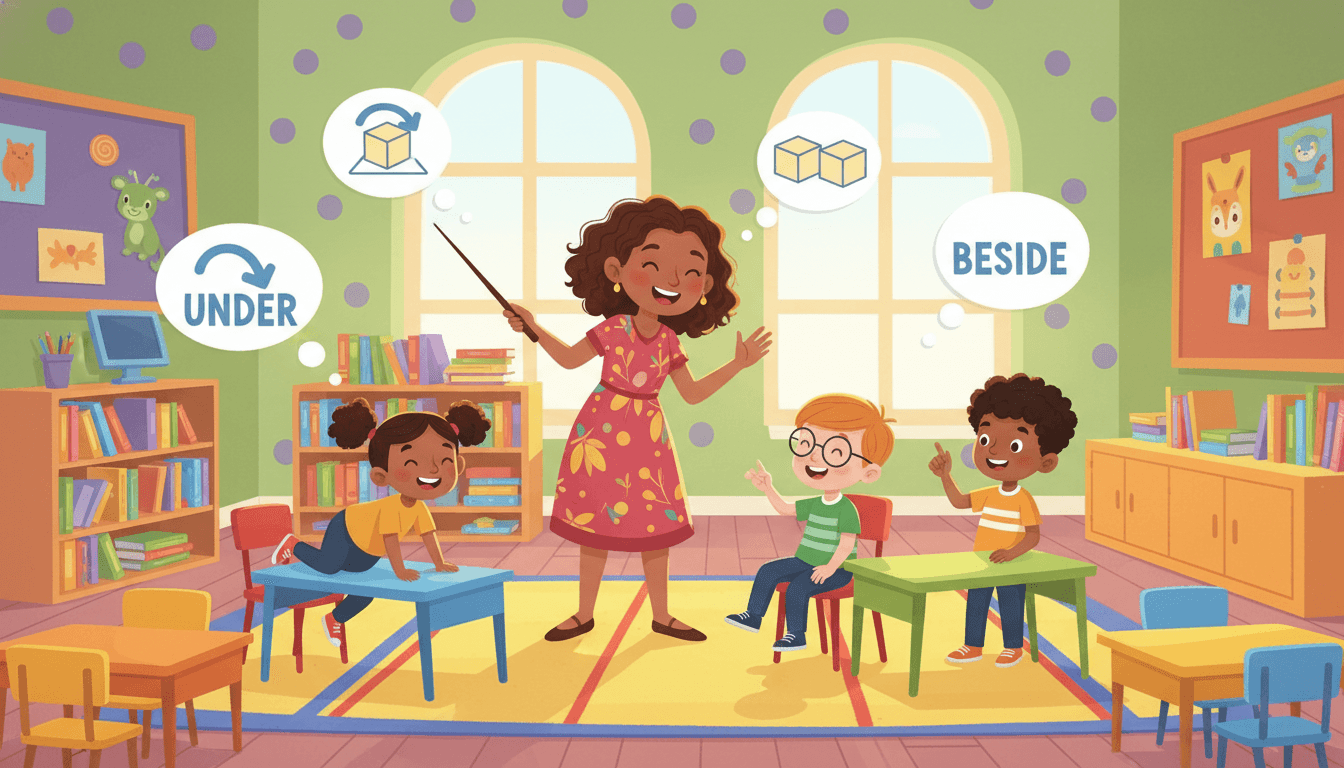
- A preposition shows the relationship between a noun and the rest of the sentence - often location or time.
- A prepositional phrase = preposition + object (noun/pronoun): 'in the box,' 'after school,' 'across the river.'
- Common prepositions: in, on, under, over, before, after, between, through, beside, among, with, by.
- Prepositional phrases act as adjectives (describe nouns) or adverbs (describe verbs) in a sentence.
What Is a Preposition?
A preposition is a word that shows the relationship between a noun (or pronoun) and another element of the sentence - usually expressing location, direction, time, or manner.
"The cat sat under the table." (location) "She arrived before dinner." (time) "He walked through the park." (direction)
Common Prepositions
Location: in, on, under, over, above, below, beside, between, among, behind, in front of, next to, near, across
Time: at, on, in, before, after, during, until, since, by, for
Direction: to, toward, from, up, down, across, along, through, into, out of
Other: with, without, by, about, of, for, against, except
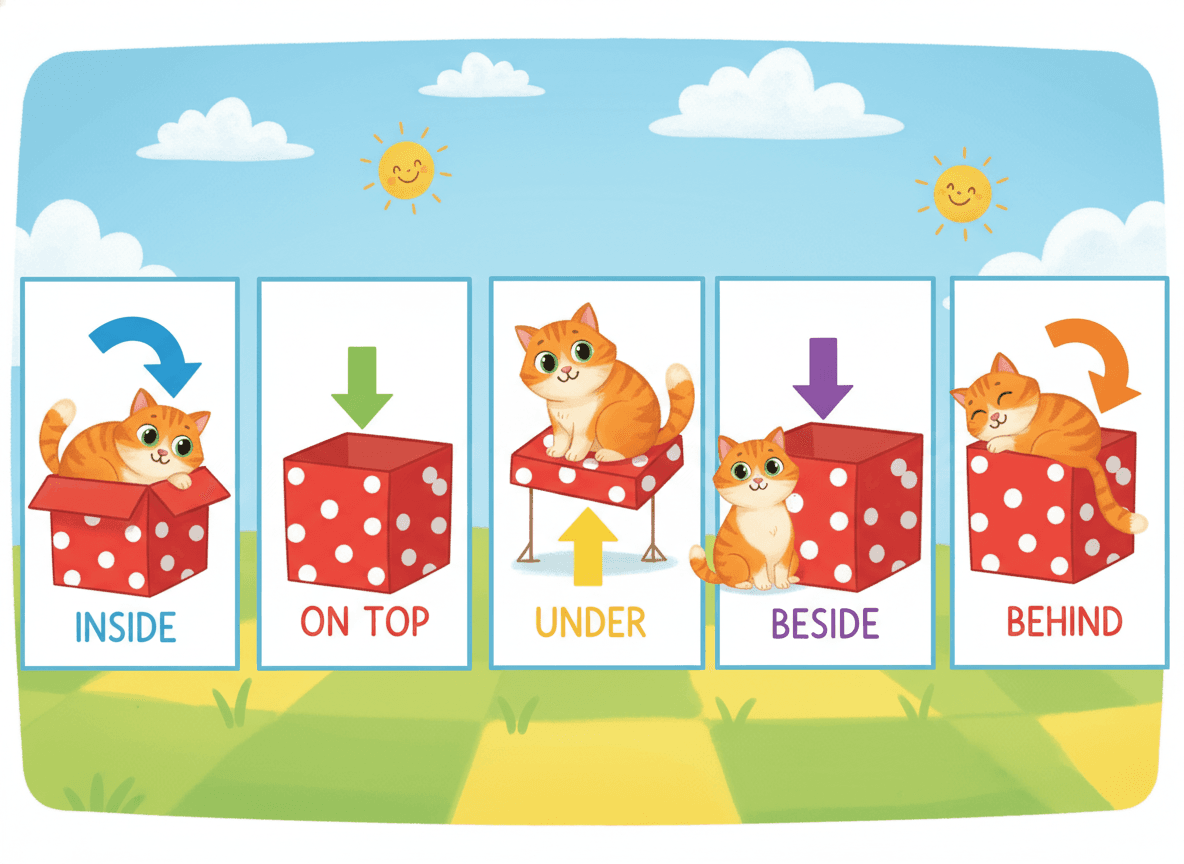
Memory trick: "A preposition is anywhere a mouse can go relative to a box" - in the box, on the box, under the box, through the box, beside the box...
Prepositional Phrases
A prepositional phrase = preposition + object (noun or pronoun) + any modifiers
"in the box" - preposition: in / object: box "after a long day" - preposition: after / object: day (modified by "a long") "between us" - preposition: between / object: us (pronoun)
Prepositional phrases add detail to sentences. They function as:
-
Adjectives (which one?): "The dog with the red collar is mine."
-
Adverbs (when/where/how?): "She ran across the field."
Object Pronoun Rule
The object of a preposition always takes an object pronoun (me, him, her, us, them) - not a subject pronoun:
✗ "between you and I" ✓ "between you and me"
✗ "a gift for she and I" ✓ "a gift for her and me"
Test: Remove the other person - "between I" sounds wrong; "between me" sounds right.
Preposition vs. Adverb
Some words can be either, depending on whether they have an object:
"She went up." (up = adverb - no object) "She climbed up the ladder." (up = preposition - object: the ladder)
The presence of a noun object after the word determines whether it's a preposition.
What Grade Do Kids Learn Prepositions?
1st Grade: Use prepositions in speaking and writing; recognize common prepositions (L.1.1e).
2nd–3rd Grade: Identify prepositional phrases; use them to add detail in writing.
4th Grade: Correctly use prepositional phrases; distinguish prepositions from adverbs; use object pronouns after prepositions (L.4.1e).
Common Misconceptions
"More prepositions make better writing." Overusing prepositional phrases creates weak, wordy prose: "The dog of the woman with the house on the hill near the river..." Precise nouns and verbs are often stronger than chains of prepositional phrases.
"Sentences can never end with a preposition." Modern English widely accepts terminal prepositions when they're natural. "What did you step on?" is correct and natural.
"Any short word is a preposition." Short words like is, a, the, and are not prepositions. Prepositions must relate a noun to something else in the sentence.
Practice Activities
-
Preposition scavenger hunt: Find prepositional phrases in a paragraph and identify each preposition and its object.
-
Draw the preposition: Give students a simple prepositional phrase; they illustrate it (the ball under the chair).
-
Expand sentences: Start with "The dog ran." Students add prepositional phrases to answer where, when, and how.
-
Preposition sort: Sort preposition cards by category: location / time / direction.
-
Object pronoun fix: Correct sentences with incorrect pronoun forms after prepositions.
Frequently Asked Questions
What is a prepositional phrase?
A prepositional phrase is a group of words that begins with a preposition and ends with its object (a noun or pronoun), plus any modifiers. The preposition + object = prepositional phrase. 'In the box.' 'After a long day.' 'Between the two trees.' 'With my best friend.' Prepositional phrases add information to sentences - they function as adjectives (modifying nouns) or adverbs (modifying verbs). 'The book on the shelf is mine' (on the shelf = adjective phrase, modifies which book). 'She arrived after lunch' (after lunch = adverb phrase, modifies when she arrived).
What are the most common prepositions?
Prepositions of place: in, on, under, over, above, below, beside, between, among, behind, in front of, next to, across, through, into. Prepositions of time: at, on, in, before, after, during, until, since, for, between. Prepositions of direction: to, toward, from, up, down, across, along, through, into, out of. Prepositions of manner/other: with, without, by, about, of, for, against. A helpful mnemonic for prepositions of place: 'A preposition is anywhere a mouse can go relative to a box' - in, on, under, through, beside, etc.
How do you identify a preposition in a sentence?
Ask: Is this word showing a relationship between a noun and another part of the sentence? Common tests: 'A mouse can go __ the box' - replace the blank with the word. If it works (a mouse can go IN the box, ON the box, UNDER the box, THROUGH the box), it's likely a preposition. The word will also be followed by a noun or pronoun (its object), forming a prepositional phrase. Some words are prepositions in some contexts but adverbs in others: 'She went up' (up = adverb) vs. 'She climbed up the ladder' (up = preposition, because it has an object: the ladder).
What is the 'object of the preposition'?
The object of a preposition is the noun or pronoun that follows the preposition and completes the prepositional phrase. In 'between the trees,' 'trees' is the object of the preposition 'between.' In 'with him,' 'him' is the object. The object always takes the object pronoun form, not subject form: 'between him and me' (not 'he and I'), 'give it to her' (not 'she'). The common error 'between you and I' is incorrect - 'I' is a subject pronoun; the object of 'between' requires 'me.'
Is it wrong to end a sentence with a preposition?
In traditional grammar, ending a sentence with a preposition was considered incorrect. In modern English, it is completely acceptable and often more natural: 'What are you looking for?' is natural and clear. 'For what are you looking?' is technically correct but sounds awkward. Winston Churchill famously mocked this rule. The Common Core does not include 'no prepositions at sentence end' as a standard. Teach students to write naturally - sometimes ending with a preposition is clearer; sometimes restructuring is better.
Free Preposition Worksheets
Curriculum-aligned printable worksheets for 1st – 4th Grade. Download free.