What Is Weight in Math?
Taught in US schools

Key Takeaways
- Weight measures how heavy an object is, using units like ounces, pounds, grams, and kilograms.
- A balance scale compares the weights of two objects directly; a spring scale or digital scale gives a reading in units.
- Estimation of weight is a practical life skill: knowing about how heavy something is before measuring.
- Students begin comparing weights informally in K-1 and learn standard units in 2nd-3rd grade.
What Is Weight?
Weight is a measurement that tells us how heavy an object is. In everyday life and elementary math, students use weight to compare objects, estimate heaviness, and use tools like scales to find exact measurements in standard units.
In the United States, weight is commonly measured in ounces (oz) and pounds (lb) using the US customary system. Scientists and much of the world use grams (g) and kilograms (kg) from the metric system.
Standard Units of Weight
US Customary:
- 16 ounces = 1 pound
- A pencil weighs about 1 ounce
- A bag of sugar weighs about 5 pounds
Metric:
- 1,000 grams = 1 kilogram
- A dollar bill weighs about 1 gram
- A large water bottle weighs about 1 kilogram
Measuring Weight: Tools
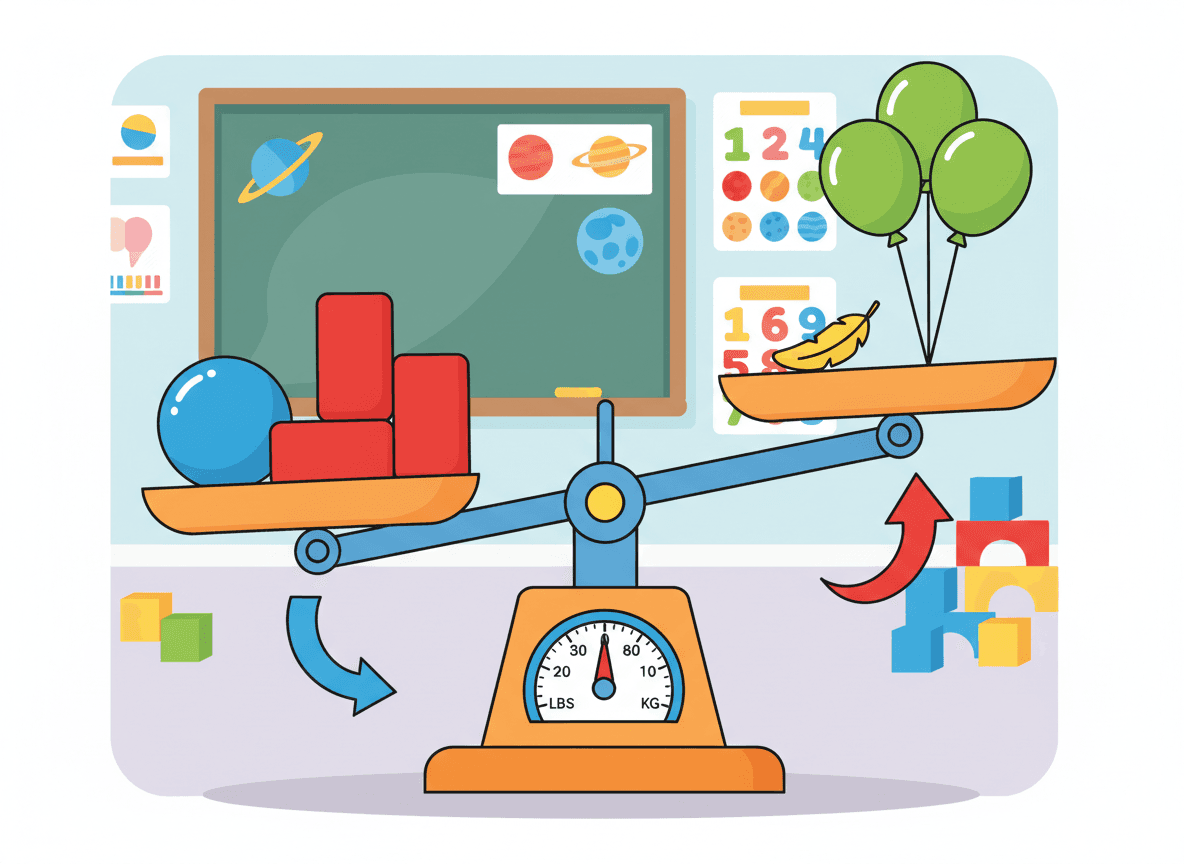
Balance scale: Places two objects on opposite pans; the heavier side sinks. Great for comparing and for building intuition.
Spring scale (hanging scale): An object hangs from a spring; the spring stretches in proportion to the weight. Reads in ounces, pounds, or grams.
Digital scale: Provides a numerical readout. Most common in real-world settings (kitchen, grocery store, doctor's office).
What Grade Do Kids Learn Weight?
Kindergarten and 1st grade: Students compare objects as heavier or lighter using balance scales; use non-standard units (blocks, paperclips) to measure.
2nd grade (2.MD.A.1): Students measure with standard rulers and begin exploring standard weight measurement.
3rd grade (3.MD.A.2): Students measure and estimate masses (grams, kilograms) and liquid volumes. This is the formal introduction to standard weight units.
Common Misconceptions
Bigger = heavier: Students assume large objects always weigh more than small objects. A deflated basketball is lighter than a small rock. Compare objects directly to challenge size-based assumptions.
Ounces and pounds are interchangeable: Students confuse these units. Connecting to familiar objects (a bag of chips = ~1 oz; a shoe = ~1 lb) builds practical intuition.
Metric and customary are interchangeable: These are separate measurement systems with different base units. Students should keep them distinct while appreciating that both measure the same property.
Practice Activities
-
Classroom weigh station: Set up a balance scale with classroom objects; students order from lightest to heaviest.
-
Estimation challenge: Show an object and ask students to estimate weight before measuring.
-
Weight benchmarks: Create a class anchor chart with benchmark weights (1 oz, 1 lb, 1 g, 1 kg).
-
Sorting by weight: Groups of objects sorted by estimated weight, then verified with a scale.
-
Word problem practice: Real-world scenarios (How many 8-oz bags fill a 2-lb container?) reinforce unit conversion.
Frequently Asked Questions
What is weight in math?
Weight is a measurement of how heavy an object is. In the United States, the customary units for weight are ounces (oz) and pounds (lb). Metric units are grams (g) and kilograms (kg). In elementary school, students measure and compare weights using balance scales, spring scales, and digital scales.
What is the difference between weight and mass?
Weight is the force of gravity on an object and can technically change in different gravitational fields (e.g., on the moon). Mass is the amount of matter in an object and stays constant. In elementary school, these terms are often used interchangeably, but middle school science makes the distinction clear.
How many ounces are in a pound?
There are 16 ounces in 1 pound. Common benchmarks students learn: a slice of bread weighs about 1 ounce; a loaf of bread weighs about 1 pound; a large bag of dog food might weigh 20 pounds.
What is a gram and a kilogram?
A gram (g) is a small metric unit of mass - a dollar bill weighs about 1 gram. A kilogram (kg) equals 1,000 grams - a large textbook weighs about 1 kilogram. Students in 3rd grade (3.MD.A.2) begin measuring and estimating in grams and kilograms.
How do balance scales work?
A balance scale has two pans on either side of a pivot point. When one side is heavier, that pan sinks lower. When both sides hold objects of equal weight, the scale balances. Balance scales are ideal for comparing the relative weights of two objects and for building intuitive understanding before using standard units.
Free Weight Worksheets
Curriculum-aligned printable worksheets for Kindergarten – 3rd Grade. Download free.