What Are Compound Words?
Taught in US schools

Key Takeaways
- Compound words are made of two or more separate words joined to create a new meaning.
- Some compounds are closed (sunflower), some are hyphenated (ice-cold), and some are open (ice cream).
- The meaning of a compound word is often (but not always) related to its parts.
- Recognizing compound words helps with both reading decoding and vocabulary development.
What Are Compound Words?
Compound words are formed by combining two or more independent words to create a new word with its own meaning. Compound words are one of the most productive word-formation processes in English - they appear everywhere and continue to be created as new concepts emerge.
Examples:
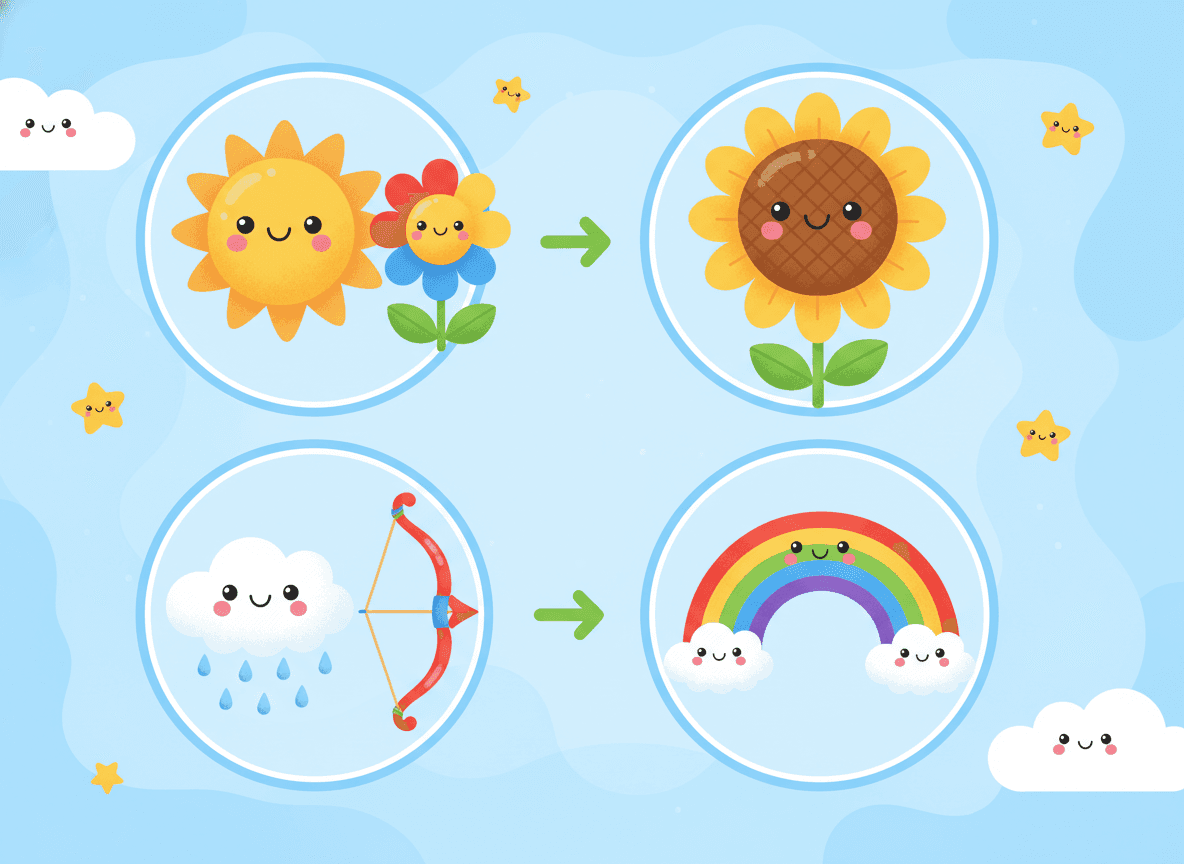
- sun + flower = sunflower
- foot + ball = football
- book + shelf = bookshelf
- rain + bow = rainbow
- tooth + brush = toothbrush
Three Types of Compound Words
Closed compounds (most common in elementary school): Written as one continuous word.
- bedroom, playground, backpack, cupcake, sunshine, outside
Hyphenated compounds: Written with a hyphen connecting the parts.
- self-control, well-known, ice-cold, short-tempered, long-term
Open compounds: Written as two separate words that function as a single concept.
- ice cream, high school, living room, post office, fire truck
Elementary instruction focuses on closed compounds. The rules for which form to use can be inconsistent, and even dictionaries sometimes disagree - context and style guides are the final arbiters.
Meaning Transparency
Most compound words have transparent meanings - you can figure out the word from its parts:
-
bookworm = a worm of a person who loves books
-
raincoat = a coat for the rain
-
sunglasses = glasses for the sun
Some are opaque - the parts don't directly reveal the meaning:
-
butterfly (not made of butter)
-
deadline (not about death)
-
nightmare (not about a female horse)
Opaque compounds must be learned as whole words.
What Grade Do Kids Learn Compound Words?
1st grade (RF.1.3e): Students decode two-syllable words by breaking them into syllables, including compound words.
2nd grade (L.2.4d): Students determine the meaning of compound words using knowledge of their component parts.
3rd grade (L.3.4d): Students use glossaries and beginning dictionaries to determine the meaning of compound words.
Common Misconceptions
All long words are compounds: Many long words are not compounds - they may use prefixes, suffixes, and roots. "Incredible" is not a compound.
You can always guess the meaning: Some compounds have shifted meaning far from their parts. Don't assume transparency.
There's always one correct form: Hyphenation and spacing of compound words can vary between dictionaries and style guides. "Email" and "e-mail" are both used; "website" vs. "web site" was debated for years.
Practice Activities
-
Compound word puzzles: Two halves of compound words on cards; students match and write the full word.
-
Compound word sort: Open, closed, or hyphenated - sort compound word cards by type.
-
Compound word brainstorm: How many compound words can students generate using "sun," "rain," or "fire" as the first part?
-
Compound word pictures: Draw two pictures for the parts, then draw the compound word (sun + flower = sunflower).
-
Compound word hunt: Find compound words in a reading passage and underline both parts.
Frequently Asked Questions
What is a compound word?
A compound word is formed by combining two or more independent words to create a new word with its own meaning. For example, 'sun' + 'flower' = 'sunflower' (a type of flower). 'Book' + 'shelf' = 'bookshelf' (a shelf for books). Compound words are extremely common in English - they are one of the main ways English creates new vocabulary.
What are the three types of compound words?
There are three forms: (1) Closed compounds - written as one word: sunflower, football, birthday, toothbrush, raincoat. (2) Hyphenated compounds - written with a hyphen: well-known, ice-cold, self-confidence, up-to-date. (3) Open compounds - written as two separate words but function as one concept: ice cream, high school, post office, living room. Elementary school focuses primarily on closed compounds.
How does knowing compound words help with reading?
Recognizing compound words helps students break long, unfamiliar words into manageable chunks. Seeing 'thunderstorm' as 'thunder' + 'storm' makes decoding and understanding easier. Similarly, 'handwriting,' 'shipwreck,' and 'fireplace' become accessible when students see the component words. This is a valuable reading strategy for multisyllabic words.
Are compound word meanings always predictable from their parts?
Not always. Many compound words have transparent meanings (bookcase = a case for books, playground = ground to play on), but some are more opaque: 'butterfly' is not a fly made of butter; 'daydream' doesn't involve the daytime literally. Students should check context when meaning isn't clear from the parts.
How do compound words keep getting added to English?
New compound words are created constantly as language evolves. 'Smartphone,' 'podcast,' 'cyberspace,' 'inbox,' 'backlog,' and 'download' are all relatively new compound words. English readily creates compounds as a shorthand for new concepts. This productivity is why vocabulary knowledge grows dramatically when students understand word formation patterns.
Free Compound Words Worksheets
Curriculum-aligned printable worksheets for 1st – 3rd Grade. Download free.