What Is a Suffix?
Taught in US schools

Key Takeaways
- A suffix is added to the end of a root word and often changes its part of speech.
- Common suffixes include -ful, -less, -tion, -er/-or, -ly, -ness, -able, and -ing.
- Suffixes often change verbs to nouns (-tion), nouns to adjectives (-ful, -less), or adjectives to adverbs (-ly).
- Knowing suffixes helps students determine the part of speech and meaning of unfamiliar words.
What Is a Suffix?
A suffix is a word part added to the end of a root word. Suffixes may change the word's meaning, its part of speech, or both. Understanding suffixes dramatically expands vocabulary because the same suffix appears in hundreds of different words.
Examples:
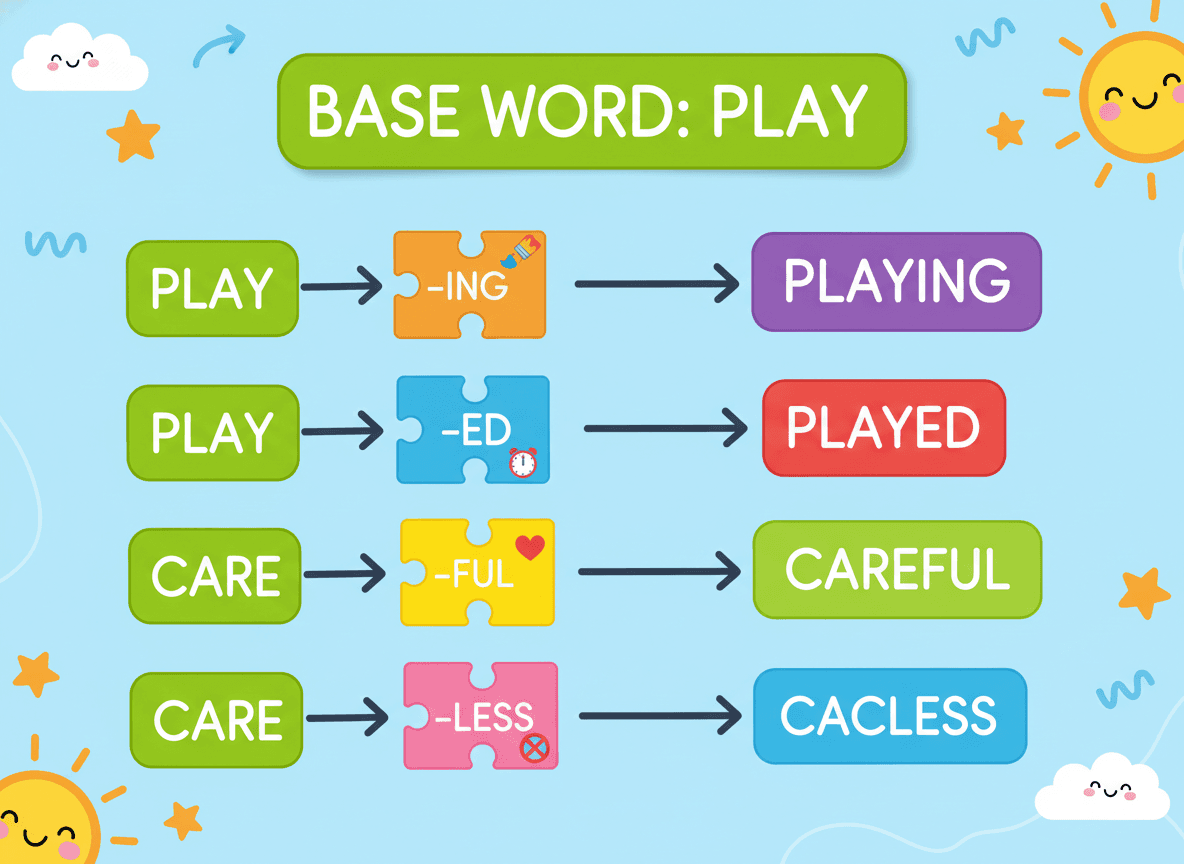
- hope + -ful = hopeful (full of hope)
- care + -less = careless (without care)
- teach + -er = teacher (one who teaches)
- quick + -ly = quickly (in a quick manner)
- create + -tion = creation (the act of creating)
Most Common Elementary Suffixes
-s / -es: plural - cats, dishes
-ed: past tense - walked, jumped
-ing: ongoing action - running, reading
-er / -or: one who does - teacher, actor
-ful: full of - hopeful, joyful
-less: without - careless, hopeless
-tion / -sion: act or state of - addition, tension
-ness: state of being - kindness, darkness
-ly: in what manner - quickly, slowly
-able / -ible: capable of - readable, flexible
How Suffixes Change Parts of Speech
One of the most important functions of suffixes is converting words from one part of speech to another:
-
Verb → Noun: teach → teacher; create → creation
-
Noun → Adjective: hope → hopeful; fear → fearless
-
Adjective → Adverb: slow → slowly; careful → carefully
-
Verb → Adjective: break → breakable; comfort → comfortable
Suffix Spelling Rules
Several important spelling changes occur when adding suffixes:
- Drop the silent -e before a vowel suffix: write → writing; love → lovable
- Double the final consonant in short-vowel CVC words: run → running; sit → sitting
- Change -y to -i before suffixes (except -ing): happy → happiness; cry → cried (but: crying)
What Grade Do Kids Learn Suffixes?
2nd grade (RF.2.3d): Students read words with common suffixes.
3rd grade (L.3.4b): Students use suffixes to determine word meanings.
4th–5th grade (L.4.4b, L.5.4b): Students use Greek and Latin suffixes as clues to meanings; apply suffix knowledge to more complex academic vocabulary.
Common Misconceptions
Every word ending is a suffix: Not all word endings are suffixes. "Carpet" doesn't end with the suffix "-et." A true suffix must be a recognizable affix that can be removed, leaving a real base word.
Suffixes don't affect spelling: The spelling rules for adding suffixes (doubling, dropping -e, changing -y to -i) are among the most important and frequently misapplied in student writing.
-ed always says /ed/: The -ed suffix is pronounced three ways: /t/ (jumped), /d/ (smiled), /ɪd/ (wanted). Students need practice recognizing all three pronunciations.
Practice Activities
-
Suffix addition practice: Add -ful and -less to the same root word (hope, care, fear) and compare meanings.
-
Part-of-speech sorting: Sort words by whether the suffix made a noun, verb, adjective, or adverb.
-
Spelling rule application: Practice adding -ing and -ed to CVC words (doubling) and silent-e words (dropping).
-
Word family charts: Create a chart showing all forms of one root with different suffixes: create, creation, creative, creativity, creatively.
-
Context clues + suffix: Identify the suffix in an unfamiliar word and use it to guess the word's part of speech, then confirm with context.
Frequently Asked Questions
What is a suffix?
A suffix is a word part added to the end of a base word. Suffixes often change the part of speech of the original word and may also change its meaning. For example, adding '-er' to 'teach' creates 'teacher' (one who teaches), changing a verb to a noun. Suffixes are one of the most common ways English creates new words.
What are the most common suffixes?
Frequently taught elementary suffixes include: -s/-es (plural), -ed (past tense), -ing (present participle), -er/-or (one who does), -ful (full of), -less (without), -tion/-sion (act or state of), -ness (state of being), -ly (in what manner), -able/-ible (capable of). These appear in thousands of common words.
How do suffixes change parts of speech?
Suffixes regularly convert words from one part of speech to another: Verb to noun: act → action; teach → teacher. Noun to adjective: hope → hopeful; care → careless. Adjective to adverb: quick → quickly; brave → bravely. Verb to adjective: break → breakable. Understanding these patterns helps students read and write more fluently.
What spelling changes happen when adding a suffix?
Common spelling rules for suffixes: (1) Drop the final silent 'e' before a vowel suffix: hope → hoping. (2) Double the final consonant when a short-vowel word ends in one consonant: run → running. (3) Change 'y' to 'i' before suffixes (except -ing): happy → happiness. These rules are taught gradually in 2nd through 4th grade.
What is the difference between a derivational suffix and an inflectional suffix?
Inflectional suffixes change the form of a word without changing its part of speech (-s, -ed, -ing, -er for comparative). They are grammatical and required by rules. Derivational suffixes create new words, often changing the part of speech (-tion, -ful, -ness, -er for doer). Elementary students learn both, though without this formal terminology.
Free Suffix Worksheets
Curriculum-aligned printable worksheets for 2nd – 5th Grade. Download free.