What Is a Prefix?
Taught in US schools
Key Takeaways
- A prefix is added to the beginning of a root word and changes its meaning.
- Common prefixes include un- (not), re- (again), pre- (before), dis- (not/opposite), and mis- (wrongly).
- Knowing prefix meanings is a powerful decoding strategy for unfamiliar vocabulary.
- Prefixes never stand alone - they must attach to a root word to form a new word.
What Is a Prefix?
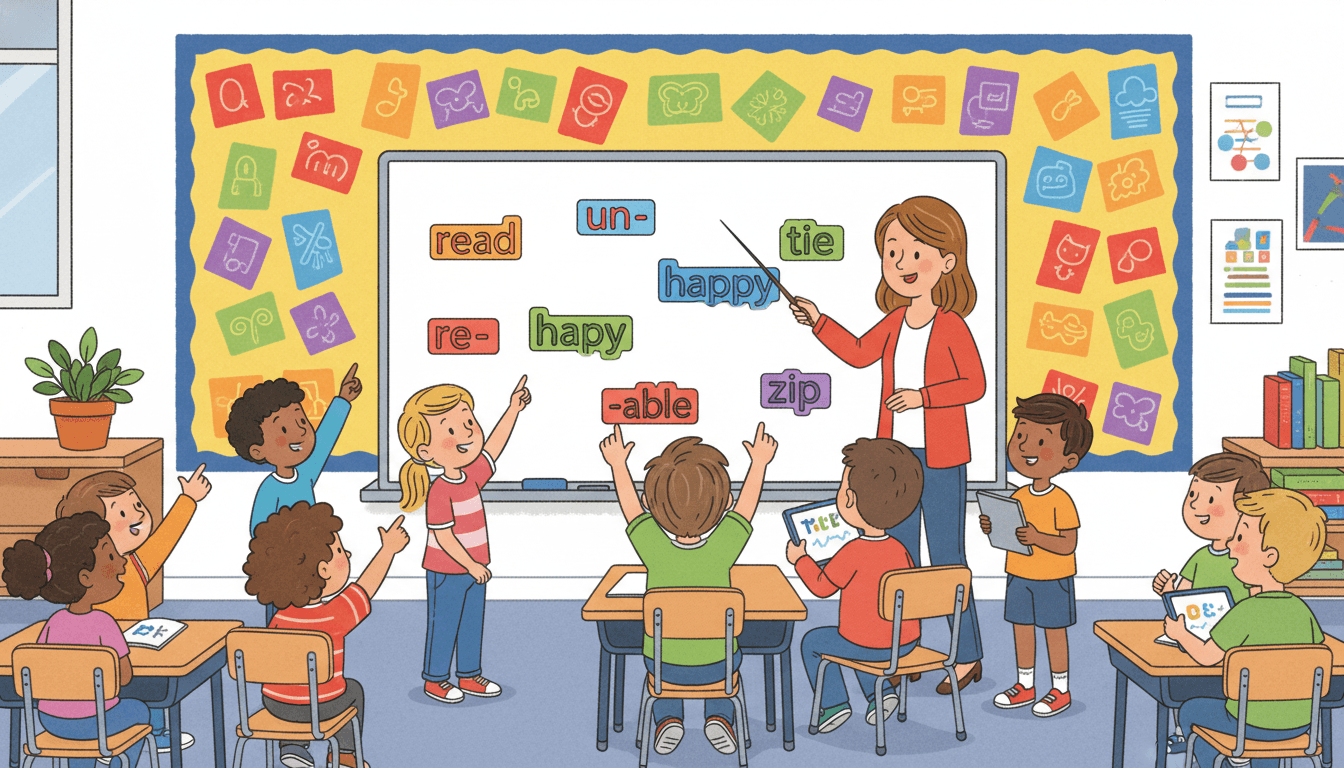
A prefix is a group of letters attached to the beginning of a root word that changes the word's meaning. Adding a prefix creates a new word with a related but different meaning.
Examples:
- happy → unhappy (not happy)
- view → preview (see before)
- do → redo (do again)
- connect → disconnect (opposite of connect)
Prefixes are one of the most efficient vocabulary-building tools in the English language. Studies show that knowing the 20 most common prefixes helps students unlock the meaning of thousands of words.
Most Common Elementary Prefixes
un-: not - unhappy, unkind, unfair
re-: again - redo, rewrite, reread
pre-: before - preview, preschool, prepay
dis-: not, opposite - disagree, dislike, disconnect
mis-: wrongly - mistake, misread, misspell
over-: too much - overflow, overdue, overeat
sub-: under - submarine, subway, subtract
in-/im-: not - incorrect, impossible, impatient
How Prefixes Change Meaning
The root word keeps its meaning; the prefix modifies it:
-
act (to do) → react (to do in response) → overreact (to respond too strongly)
-
able (capable) → unable (not capable) → disable (to make unable)
Students who understand this layering system can decode complex words they've never seen before.
What Grade Do Kids Learn Prefixes?
2nd grade (RF.2.3d): Students decode words with common prefixes and suffixes.
3rd grade (L.3.4b): Students use knowledge of prefixes to determine the meaning of unknown words.
4th–5th grade (L.4.4b, L.5.4b): Students use Greek and Latin affixes and roots as clues to word meaning; analyze more complex prefix patterns.
Common Misconceptions
Any two or three letters at the start of a word is a prefix: The first letters must be a meaningful affix that changes the root's meaning. "Uncle" is not "un" + "cle" - there is no root word "cle." Checking that the remaining letters form a real word is a key verification step.
Prefixes always have the same effect on every word: The same prefix can have slightly different implications depending on the root. Students should always verify meaning in context, not assume.
All prefixes are from English: Many common prefixes come from Latin (pre-, dis-, sub-) or Greek (mis-, anti-). This is why knowing etymology helps with more advanced vocabulary.
Practice Activities
-
Prefix flip book: Each page shows a prefix and lists 5 words formed with that prefix.
-
Word building: Students add prefixes to a list of root words and write the new definition.
-
Prefix sort: Sort vocabulary words into categories by their prefix.
-
Context clues + prefix: Decode an unfamiliar word in a sentence using both prefix knowledge and context.
-
Prefix hunt: Scan a text passage and highlight all words with prefixes, then explain what each prefix contributes.
Frequently Asked Questions
What is a prefix?
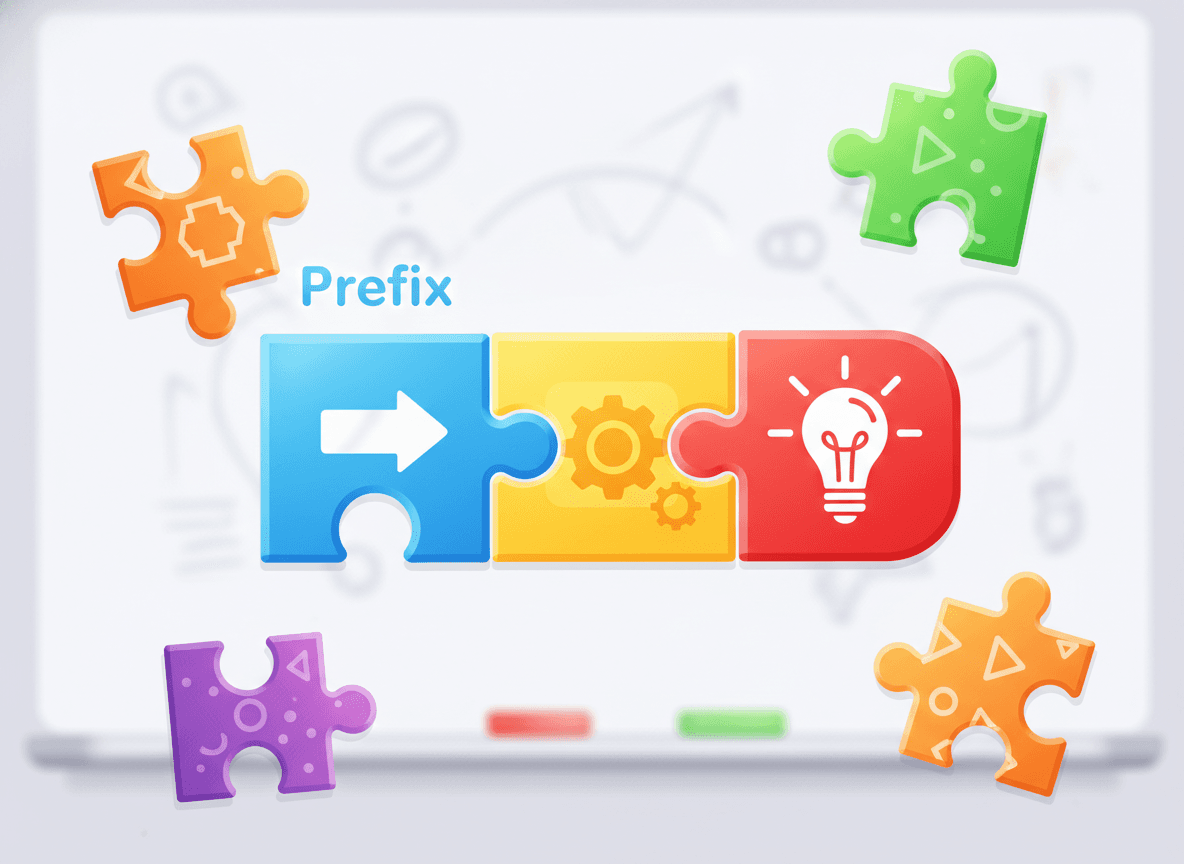
A prefix is a word part added to the beginning of a base (root) word that changes the word's meaning. For example, the prefix 'un-' means 'not,' so adding it to 'happy' creates 'unhappy,' meaning 'not happy.' Prefixes cannot stand alone - they always attach to an existing word.
What are the most common prefixes students learn?
The most frequently taught elementary prefixes are: un- (not: unhappy, unfair), re- (again: redo, rewrite), pre- (before: preview, preschool), dis- (not or opposite: disagree, disconnect), mis- (wrongly: mistake, misread), and over- (too much: overflow, overdue). These eight prefixes appear in a large percentage of prefixed words in English.
How do prefixes help with reading comprehension?
When students recognize a familiar prefix in an unfamiliar word, they can break the word apart and use the prefix's meaning to make an educated guess. Encountering 'submarine' becomes easier when students know 'sub' means 'under' (underwater vessel). This prefix-recognition strategy reduces dependence on the dictionary and builds vocabulary independently.
What is the difference between a prefix and a suffix?
Both are affixes - word parts added to a root word. Prefixes attach to the beginning (pre + fix → prefix literally means 'fixed before'). Suffixes attach to the end (-tion in 'addition'). Prefixes usually change meaning; suffixes often change the part of speech (run → runner; happy → happily).
Are prefixes always hyphenated?
No. In modern American English, most prefixes attach directly to the root without a hyphen: unhappy, redo, preschool. However, some prefixes use a hyphen when attached to a proper noun (un-American), when the combination would look strange (re-enter), or in formal writing contexts. Most elementary-level prefix words are written solid (without hyphens).
Free Prefix Worksheets
Curriculum-aligned printable worksheets for 2nd – 5th Grade. Download free.