What Are Root Words?
Taught in US schools

Key Takeaways
- A root word is the core meaning unit of a word; all related words in a word family share the same root.
- English root words come largely from Latin and Greek, especially in academic and technical vocabulary.
- Knowing common roots (rupt, port, spect, dict, aud) unlocks dozens of related words.
- Root word knowledge is one of the most powerful vocabulary-building strategies for upper elementary students.
What Are Root Words?
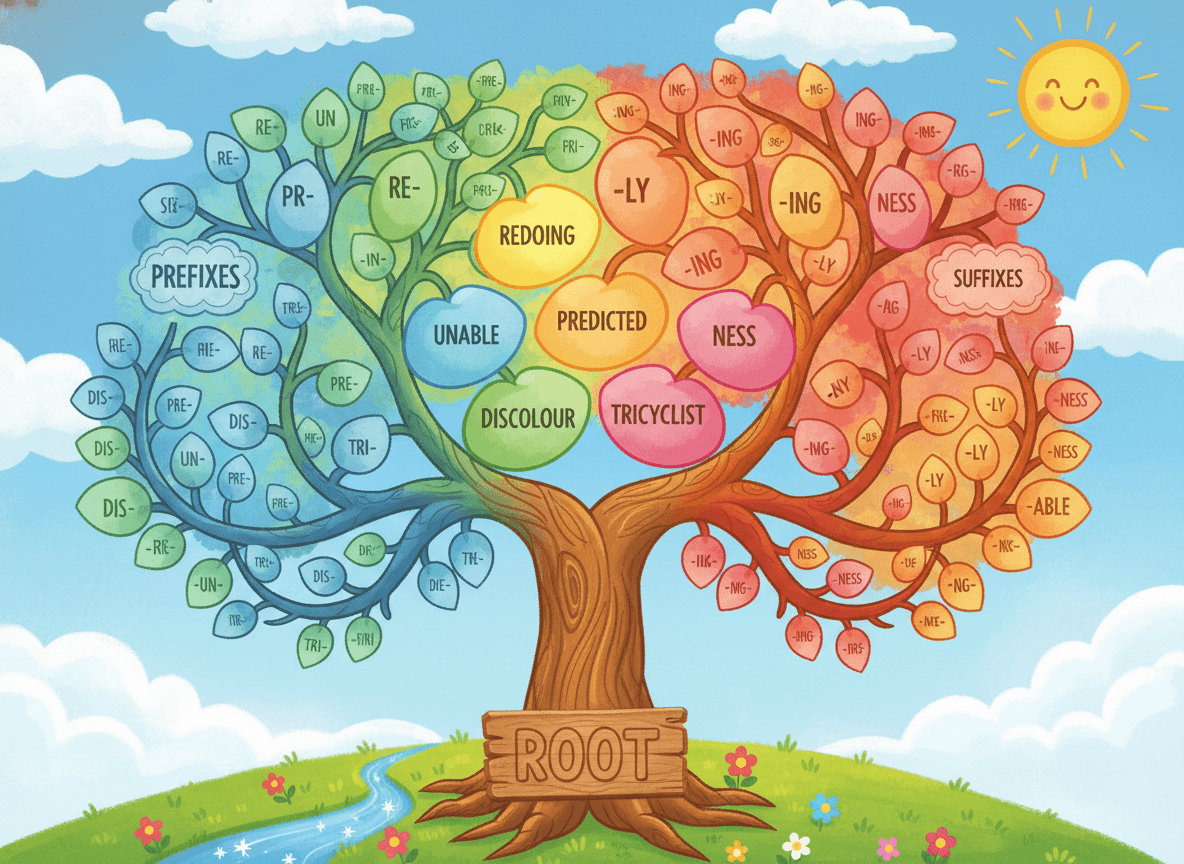
Root words are the core building blocks of words - the central unit of meaning from which related words are constructed by adding prefixes and suffixes.
A word family is a group of words that share the same root:
- Root port (carry): transport, import, export, portable, reporter, support
- Root struct (build): construct, instruct, structure, destruction, infrastructure
When students recognize a root, they can make educated guesses about the meanings of dozens of related words - even words they've never seen before.
English, Latin, and Greek Roots
Many everyday English words have Anglo-Saxon roots (base words that can stand alone): help → helpful → helpfulness.
But academic, scientific, and formal vocabulary often comes from Latin and Greek roots - roots that may not stand alone in English but appear across many words:
port: Latin - carry - transport, import, portable
rupt: Latin - break - rupture, interrupt, erupt
spect: Latin - look - inspect, spectacle, expect
dict: Latin - say - dictate, predict, dictionary
aud: Latin - hear - audience, audible, auditorium
graph: Greek - write - paragraph, photograph, autograph
vis: Latin - see - vision, visit, invisible
struct: Latin - build - construct, instruct, destruction
Word Family Webs
A word family web puts the root in the center and radiates out to all related words. Seeing all these words together helps students see the root's consistent meaning across different word forms.
Example web for script/scrib (write):
- describe, prescription, script, scripture, manuscript, inscription, subscribe
What Grade Do Kids Learn Root Words?
3rd grade (L.3.4b): Students use a known root as a clue to determine the meaning of an unknown word.
4th grade (L.4.4b): Students use common grade-appropriate Greek and Latin affixes and roots as clues.
5th grade (L.5.4b): Students use Greek and Latin affixes and roots to determine the meaning of content-area vocabulary.
Common Misconceptions
All root words can stand alone: Latin and Greek roots often cannot. "Rupt" isn't a word by itself, but it's a root in disrupt, rupture, bankrupt, and corrupt. Students shouldn't expect roots to be standalone English words.
Root = prefix: Students sometimes confuse word roots with prefixes. A prefix modifies meaning; a root carries the core meaning. In "transport," "trans-" is the prefix (across) and "-port" is the root (carry).
Knowing the root gives the exact definition: Root knowledge gives a useful clue, not a guaranteed definition. Context must always be checked.
Practice Activities
-
Root word web: Place a root in the center of a spiderweb diagram; students brainstorm all the words they know that contain it.
-
Root + prefix/suffix building: Combine given roots with given prefixes and suffixes to form new words and define them.
-
Vocabulary detective: When encountering an unfamiliar word, students identify the root, prefix, and suffix, then use all three to form a definition guess.
-
Root of the week: Introduce one Latin or Greek root per week; students collect words containing it throughout the week.
-
Content area connections: Find roots in science or social studies vocabulary (biology: bio = life; democracy: dem = people).
Frequently Asked Questions
What is a root word?
A root word is the base or core of a word that carries its essential meaning. Prefixes and suffixes attach to root words to create new, related words. For example, the root 'port' (meaning 'carry') appears in transport, import, export, portable, and porter. All these words relate back to the idea of carrying.
What is the difference between a root word and a base word?
A base word is an English word that can stand alone (like 'help' in 'helpful'). A root word often refers to a Latin or Greek origin that cannot stand alone in English (like 'spect' from the Latin 'specere,' meaning 'to look,' found in inspect, spectacle, spectacular). Base words are always real English words; roots may not be.
Why do so many English roots come from Latin and Greek?
English developed through a blend of Anglo-Saxon, French, and Latin (via the Norman Conquest in 1066) plus direct borrowing from Greek for scientific and academic terms. Academic, scientific, and formal vocabulary tends to use Latin and Greek roots heavily. This is why root-word knowledge is especially valuable for reading complex informational texts.
What are the most useful Latin and Greek roots for elementary students?
High-value roots include: port (carry: transport, import), rupt (break: rupture, interrupt), spect (look: inspect, spectacle), dict (say: dictate, predict), aud (hear: audience, audible), graph (write: paragraph, autograph), vis (see: vision, visit), struct (build: construct, instruct), and scrib/script (write: describe, scripture).
How do I teach root words to elementary students?
Start with roots that appear in multiple familiar words, so students can see the connection immediately. For example, 'graph' (write) appears in paragraph, photograph, biography, and autograph - all familiar to students. Create word family webs, use roots in context, and build vocabulary walls organized by root. Gradually introduce Latin and Greek roots in 3rd–5th grade.
Free Root Words Worksheets
Curriculum-aligned printable worksheets for 3rd – 5th Grade. Download free.