What Are Equivalent Fractions?
Taught in US schools
Key Takeaways
- Equivalent fractions name the same amount using different numerators and denominators.
- Multiplying or dividing both numerator and denominator by the same number creates an equivalent fraction.
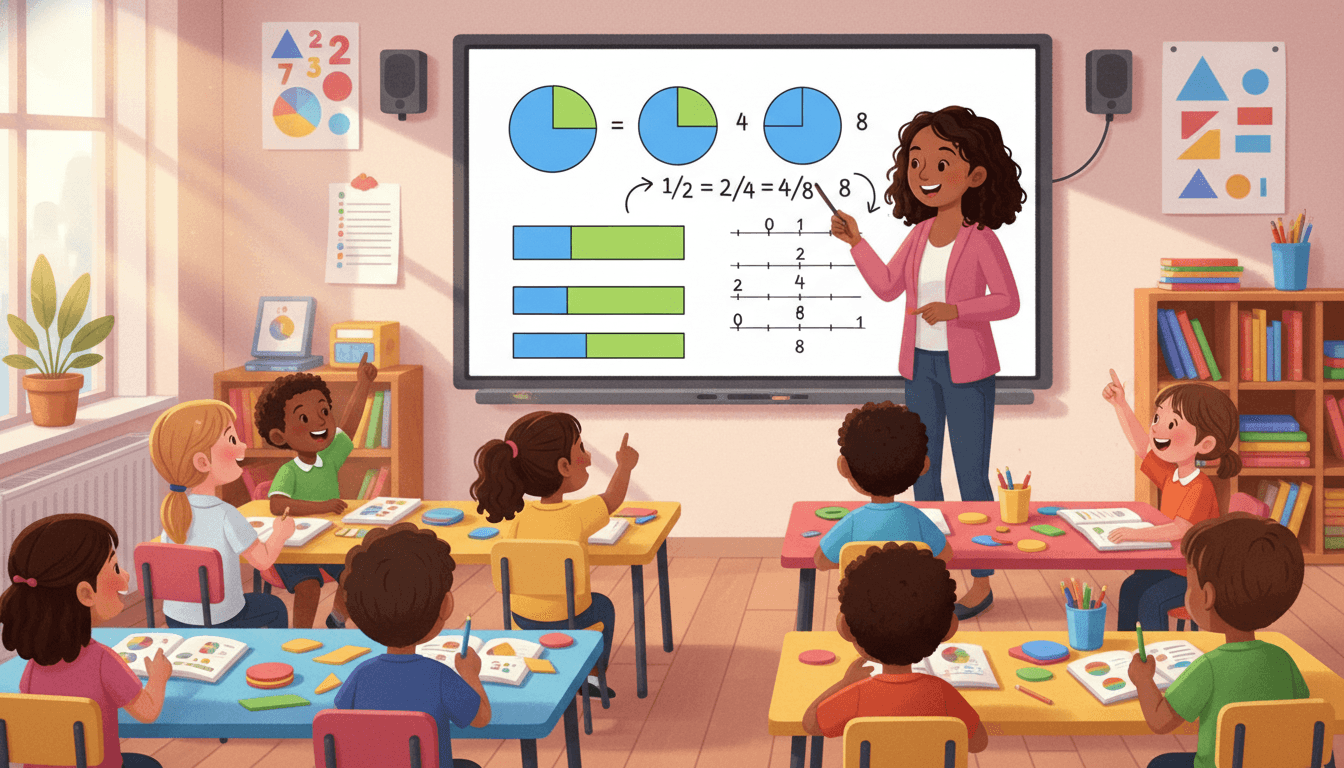
- Fraction models, number lines, and area diagrams help students see why fractions are equivalent.
- Finding equivalent fractions is essential for comparing, adding, and subtracting fractions with unlike denominators.
What Are Equivalent Fractions?
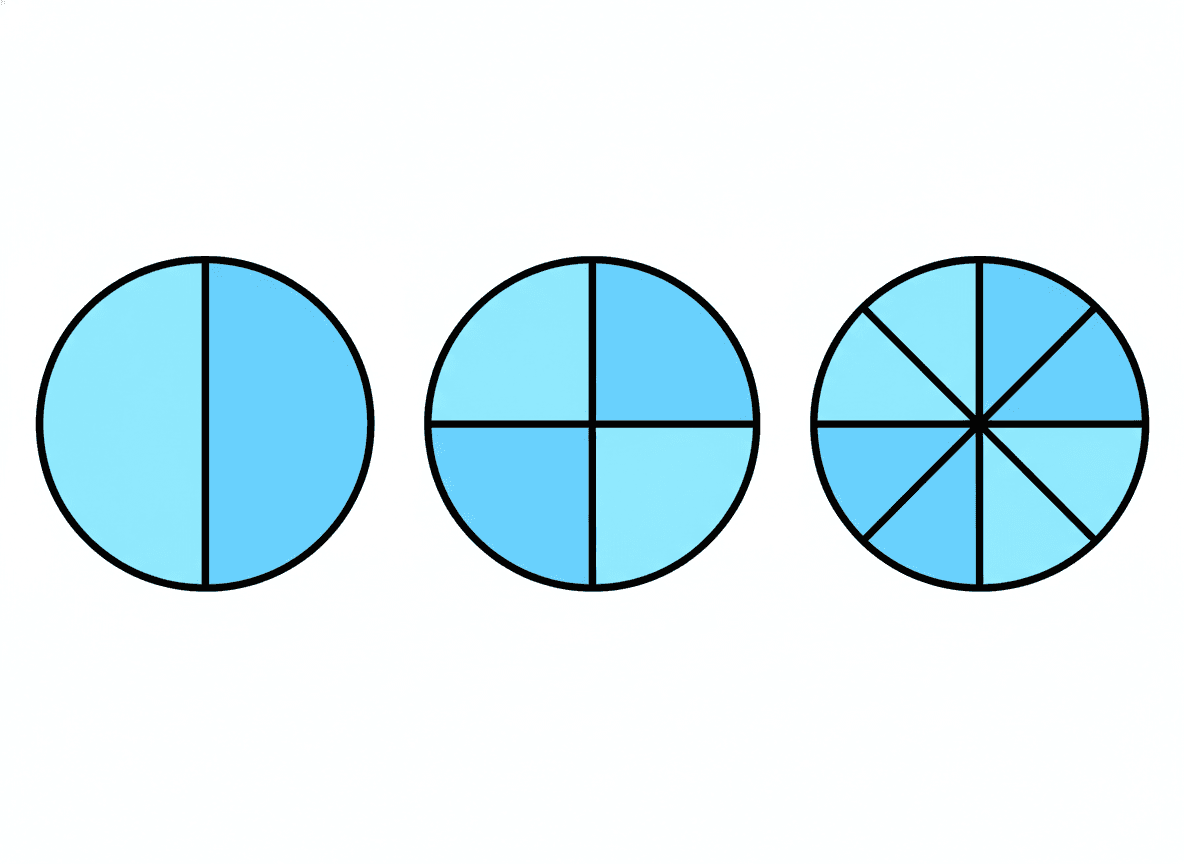
Equivalent fractions are fractions that represent the same value or the same portion of a whole, even though they have different numerators and denominators. The fractions 1/2, 2/4, 3/6, and 4/8 are all equivalent - each represents exactly half of a whole.
Understanding equivalence is one of the most important fraction concepts in elementary school. It's the bridge between visual fraction models in 3rd grade and fraction operations in 4th and 5th grade.
How to Create Equivalent Fractions
The rule is simple: multiply or divide both the numerator and denominator by the same nonzero number.
- 1/4 × 3/3 = 3/12 (equivalent to 1/4)
- 6/10 ÷ 2/2 = 3/5 (equivalent to 6/10)
This works because multiplying by 2/2, 3/3, or any form of 1 doesn't change the fraction's value - it just renames it.
Visual Models for Equivalent Fractions
Fraction bars: Place a 1/2 bar next to 2/4 bars. Students see they fill the same length.
Area models: Shade 1/3 of a rectangle. Then divide each third into 2 equal parts - now 2/6 is shaded. Same area, different fraction name.
Number line: Plot 1/2 and 2/4 on the same number line. Both land on the exact same point.
Fraction circles: Lay a 1/2 piece over two 1/4 pieces to see they cover the same area.
What Grade Do Kids Learn Equivalent Fractions?
3rd grade (3.NF.A.3): Students recognize and generate simple equivalent fractions (e.g., 1/2 = 2/4, 4/6 = 2/3) and explain them using models.
4th grade (4.NF.A.1): Students use multiplication and division to generate equivalent fractions systematically, including larger numbers.
5th grade: Equivalent fractions are applied when adding and subtracting fractions with unlike denominators, requiring students to find common denominators.
Common Misconceptions
Bigger denominator = bigger fraction: Students sometimes think 1/8 > 1/4 because 8 > 4. Fraction models correct this by showing that more pieces means smaller pieces.
Adding top and bottom: When creating equivalents, students sometimes add the same number to both numerator and denominator instead of multiplying. Adding 2 to 1/3 gives 3/5, which is NOT equivalent to 1/3.
Equivalent means equal amounts of numerator: Students may think 2/4 and 2/6 are equivalent because the numerators match. They're not - they represent different amounts.
Practice Activities
-
Fraction bar matching: Give students fraction bars and ask them to line up all fractions equivalent to 1/2, 1/3, and 1/4.
-
Multiplication table connections: Show how the multiplication table generates equivalent fractions (the 3 row: 3/6, 6/12, 9/18... all equal 1/2).
-
Number line placement: Have students place 6-8 fractions on a number line and circle groups that land on the same point.
-
Equivalent fraction war card game: Students flip fraction cards and compare - the player who names the equivalent fraction first wins the round.
-
Missing numerator/denominator: Give students 3/4 = ?/12 and have them solve for the missing number, explaining their strategy.
Frequently Asked Questions
What are equivalent fractions?
Equivalent fractions are fractions that look different but represent the same value. For example, 1/2, 2/4, and 4/8 are all equivalent - each one describes exactly half of a whole. The numerator and denominator are different, but the portion of the whole they represent is identical.
How do you find equivalent fractions?
To find an equivalent fraction, multiply or divide both the numerator and the denominator by the same nonzero number. For example, 1/3 × 2/2 = 2/6. Since you're multiplying by a form of 1 (2/2 = 1), the value of the fraction stays the same. You can also divide: 6/8 ÷ 2/2 = 3/4.
Why are equivalent fractions important?
Equivalent fractions are the foundation for adding and subtracting fractions with different denominators. Before you can add 1/2 + 1/3, you must convert both to a common denominator (3/6 + 2/6). Without understanding equivalence, fraction operations make little sense to students.
How can I use models to show equivalent fractions?
Area models (folded paper or fraction bars) work well: fold a paper in half to show 1/2, then fold again to see 2/4. Number lines are also powerful - placing 1/2 and 2/4 on the same number line shows they land on exactly the same point. Fraction tiles are a hands-on manipulative that makes this concrete.
What is the difference between equivalent fractions and simplifying fractions?
They are reverse processes using the same rule. To find equivalent fractions, you multiply the numerator and denominator by the same number (scaling up). To simplify (reduce) a fraction, you divide both by their greatest common factor (scaling down). Both processes preserve the value of the fraction.
Free Equivalent Fractions Worksheets
Curriculum-aligned printable worksheets for 3rd – 5th Grade. Download free.