What Are Mixed Numbers?
Taught in US schools
Key Takeaways
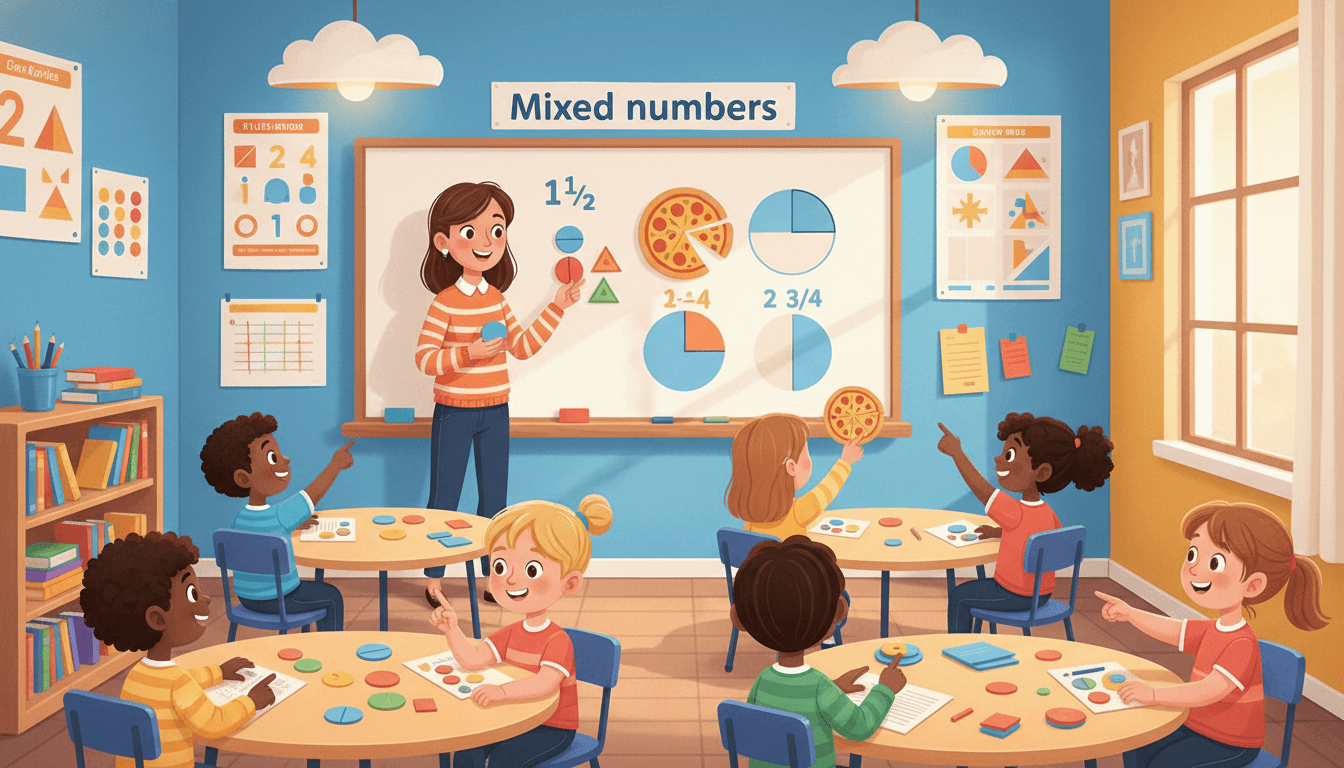
- A mixed number combines a whole number and a fraction, such as 3½ (three and one-half).
- Mixed numbers and improper fractions represent the same value and can be converted between each other.
- Adding and subtracting mixed numbers requires working with both the whole number and fraction parts.
- Mixed numbers appear constantly in real life: cooking measurements, distances, and time.
What Are Mixed Numbers?
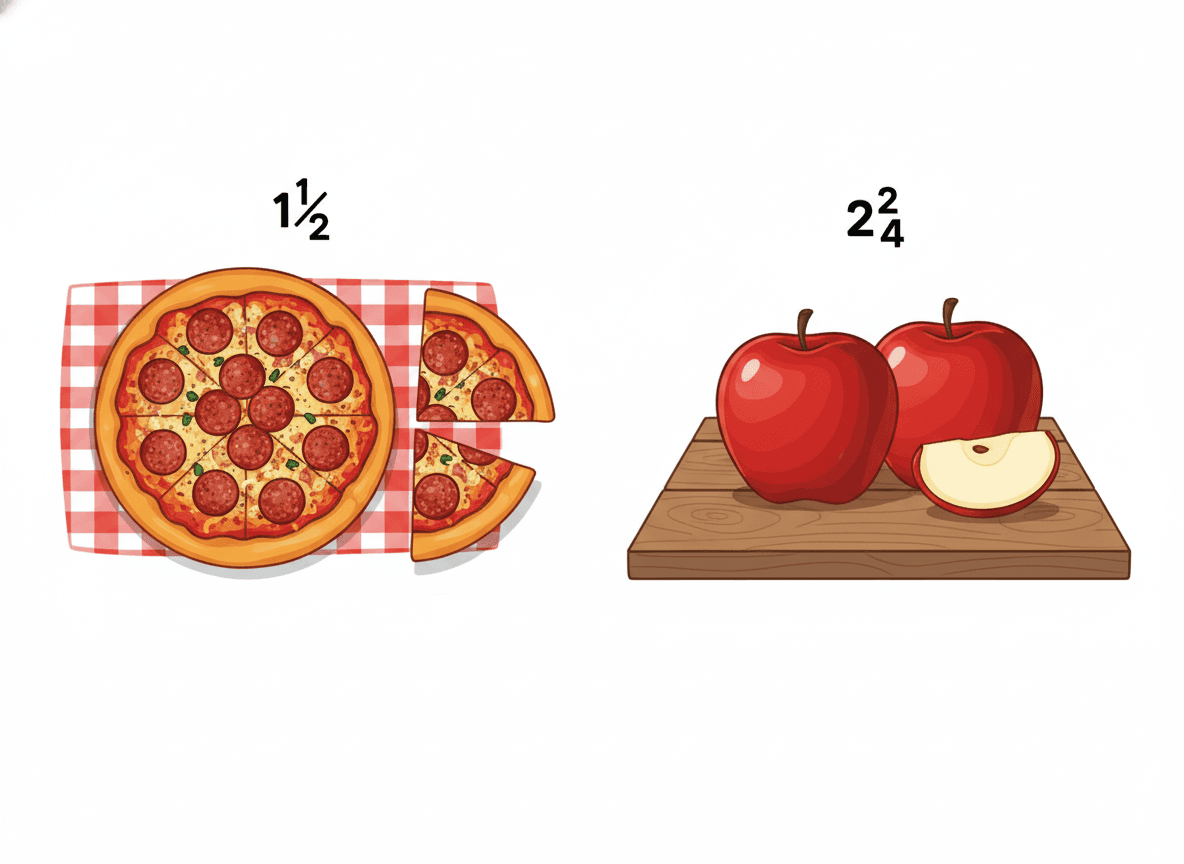
A mixed number is a number that combines a whole number and a proper fraction. Examples: 2½, 3¾, 5⅓.
Mixed numbers represent quantities that are between two whole numbers - they are more than one whole but not a complete next whole. They appear constantly in real life whenever amounts don't come out to exact whole numbers.
Mixed Numbers and Improper Fractions
Every mixed number can be written as an improper fraction (a fraction where the numerator is larger than the denominator), and vice versa.
Mixed → Improper: Multiply the whole number by the denominator, add the numerator.
- 2¾ → (2 × 4) + 3 = 11 → 11/4
Improper → Mixed: Divide the numerator by the denominator; the quotient is the whole number, remainder is the new numerator.
- 11/4 → 11 ÷ 4 = 2 remainder 3 → 2¾
Adding and Subtracting Mixed Numbers
Same denominators:
- 3¼ + 2¼ = 5¼ (add whole numbers, add fractions)
- Watch for regrouping: 2¾ + 1¾ = 3 6/4 = 4½
Different denominators:
- Find the LCD (least common denominator).
- Convert fractions to equivalent fractions.
- Add whole numbers and fractions separately.
- Regroup if the fraction part exceeds 1.
Subtraction with regrouping: When the fraction in the first number is smaller, borrow 1 whole and add it (as an equivalent fraction) to the fraction part.
- 4⅓ - 1⅔: borrow 1 from 4 → 3 4/3 - 1⅔ = 2 2/3
What Grade Do Kids Learn Mixed Numbers?
4th grade (4.NF.B.3): Students add and subtract mixed numbers with like denominators, understand mixed numbers on a number line, and decompose mixed numbers.
5th grade (5.NF.A.1): Students add and subtract mixed numbers with unlike denominators.
Common Misconceptions
Adding whole numbers and fractions separately without regrouping: Students may add 2¾ + 1¾ and write 3¾ instead of regrouping the 6/4 = 1½. Reinforce that the fraction part must also be simplified and regrouped.
Improper fractions are "wrong": Students sometimes think improper fractions are incorrect. Both forms are mathematically valid; the context determines which is more useful.
Ignoring the whole number when converting: When converting mixed to improper, students may just use the fraction part and forget to account for the whole number.
Practice Activities
-
Number line placement: Plot mixed numbers on a number line between whole numbers.
-
Conversion practice: Convert between mixed numbers and improper fractions with 10 problems each direction.
-
Recipe math: Use a recipe that serves 4 and scale it to serve 6 or 10, requiring mixed number addition.
-
Regrouping subtraction: Work through problems specifically designed to require regrouping (e.g., 5⅙ - 2⅚).
-
Mixed number story problems: Write their own word problems that require adding or subtracting mixed numbers.
Frequently Asked Questions
What is a mixed number?
A mixed number is a number that has both a whole number part and a fraction part. For example, 2¾ means 2 whole things plus ¾ of another. Mixed numbers are greater than 1 and are used when an amount falls between two whole numbers.
What is an improper fraction and how does it relate to a mixed number?
An improper fraction has a numerator that is equal to or greater than its denominator, such as 7/4. It represents an amount greater than 1 whole. You can convert: 7/4 = 1 3/4 (one whole and three-fourths). Going the other direction, 1 3/4 = (1×4 + 3)/4 = 7/4.
How do you add mixed numbers?
Add the whole number parts together and the fraction parts together separately. If the fraction parts sum to a value greater than 1, regroup: 2 3/4 + 1 2/4 = 3 5/4 = 4 1/4. When denominators are different, find equivalent fractions with a common denominator first.
How do you subtract mixed numbers with regrouping?
If the fraction in the first number is smaller than the fraction in the second, borrow 1 from the whole number and add it to the fraction. For example: 3 1/4 - 1 3/4 → rewrite as 2 5/4 - 1 3/4 = 1 2/4 = 1 1/2.
Where do mixed numbers appear in real life?
Mixed numbers appear in recipes (2½ cups of flour), carpentry measurements (3¾ inches), running distances (5½ miles), and time (1½ hours). They are among the most practical fraction forms students encounter outside of school.
Free Mixed Numbers Worksheets
Curriculum-aligned printable worksheets for 4th – 5th Grade. Download free.