What Are Greek and Latin Roots?
Taught in US schools
Key Takeaways
- About 60% of English words have Greek or Latin roots - especially in science, math, and academic vocabulary.
- Learning one root can unlock the meaning of dozens of related words.
- Greek roots often appear in science and math; Latin roots are common across all academic subjects.
- Root knowledge is one of the most efficient vocabulary-building strategies for upper elementary students.
What Are Greek and Latin Roots?
Greek and Latin roots are word parts from ancient Greek and Latin that form the base of a huge portion of English vocabulary - especially academic, scientific, and technical words.
A root carries the core meaning of a word. Prefixes and suffixes are added to roots to create new words. When students learn one root, they often gain a key to dozens of related words across multiple subjects.
Root: bio (Greek: life) Related words: biology, biography, biodiversity, biome, antibiotic, symbiosis
Why So Much English Comes from Greek and Latin
English is a hybrid language. Its everyday words (house, water, eat, go) mostly come from Old English (Germanic). But its academic, scientific, and formal vocabulary was heavily influenced by Latin (the language of the Roman Empire and the medieval church) and Greek (the language of ancient philosophy and science).
When scientists and scholars needed words for new discoveries and concepts, they built them from Greek and Latin - which is why almost every science term has a Greek or Latin root.
High-Frequency Roots to Know
Latin Roots:
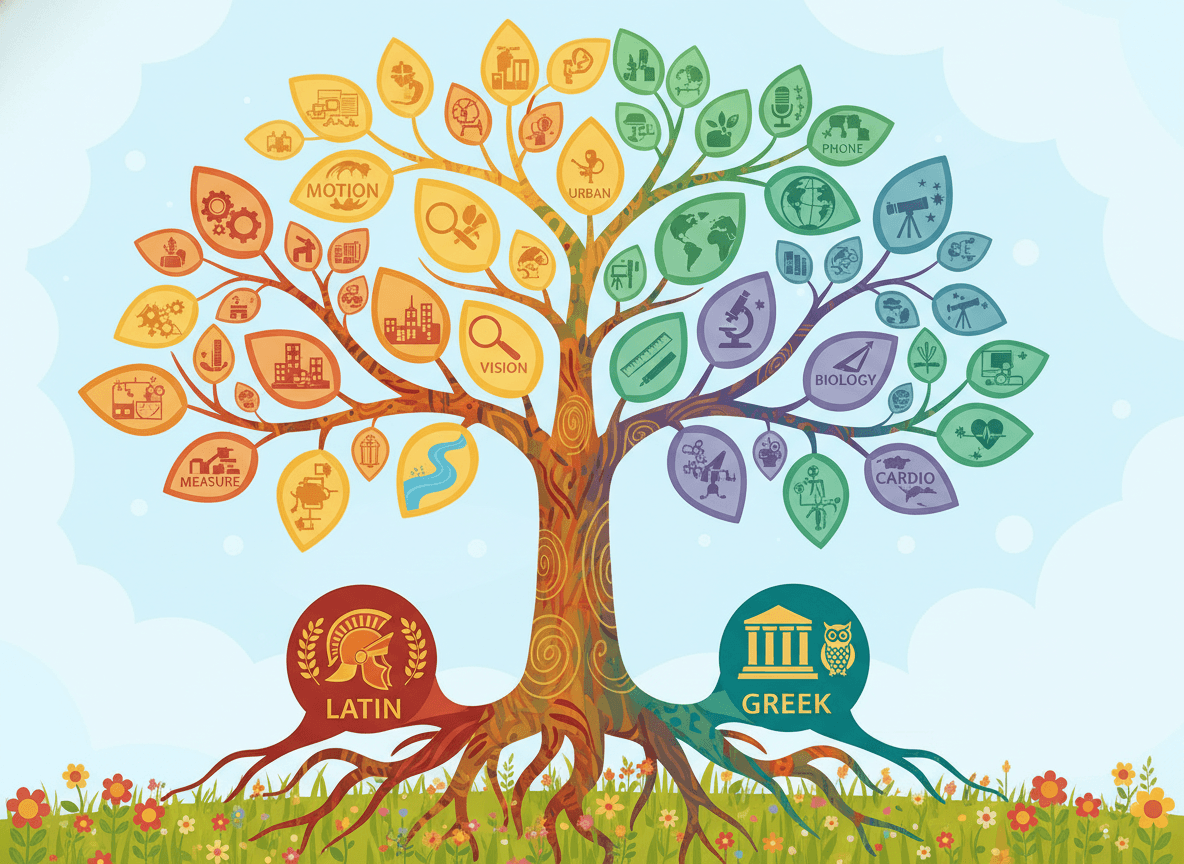
port: carry - transport, import, export, portable
rupt: break - erupt, interrupt, disrupt
dict: say/speak - dictate, predict, contradict
scrib/script: write - describe, inscription, manuscript
vis/vid: see - visible, video, evidence
struct: build - construct, destroy, structure
aqua: water - aquarium, aquatic, aquifer
Greek Roots:
bio: life - biology, biography, biome
geo: earth - geography, geology, geometry
graph: write/draw - photograph, paragraph, autograph
phone: sound - telephone, microphone, symphony
therm: heat - thermometer, thermal, thermostat
astro: star - astronaut, astronomy, asteroid
hydro: water - hydrogen, hydrant, hydroelectric
Practice Activities
- Play "Root Detective" - give students a new vocabulary word and ask them to identify the root and use it to guess the meaning before looking it up.
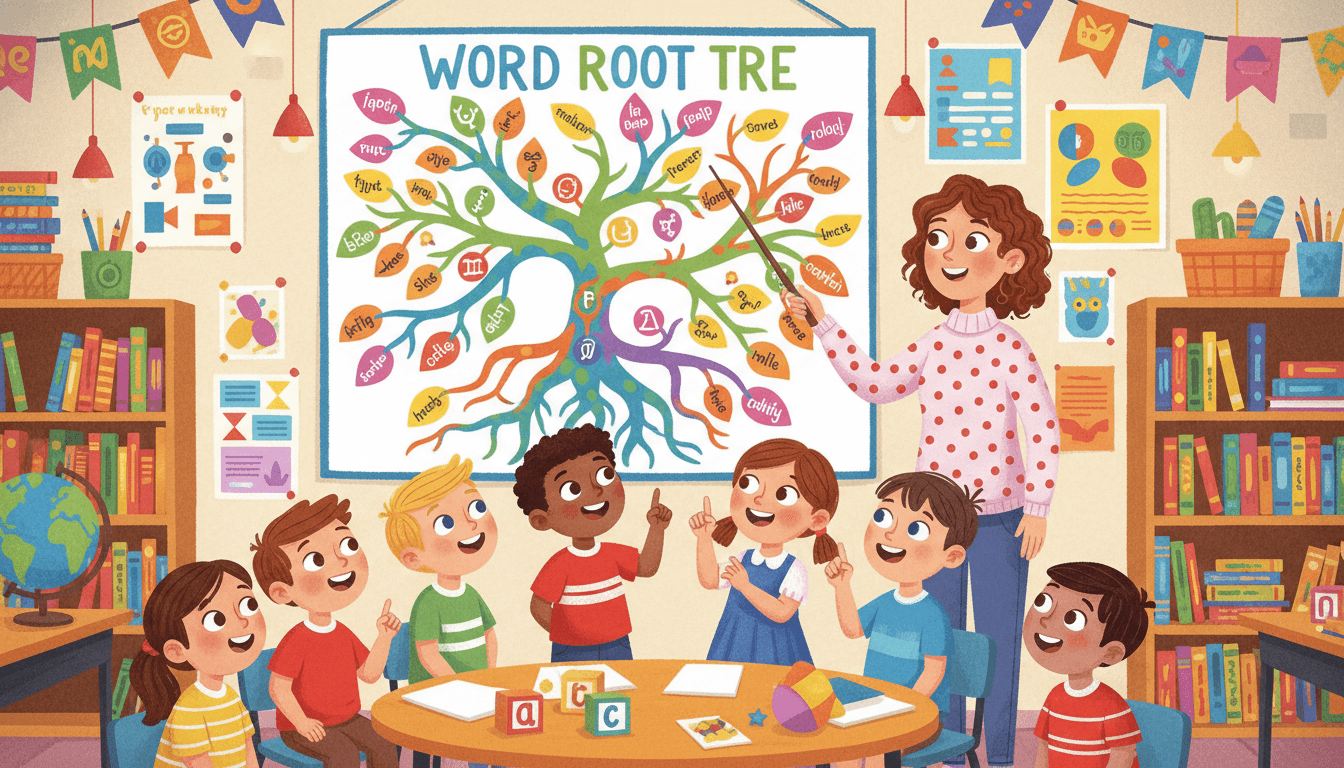
- Create a "root tree" poster: write a root at the trunk and have students add branches for every word they can find that uses that root.
- Introduce new science or social studies vocabulary by breaking each word into root + prefix/suffix before explaining the definition.
- Give students a list of unknown words (contradict, disruption, inscribed) and ask them to use their root knowledge to write a tentative definition, then check it.
Frequently Asked Questions
What are Greek and Latin roots?
Greek and Latin roots are word parts from ancient Greek and Latin languages that form the base of thousands of modern English words. A root carries the core meaning of a word. For example, the Latin root 'port' means 'carry' - it appears in portable, transport, import, export, and deportation. Knowing the root helps unlock the meaning of all these words.
Why are Greek and Latin roots important in elementary school?
Approximately 60% of English vocabulary - and over 90% of technical and scientific vocabulary - comes from Greek or Latin roots. Students who know common roots can often figure out the meaning of unfamiliar words they encounter in science, social studies, and math without looking them up. Root knowledge is one of the most powerful vocabulary strategies for grades 3-5.
What is the difference between a root, a prefix, and a suffix?
A root carries the core meaning of a word. A prefix is added to the beginning of a root to change or add meaning (un-, re-, pre-). A suffix is added to the end to change meaning or part of speech (-tion, -ful, -less, -ing). Words are often built from roots + prefixes and/or suffixes: un (prefix) + port (root) + able (suffix) = unportable.
Free Greek and Latin Roots Worksheets
Curriculum-aligned printable worksheets for 3rd – 5th Grade. Download free.
Common Core Standards