What Is Morphology?
Taught in US schools

Key Takeaways
- Morphology is the study of morphemes - the smallest meaningful units of language.
- A single morpheme can be a whole word (cat) or a word part (un-, -ful, -tion).
- Morphological knowledge helps students decode, spell, and understand unfamiliar words.
- Teaching morphology is one of the most efficient vocabulary strategies - one root unlocks many words.
What Is Morphology?
Morphology is the study of morphemes - the smallest units of meaning in language - and how they combine to form words. In reading and vocabulary instruction, it means teaching students to recognize and use word parts to decode and understand unfamiliar words.
Morphological knowledge is one of the most efficient vocabulary strategies available because one word part can unlock dozens of words. A student who knows the prefix un- means "not" can apply that knowledge to unhappy, uncertain, unusual, unexpected, and hundreds more words.
What Is a Morpheme?
A morpheme is the smallest meaningful unit in a language.
Free morphemes can stand alone as words:
cat, run, happy, book
Bound morphemes must attach to other morphemes:
un- (prefix: not), -ful (suffix: full of), -tion (suffix: act or state of), -ed (suffix: past tense)
The word "unhappiness" contains three morphemes:
un- (not) + happy (free morpheme) + -ness (state of being) = the state of not being happy
Why Morphology Matters
For decoding: When students encounter an unfamiliar long word, recognizing its parts makes it manageable. transformation → trans (across) + form (shape) + ation (state of) = the state of changing shape across.
For vocabulary: Research shows morphological instruction produces significant vocabulary growth. Each new root connects to a family of related words.
For spelling: Many English spellings are driven by meaning, not pronunciation. Knowing that sign and signal share a root explains the silent g in both.
For comprehension: Morphological awareness correlates strongly with reading comprehension, especially in upper grades where academic vocabulary is dense with Latin and Greek roots.
Key Morphological Elements to Teach
Common prefixes: un- (not), re- (again), pre- (before), dis- (not/opposite), mis- (wrongly), over- (too much)
Common suffixes: -ful (full of), -less (without), -tion (state of), -er/-or (one who), -ment (act of), -ness (state of being)
High-frequency roots: port (carry), rupt (break), vis (see), dict (say), bio (life), graph (write)
Practice Activities
- "Word family trees" - start with a root word (happy) and generate all the related words: unhappy, happiness, unhappiness, happily.
- Morpheme sorting: given a list of words, students sort them by root, prefix, or suffix.
- "Break it down" - students divide multi-syllable vocabulary words into morphemes and use the parts to write a definition.
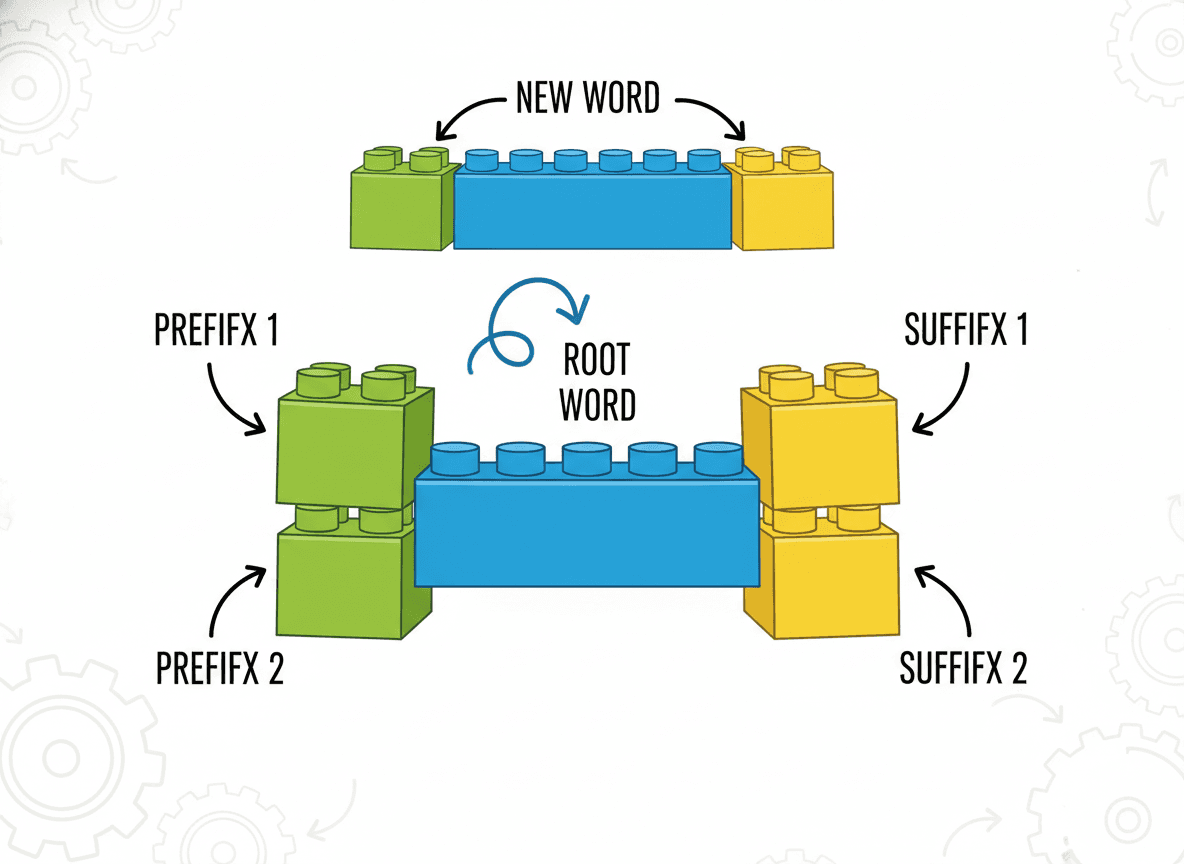
- Word building: give students a set of morpheme cards (roots and affixes); they combine them to build real words and explain what each combination means.
Frequently Asked Questions
What is morphology in reading?
Morphology is the branch of linguistics that studies morphemes - the smallest units of meaning in a language. In reading instruction, morphology means teaching students how words are built from meaningful parts: roots (the core meaning), prefixes (added to the beginning), and suffixes (added to the end). A student who understands morphology can often figure out the meaning of an unfamiliar word by analyzing its parts.
What is a morpheme?
A morpheme is the smallest unit of language that carries meaning. Some morphemes are complete words: 'cat,' 'run,' 'happy.' These are called free morphemes - they can stand alone. Other morphemes cannot stand alone and must attach to other words: 'un-,' '-ful,' '-tion,' '-ed.' These are called bound morphemes. The word 'unhappiness' contains three morphemes: un + happy + ness.
How does morphology help with spelling?
Morphological knowledge improves spelling because the spelling of many words is driven by meaning, not sound. For example, 'sign' and 'signal' are related morphologically (both contain the root 'sign'), so the silent 'g' in 'sign' makes sense when you see it in 'signal' (where the g is pronounced). Understanding that -ed means past tense explains why we write 'walked' even though it sounds like 'walkt.'
Free Morphology Worksheets
Curriculum-aligned printable worksheets for 2nd – 5th Grade. Download free.
Common Core Standards