What Are Irregular Verbs?
Taught in US schools

Key Takeaways
- Irregular verbs don't follow the -ed rule for past tense and must be memorized.
- Irregular verbs are among the most common verbs in English: be, go, eat, run, see, come, give.
- Many irregular verbs have distinct past and past participle forms (go/went/gone, eat/ate/eaten).
- Overgeneralizing the -ed rule ('goed,' 'eated') is a normal developmental stage students move through.
What Are Irregular Verbs?
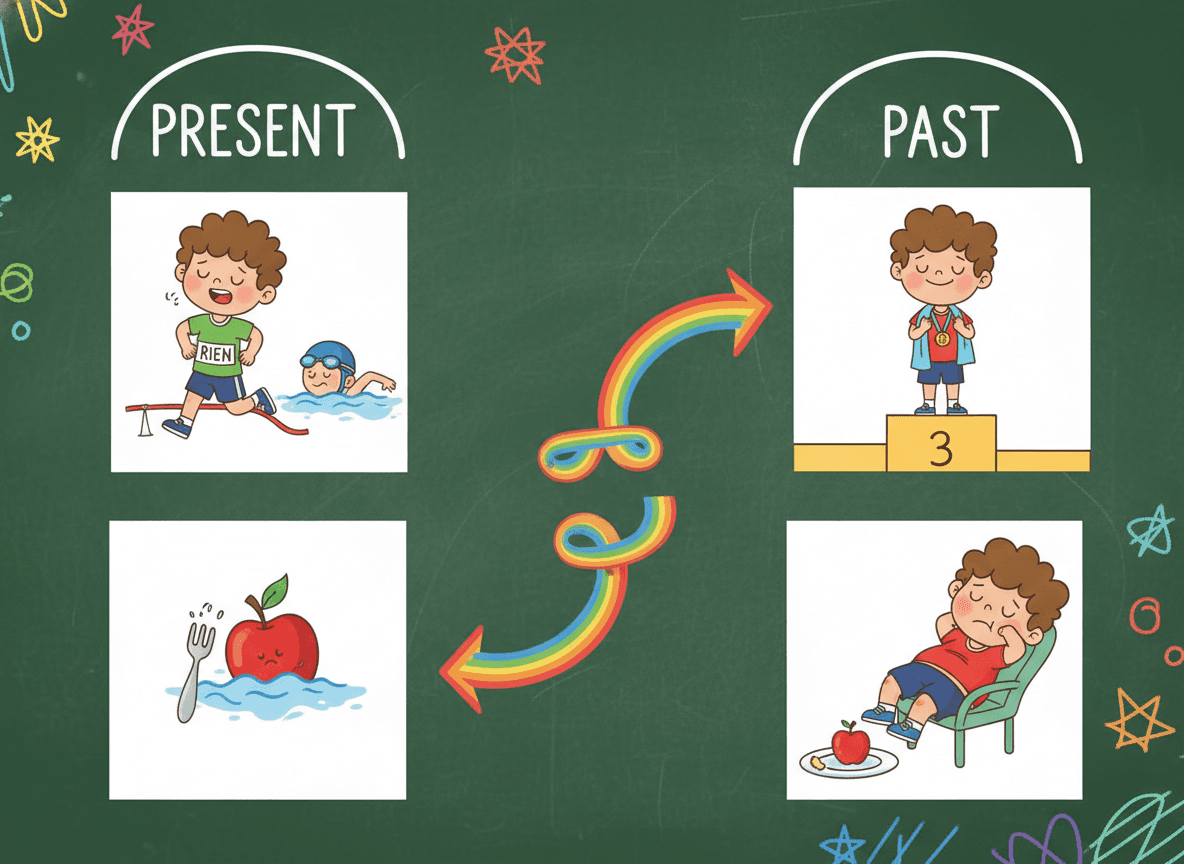
Irregular verbs are verbs whose past tense is NOT formed by simply adding -ed or -d. Instead, the verb changes its form in an unpredictable way - which means students must memorize these forms rather than apply a rule.
Regular pattern: walk → walked, jump → jumped, play → played
Irregular examples: run → ran, eat → ate, go → went, see → saw
Irregular verbs are common in English - and the most frequent verbs (be, have, do, go, say, make) are nearly all irregular. This is why mastering them is so important.
Categories of Irregular Verbs
Vowel changes (ablaut): The vowel in the middle of the verb changes.
- sing → sang, ring → rang, swim → swam, drink → drank
Completely different word:
- go → went, be → was/were
Same in all forms:
- cut → cut → cut; put → put → put; hit → hit → hit
-t or -d ending changes:
- feel → felt, keep → kept, leave → left, lose → lost, mean → meant, build → built
-en past participle:
- break → broke → broken; speak → spoke → spoken; rise → rose → risen
Past Tense vs. Past Participle
Some irregular verbs have three distinct forms:
go: went - gone
eat: ate - eaten
give: gave - given
run: ran - run
write: wrote - written
see: saw - seen
be: was/were - been Past participle is used with helping verbs: "She has eaten." "He had gone." "It was written."
What Grade Do Kids Learn Irregular Verbs?
2nd grade (L.2.1d): Students form and use the past tense of frequently occurring irregular verbs (sat, hid, told).
3rd grade (L.3.1d): Students form and use irregular verbs.
4th grade (L.4.1b): Students form and use progressive verb tenses; distinguish irregular verb forms in context.
Common Misconceptions
"-ed" works for all verbs: This is the defining error. "Goed," "eated," "runned," "wented" - all result from applying the regular rule to irregular verbs. Memorization and repeated exposure are the solutions.
Past tense and past participle are always the same: Many students use "ran" where "run" is needed ("I have ran three miles") and vice versa. The helping verb test: if you see have/has/had/was/were before the verb, use the past participle.
Irregular verbs are rare: They are actually the most common verbs in English. Students encounter and use them daily - which is why drilling them is worth the time.
Practice Activities
-
Irregular verb chart: Students keep a running chart of irregular verbs as they learn them: Base / Past / Past Participle.
-
Concentration game: Match base form and past tense cards face-down.
-
Fill in the past tense: Give sentences in present tense; students rewrite in past tense (catching all irregulars).
-
Story editing: Give a passage with overgeneralized irregular forms ("She runned fast"); students find and fix errors.
-
Irregular verb stories: Students write a short story using at least 8 irregular verbs in past tense.
Frequently Asked Questions
What are irregular verbs?
Irregular verbs are verbs that do not form their past tense simply by adding -ed. Instead, they change their form in other ways - sometimes vowel changes (run → ran, sing → sang), sometimes completely different forms (go → went), and sometimes not at all (put → put, cut → cut). Because they don't follow a pattern, they must be memorized.
What are the most common irregular verbs in English?
The most frequently used irregular verbs include: be (was/were), have (had), do (did), go (went), say (said), get (got), make (made), know (knew), think (thought), take (took), come (came), see (saw), run (ran), eat (ate), give (gave), find (found), tell (told), write (wrote), feel (felt), become (became), leave (left), bring (brought).
What is the difference between past tense and past participle?
Past tense is used without a helping verb: 'She ran home.' Past participle is used with a helping verb (have/has/had or was/were): 'She has run three miles' or 'The letter was written.' Many irregular verbs have the same past tense and past participle (thought/thought, said/said), but others differ: go → went (past) / gone (past participle); run → ran (past) / run (past participle).
Why do irregular verbs exist in English?
Irregular verbs are mostly very old English words (Anglo-Saxon). They formed their past tense through internal vowel changes (ablaut: sing/sang/sung) rather than suffixes. This pattern is ancient and predates the -ed rule. The most common words in any language tend to be irregular because they were established early in the language's history, before regularization patterns developed.
What is overgeneralization and why does it happen?
Overgeneralization is when children apply the -ed rule to irregular verbs, producing forms like 'goed,' 'eated,' 'runned,' or 'wented.' This is a normal stage of language development - it actually signals that the child has learned the regular rule and is applying it consistently. Children eventually learn the exceptions through exposure and instruction. Teachers should correct kindly without discouraging communication.
Free Irregular Verbs Worksheets
Curriculum-aligned printable worksheets for 2nd – 4th Grade. Download free.