What Is a Line Plot?
Taught in US schools

Key Takeaways
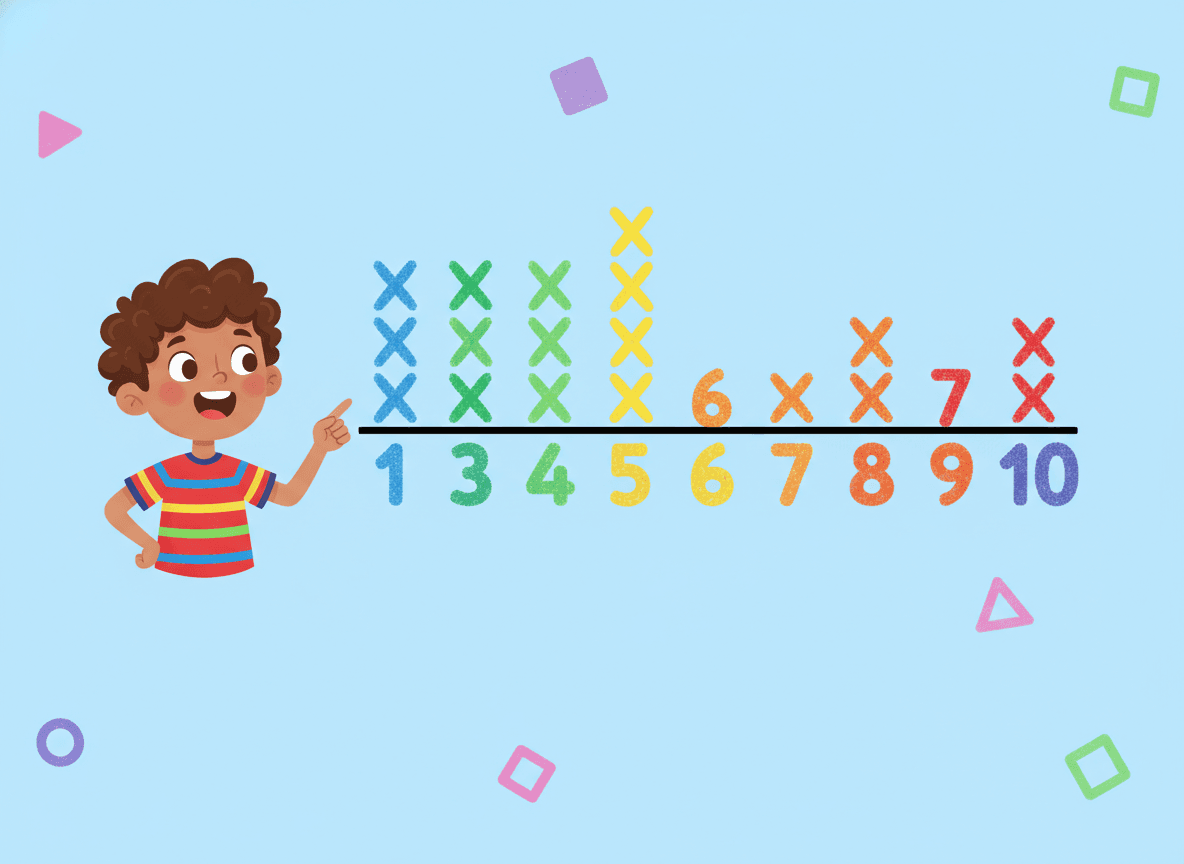
- A line plot shows data as X marks or dots above a number line.
- Each X represents one data point (one measurement or observation).
- Line plots make it easy to see clusters, gaps, and the range of the data.
- In grades 4-5, line plots include fractions on the number line.
What Is a Line Plot?
A line plot is a type of graph that uses a number line as its base and places an X mark (or dot) above the line for each data point. It shows how data is distributed - where values cluster, where they're sparse, and what the range is.
Line plots are introduced in grade 2 for whole number measurements, and by grades 4-5, students work with line plots that include fractions on the number line.
Parts of a Line Plot
-
Title - tells what data is being displayed
-
Number line - the horizontal base, labeled with relevant values
-
X marks - one X per data point, stacked above the corresponding value
-
Labels - units of measurement
Example: 7 students measured how many inches their bean plants grew. The data: 1, 2, 2, 3, 3, 3, 4 inches.
Line Plot: Bean Plant Growth (inches)

X
X  X  X
X  X  X  X
 -  -  -  -  -  -  -  -  -  -  -  -  -
1  2  3  4
At a glance: most plants grew 3 inches; the range is 1 to 4 inches; no plants grew 0 or 5 inches.
How to Create a Line Plot
- Collect your data
- Find the smallest and largest values - these define your number line's range
- Draw a number line and label it with equal intervals
- For each data point, draw an X above the corresponding number
- Add a title and label the unit of measurement
What Line Plots Show
Mode - the value with the most X marks (most common data point)
Range - the difference between the largest and smallest values
Clusters - groups of X marks bunched together (many values in that area)
Gaps - areas of the number line with few or no X marks
Outliers - data points far away from the rest
Line Plots with Fractions (Grades 4-5)
Upper grade students work with line plots that include fractional measurements on the number line. Common examples: lengths measured to the nearest 1/4 or 1/8 of an inch.
"Measure the length of each pencil to the nearest 1/4 inch. Make a line plot to display the data."
Practice Activities
- Collect real classroom data (shoe sizes, number of siblings, hours of sleep) and create a line plot together as a class.
- Give students a completed line plot and ask them to answer questions: "What is the mode? What is the range? How many students in all?"
- Mystery line plot challenge: give students a line plot with no title and ask them to imagine what real-world data it could represent.
- Create line plots with fractions using physical measurement data from a science activity.
Frequently Asked Questions
What is a line plot in math?
A line plot is a graph that uses a number line as its base and places an X (or dot) above the number line for each data point. If three students are 52 inches tall, there are three X marks above 52. Line plots are used to display measurement data and show the distribution - where data clusters, what the range is, and which values appear most or least often.
What is the difference between a line plot and a line graph?
A line plot uses a number line with X marks to show how many times each value occurs - it displays distribution. A line graph uses two axes (x and y) with dots connected by lines to show how data changes over time - it shows trends. They look similar in name but are used for different purposes. Line plots are introduced in grades 2-3; line graphs typically appear in grades 4-5.
How do you read a line plot?
To read a line plot: (1) Look at the number line - what values are shown? (2) Count the X marks above each value - each X = one data point; (3) Find the value with the most X marks - this is the mode (most frequent); (4) Find the range - the difference between the largest and smallest values; (5) Identify clusters (where X marks bunch together) and gaps (where there are few or no X marks).
Free Line Plot Worksheets
Curriculum-aligned printable worksheets for 2nd – 5th Grade. Download free.