What Are Linking Verbs?
Taught in US schools

Key Takeaways
- Linking verbs connect the subject to a predicate noun or predicate adjective - they don't show action.
- The most common linking verb is 'be' (am, is, are, was, were, being, been).
- Other common linking verbs include seem, become, appear, feel, look, sound, taste, smell, grow, remain.
- Some verbs (feel, look, smell, taste) can be either action or linking verbs depending on how they are used.
What Are Linking Verbs?
Linking verbs connect the subject of a sentence to a word that describes or identifies it. Unlike action verbs, linking verbs don't show what the subject does - they show what the subject is or what it is like.
Example:
- "The dog runs in the yard." (action verb - shows what the dog does)
- "The dog seems tired." (linking verb - connects dog to the description "tired")
Common Linking Verbs
Forms of "be" (primary linking verbs): am, is, are, was, were, being, been
Other common linking verbs: appear, become, feel, grow, look, prove, remain, seem, smell, sound, stay, taste, turn
Sentence examples:
- "She is a doctor." (is = linking; "doctor" renames "she")
- "The cookies smell delicious." (smell = linking; "delicious" describes "cookies")
- "He became famous." (became = linking; "famous" describes "he")
- "The leaves turned yellow." (turned = linking; "yellow" describes "leaves")
Linking Verbs and What They Connect To
A linking verb connects the subject to one of two things:
Predicate adjective: An adjective that describes the subject. "The soup is hot." (hot describes soup)
Predicate noun (predicate nominative): A noun that renames the subject. "Lincoln was a president." (a president renames Lincoln)
Both types of words appear in the predicate (after the linking verb) and describe or identify the subject.
The Dual-Role Verbs
Some verbs can be either action or linking verbs depending on context:
feel: She felt the texture. - She felt sad.
look: He looked at the map. - He looked tired.
smell: The dog smelled the flowers. - The flowers smelled sweet.
taste: She tasted the sauce. - The sauce tasted bitter.
sound: She sounded the alarm. - That sounds strange.
Substitution test: Replace the verb with "is" or "was." If it still makes sense, it's linking.
What Grade Do Kids Learn Linking Verbs?
3rd grade (L.3.1a): Students explain the functions of verbs; encounter linking verbs in context.
4th–5th grade: Linking verbs are explicitly taught as part of predicate noun and predicate adjective instruction. Students distinguish action, linking, and helping verbs.
Common Misconceptions
Linking verbs are not "real" verbs: Linking verbs are genuine verbs - they form the main verb of the sentence and determine its grammatical structure. They just have a different function than action verbs.
"Be" is always a linking verb: "Be" can also be a helping verb: "She is running" - here "is" is a helping verb supporting "running," not a linking verb.
All forms of "feel," "look," "smell," "taste," "sound" are linking: These verbs shift between action and linking based on context. Always apply the substitution test.
Practice Activities
-
Linking or action sort: Cards with sentences; students sort by verb type.
-
Substitution test practice: Students test whether a verb is linking by replacing it with "is/was."
-
Predicate adjective finder: Identify the linking verb and predicate adjective in each sentence.
-
Linking verb sentences: Students write 5 sentences with linking verbs, underlining the verb and circling the predicate adjective.
-
Be verb tracking: Students read a paragraph and identify every form of "be" - then determine if each is linking or helping.

Frequently Asked Questions
What is a linking verb?
A linking verb connects the subject of a sentence to a word in the predicate that describes or identifies the subject. Instead of showing what the subject does, a linking verb shows what the subject is or what it is like. For example: 'The soup tastes delicious' - 'tastes' links 'soup' to the adjective 'delicious.' The verb is not showing an action; it's making a connection.
What are the most common linking verbs?
Forms of 'be' are the primary linking verbs: am, is, are, was, were, being, been. Other common linking verbs: appear, become, feel, grow, look, prove, remain, seem, smell, sound, stay, taste, turn. These are often called 'sensory' or 'state-of-being' verbs because they describe how something is perceived or what state it is in.
How can you tell if a verb is linking or action?
The substitution test: replace the verb with a form of 'be' (am/is/are/was). If the sentence still makes sense, the verb is probably linking. 'She feels happy' → 'She is happy' (makes sense → linking). 'She feels the fabric' → 'She is the fabric' (doesn't make sense → action verb). This test works for feel, look, taste, smell, and sound, which can be either.
What is a predicate adjective?
A predicate adjective is an adjective that follows a linking verb and describes the subject. In 'The flowers smell wonderful,' 'wonderful' is a predicate adjective describing 'flowers.' In 'The sky is blue,' 'blue' is a predicate adjective. Predicate adjectives are important because they appear after the linking verb rather than directly before the noun they describe.
What is a predicate noun (predicate nominative)?
A predicate noun (also called predicate nominative) is a noun or pronoun that follows a linking verb and renames the subject. In 'Lincoln was a president,' 'president' is a predicate noun renaming 'Lincoln.' In 'Maria is the captain,' 'captain' is a predicate noun. Unlike direct objects, predicate nouns rename the subject rather than receiving the action.
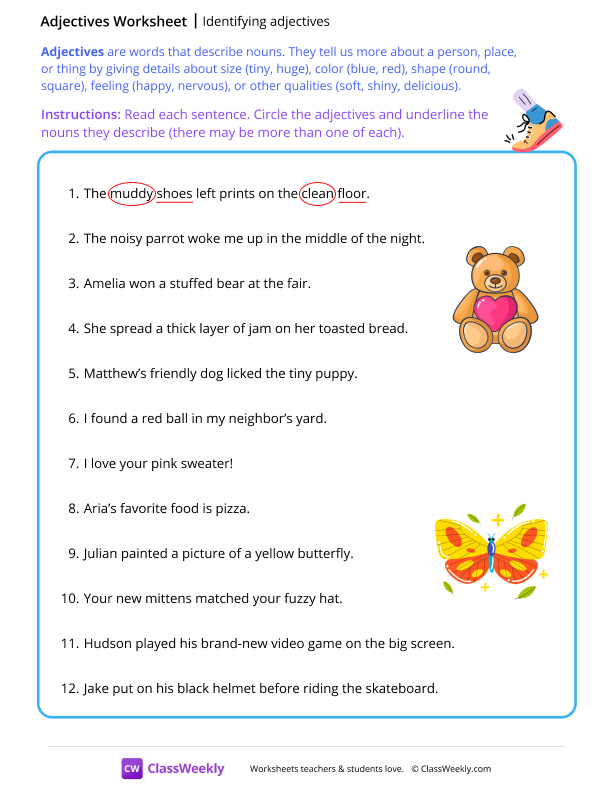
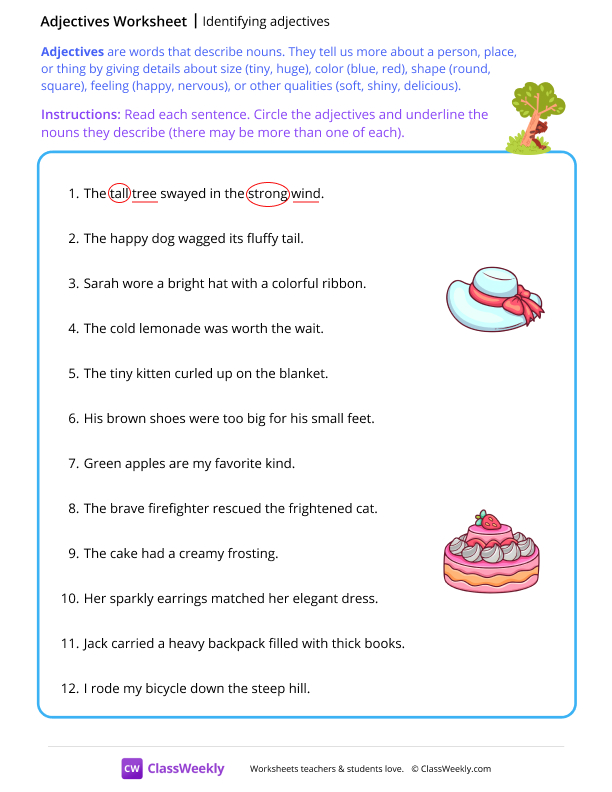
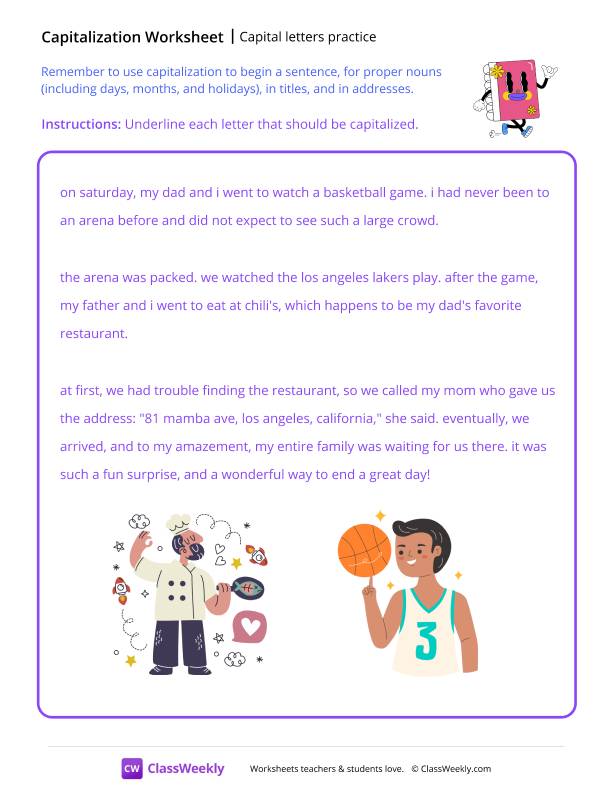
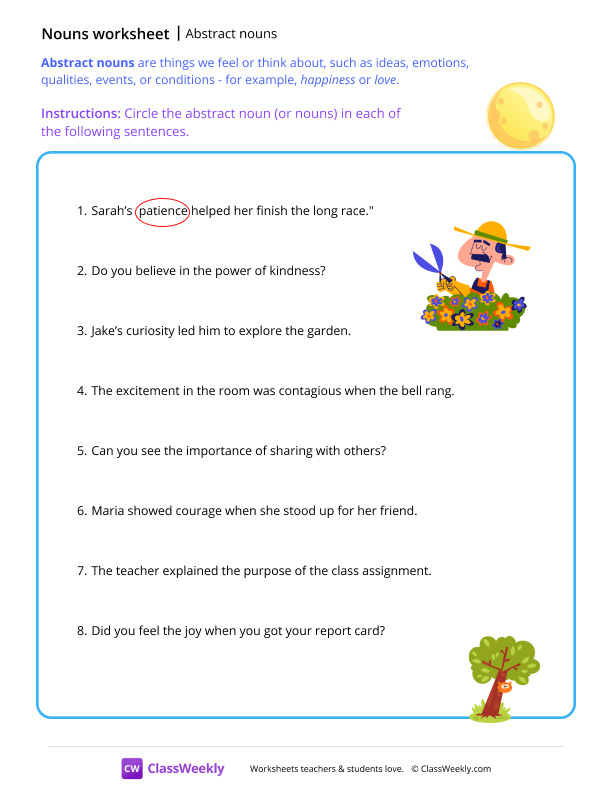
Free Linking Verbs Worksheets
Curriculum-aligned printable worksheets for 3rd – 5th Grade. Download free.