What Are Math Manipulatives?
Taught in US schools
Key Takeaways
- Math manipulatives are physical or virtual objects used to make abstract mathematical concepts concrete and visible.
- The CPA progression (Concrete → Pictorial → Abstract) describes how manipulatives build toward symbolic understanding.
- Manipulatives are tools for learning, not rewards - every student benefits from concrete representation, not just struggling learners.
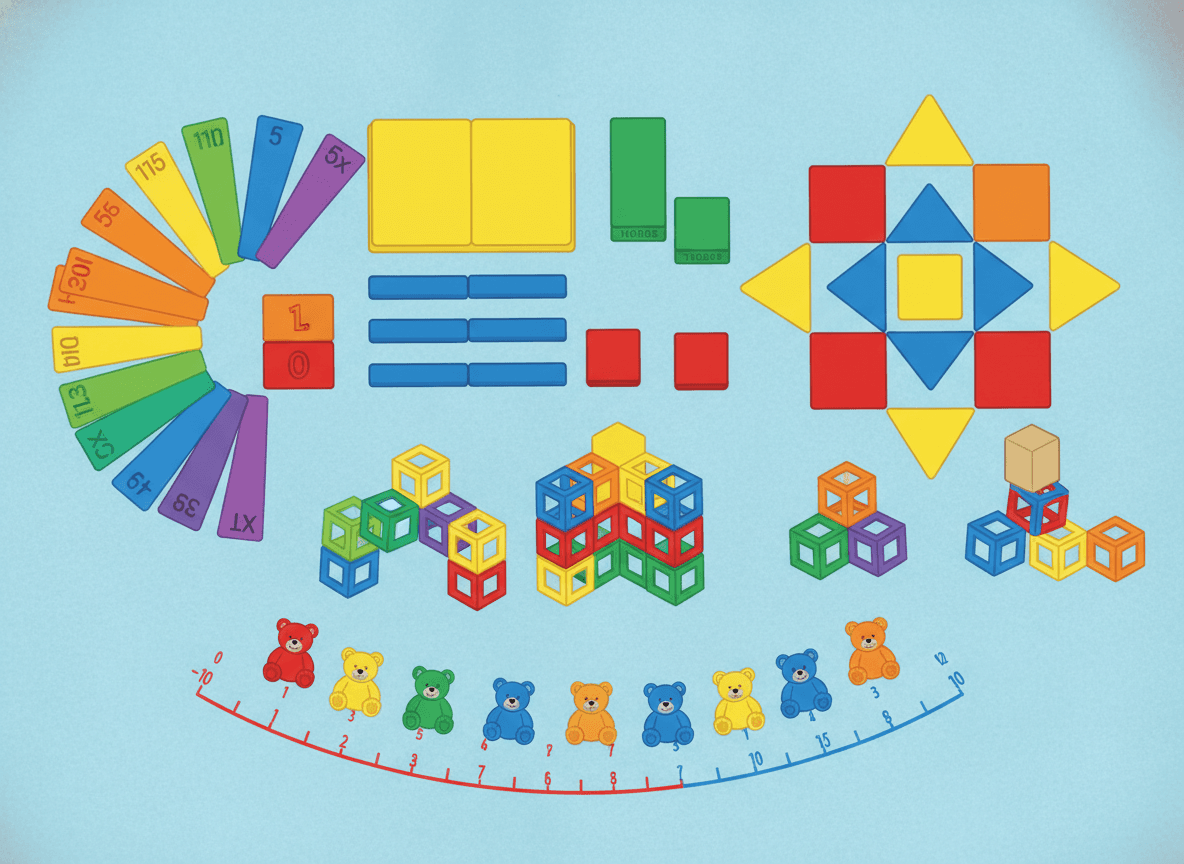
- Common K-5 manipulatives include base-ten blocks, fraction tiles, counters, pattern blocks, number lines, and geometric shapes.
What Are Math Manipulatives?
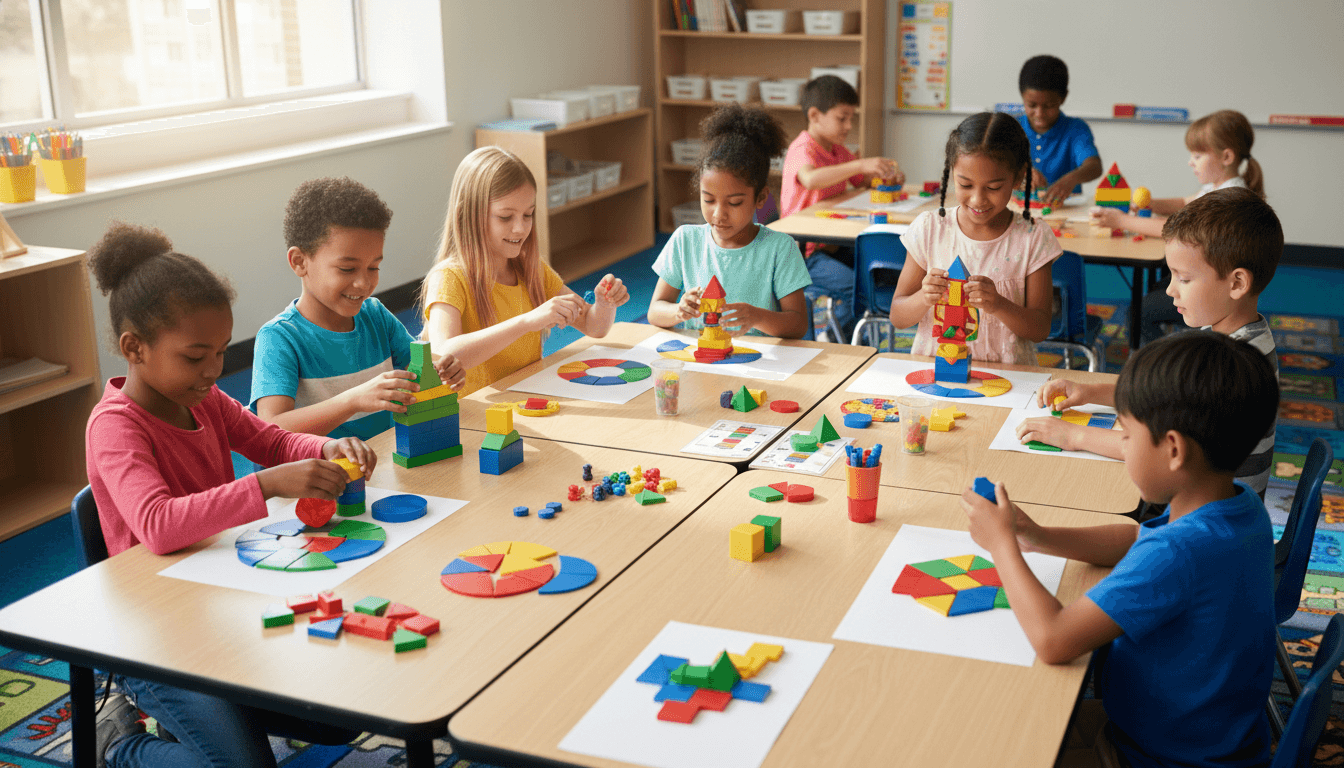
Math manipulatives are physical objects - blocks, tiles, cubes, counters, cards - that students handle to represent and explore mathematical concepts. They make abstract mathematical ideas concrete, visible, and physically manipulable.
Manipulatives are not decorations or rewards. They are cognitive tools that bridge the gap between abstract symbols (3 × 4 = 12) and conceptual understanding (what multiplication actually means). Every elementary classroom benefits from a well-organized manipulative toolkit.
The CPA Progression
The Concrete-Pictorial-Abstract (CPA) progression, developed by educator Jerome Bruner and embedded in Singapore Math and other research-based programs, describes the path to mathematical understanding:
Concrete: Students use physical objects to represent a concept. "I have 3 groups of 4 counters. I count 12 total."
Pictorial: Students draw or diagram the concept. "I draw 3 circles with 4 dots each."
Abstract: Students work with numbers and symbols only. "3 × 4 = 12"
Moving too quickly to the abstract without the concrete and pictorial foundation leaves students with procedures they can execute but cannot explain or adapt.
Common K-5 Math Manipulatives
Counting and Number Sense
Connecting cubes (snap cubes): Build towers, show quantities, explore place value.
Two-color counters: Show addition, subtraction, even/odd, probability.
Ten frames: Build number sense 0-20; visual anchor for making ten.
Counting bears/chips: Sorting, classifying, basic operations.
Place Value
Base-ten blocks: Ones (unit cubes), tens (rods), hundreds (flats), thousands (cubes). Essential for place value, regrouping, addition, and subtraction.
Place value disks: Faster to use than physical base-ten blocks for larger numbers.
Fractions
Fraction tiles/strips: Physical pieces representing halves, thirds, fourths, sixths, eighths, twelfths. Essential for comparing, adding, and subtracting fractions.
Fraction circles: Circular representations of fractions; useful for showing parts of a whole.
Geometry and Measurement
Pattern blocks: Hexagons, triangles, rhombi, trapezoids. Explore geometry, fractions, and patterns.
Geometric solids: 3D shapes for identifying and comparing faces, edges, vertices.
Rulers, protractors, measuring tapes: Essential measurement tools from 1st grade up.
Operations
Area model tiles: Show multiplication as rectangular arrays.
Algebra tiles: Introduction to variables (5th grade).
Number lines: Available as physical floor-length, desktop, or drawn versions; essential for fractions, integers, and operations.
Virtual Manipulatives
Digital alternatives include:
-
Desmos Activity Builder - interactive and free
-
Toy Theater - virtual pattern blocks, base-ten blocks, geoboards
-
Math Playground - virtual manipulative library
-
National Library of Virtual Manipulatives (NLVM) - comprehensive collection
Virtual manipulatives are particularly useful when physical materials are unavailable, during remote learning, or for students who need accessibility accommodations.
Common Misconceptions
Manipulatives are only for students who struggle: All learners benefit from concrete representation when learning new concepts. The research is clear: using manipulatives during initial learning - regardless of ability level - builds stronger, more flexible mathematical understanding.
Students should stop using manipulatives as they get older: There is no age at which manipulatives become inappropriate. 5th graders exploring fractions with physical tiles are doing the same cognitive work as mathematicians who draw diagrams to understand a new concept. Manipulatives are removed when students have built solid understanding, not based on age.
Manipulatives are too disruptive to manage: With explicit introduction, clear expectations, and consistent routines, manipulatives can be managed efficiently. The time cost of management is far outweighed by the learning benefit.
Practice Activities
-
Manipulative introduction routine: When introducing a new manipulative, give students 2 minutes of "free exploration" before the lesson - this reduces off-task behavior during instruction.
-
CPA sequence for a lesson: Plan a multi-day sequence: Day 1 (concrete), Day 2 (pictorial with diagrams), Day 3 (abstract with equations). Connect each day explicitly.
-
Partner manipulative explanation: After using manipulatives to solve a problem, one partner explains to the other using the objects - verbalization deepens understanding.
-
Sketch it: After solving with manipulatives, students draw a quick sketch representing what they built - this is the pictorial stage.
-
Manipulative math journal: Students photograph or draw their manipulative setups in a math journal with captions explaining the math.
Frequently Asked Questions
What are math manipulatives?
Math manipulatives are physical objects - blocks, tiles, counters, coins, cubes - that students manipulate with their hands to represent and explore mathematical concepts. Rather than working with abstract symbols alone, students can see and physically arrange objects to build understanding. Examples include base-ten blocks for place value and regrouping, fraction tiles for comparing and computing fractions, two-color counters for addition and subtraction, and pattern blocks for geometry and fractions.
What is the CPA (Concrete-Pictorial-Abstract) progression?
The CPA progression, developed by educator Jerome Bruner, describes how students best learn mathematics: (1) Concrete - students use physical manipulatives to represent a concept. (2) Pictorial - students draw or use diagrams to represent the concept. (3) Abstract - students work with numbers and symbols only. Moving through this progression ensures students build conceptual understanding before (or alongside) procedural fluency. Rushing to the abstract stage before students have concrete and pictorial experience often leads to fragile, procedural-only understanding that breaks down under novel conditions.
What manipulatives are used at each grade level?
Kindergarten and 1st grade: Two-color counters, connecting cubes, ten frames, number lines, pattern blocks. 2nd grade: Base-ten blocks (ones, tens, hundreds), number lines, connecting cubes, measurement tools. 3rd grade: Area models (tiles), fraction strips, number lines, pattern blocks, clocks. 4th grade: Fraction tiles, base-ten blocks (including tenths/hundredths), protractors, rulers, geometric solids. 5th grade: Fraction and decimal tiles, coordinate grids, measurement conversions kits, volume cubes. Virtual manipulatives (available through platforms like Toy Theater, Math Playground, and Desmos) are effective digital alternatives or supplements.
Aren't manipulatives just for students who struggle in math?
No - this is one of the most common misconceptions about manipulatives. Research shows that concrete representation benefits all learners when encountering new concepts, regardless of ability level. Manipulatives are tools for learning, not remediation aids. High-performing math students benefit from manipulatives when learning new concepts just as much as struggling students. Restricting manipulative use to 'low' students while 'advanced' students work only abstractly actually deepens the gap, because abstract-only learning builds procedural fluency without conceptual understanding.
How do you manage math manipulatives in a classroom?
Effective manipulative management requires: (1) Designated storage - each type of manipulative in a labeled, accessible location. (2) Explicit introduction - students learn the name, purpose, and handling of each manipulative before using it academically. (3) Clear use expectations - manipulatives are math tools, not toys; there are class agreements about respectful use. (4) Independent access - students can get and put away manipulatives without disrupting instruction. (5) Cleanup routine - a consistent signal and procedure for putting manipulatives away in 1-2 minutes. Virtual manipulatives reduce storage and management demands significantly.
Free Math Manipulatives Worksheets
Curriculum-aligned printable worksheets for Kindergarten – 5th Grade. Download free.