What Is Money Math?
Taught in US schools
Key Takeaways
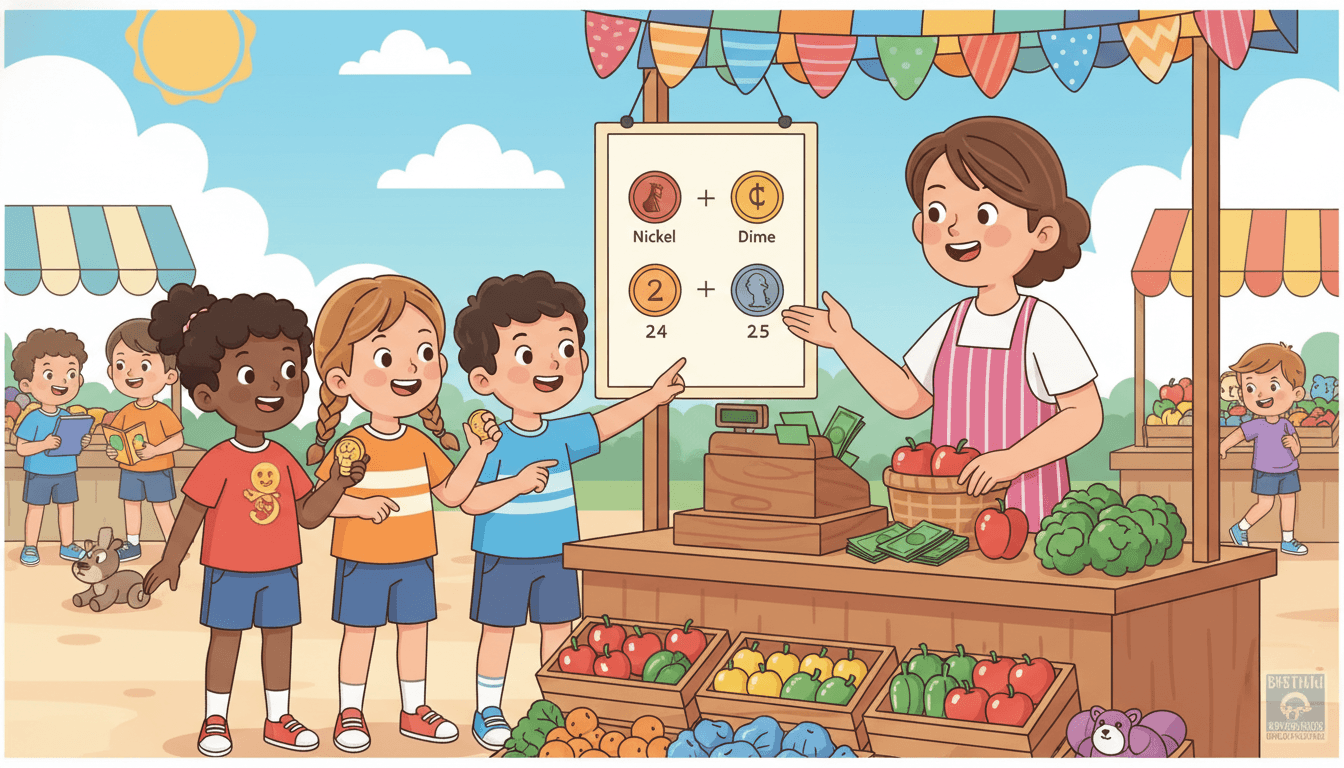
- US coins: penny (1¢), nickel (5¢), dime (10¢), quarter (25¢), half-dollar (50¢).
- Count coins from greatest to least value - count quarters first, then dimes, then nickels, then pennies.
- Money connects directly to decimals: $1.00, $0.25, $0.10, $0.01 match whole and decimal place values.
- Making change = 'counting up' from the cost to the amount paid.
What Is Money Math?
Money math teaches children to identify, count, and use US coins and bills to solve real-world problems.
It's also a powerful context for:
- Skip-counting (counting by 1s, 5s, 10s, 25s)
- Addition and subtraction
- Decimals (money is the most accessible decimal model)
- Real-world problem-solving
US Coins: Know Your Money
Penny: 1¢ - Copper color; Lincoln
Nickel: 5¢ - Largest of the small coins; Jefferson
Dime: 10¢ - Smallest coin; Roosevelt
Quarter: 25¢ - Most common; Washington
Half-dollar: 50¢ - Large; Kennedy
Dollar coin: 100¢ = $1.00 - Golden color
Key confusion to address early: The dime is smaller than the nickel but worth twice as much. Size ≠ value.
Counting a Mixed Collection of Coins
Strategy: Greatest to Least Value
Always count quarters first, then dimes, then nickels, then pennies.
2 quarters + 1 dime + 2 nickels + 4 pennies Count: 50¢ → 60¢ → 70¢ → 80¢ → 81, 82, 83, 84¢ Total: 84¢
This minimizes steps and connects to skip-counting patterns.
Dollars and Cents Notation
- Use the dollar sign ($) with a decimal point: $1.25
- Use the cent sign (¢) without a decimal: 75¢
- Do NOT write $1.25¢ - it's either $1.25 or 125¢
100 cents = $1.00
Making Change
Subtraction method:
Paid $5.00, cost $3.47 → $5.00 − $3.47 = $1.53
Counting-up method (more intuitive):
Cost: $3.47 → add 3¢ → $3.50 → add 50¢ → $4.00 → add $1.00 → $5.00 Change: 3¢ + 50¢ + $1.00 = $1.53
The counting-up strategy mirrors how cashiers make change in real life and is more reliable for students who struggle with subtraction across zeros.
Money and Decimals
Money directly models decimal place value:
- $1.00 = 1 whole
- $0.10 = 1 tenth (like a decimal tenth)
- $0.01 = 1 hundredth (like a decimal hundredth)
A dime is literally one tenth of a dollar. A penny is one hundredth. This connection is powerful - but students still need to build decimal understanding independently of the dollars/cents context.
What Grade Do Kids Learn Money?
1st Grade: Identify and know the value of coins (informal introduction).
2nd Grade: Solve word problems involving dollar bills, quarters, dimes, nickels, and pennies using $ and ¢ symbols (2.MD.C.8).
3rd Grade: Apply money in multi-step addition and subtraction word problems.
4th Grade: Money reappears in decimal context - reading, writing, comparing money amounts as decimals.
Common Misconceptions
"The dime is worth less because it's smaller." Size ≠ value. The dime is the highest-value small coin relative to its size. Always explicitly address this.
"$0.25¢ is a way to write 25 cents." This is a common error in the real world too. It's either $0.25 (dollar notation) or 25¢ (cent notation). Mixing both is redundant and technically incorrect.
"Start counting pennies first." Always count from greatest to least value. Pennies last.
Practice Activities
-
Coin recognition sort: Mixed coins; students identify and sort by type.
-
Make the amount: Given an amount, students build it three different ways using different coin combinations.
-
Counting up to $1.00: Given an amount less than $1, count up to the dollar using real or plastic coins.
-
Change calculator: Simple store scenarios; students calculate exact change.
-
Price comparison: Two items; students compare prices, find total, find change from $5 or $10.

Frequently Asked Questions
What are the US coins and their values?
Penny: 1 cent (¢). Abraham Lincoln on the front; Lincoln Memorial on the back. Nickel: 5 cents. Thomas Jefferson on the front. Dime: 10 cents - the smallest coin but worth more than the nickel (a common confusion). Franklin D. Roosevelt on the front. Quarter: 25 cents - 1/4 of a dollar. George Washington on the front. Half-dollar: 50 cents. Dollar coin: 100 cents = $1.00. Students need to recognize both the front and back and connect the name to the value. The dime-nickel size/value reversal is the most common early coin confusion.
What is the best strategy for counting a mixed collection of coins?
Count from greatest to least value: quarters first, then dimes, then nickels, then pennies. This strategy minimizes the number of steps. Example: 1 quarter + 2 dimes + 1 nickel + 3 pennies. Count: 25... 35, 45... 50... 51, 52, 53. Total: 53¢. Starting with the smallest coins (pennies first) creates more work and more opportunities for error. Teaching this 'greatest to least' strategy alongside skip-counting (counting by 25s, 10s, 5s, 1s) builds both skills simultaneously.
How do you make change?
Making change means finding how much money is returned when you pay more than the cost. Two strategies: Subtraction: Amount paid − Cost = Change. '$5.00 − $3.47 = $1.53.' Counting up (more intuitive): Start at the cost and count up to the amount paid. '$3.47 → $3.50 (3¢) → $4.00 (50¢) → $5.00 ($1.00) = $1.53 change.' The counting-up strategy is how cashiers typically make change and is more robust against arithmetic errors. It connects change-making to number lines and elapsed time strategies.
How does money connect to decimals?
Money is the most accessible real-world context for understanding decimals because the denominations directly map to place values: $1.00 = 1 whole, $0.10 = 1 tenth, $0.01 = 1 hundredth. A dime is literally one-tenth of a dollar; a penny is one-hundredth. When students encounter decimal notation in 4th grade, many have already internalized the structure through money. However, teachers should be careful not to simply say 'decimals are like money' - the concept of tenths and hundredths needs to be built independently of the dollars/cents context.
At what grade level is money formally taught?
Money is formally addressed in Common Core at 2nd grade (2.MD.C.8): solve word problems involving dollar bills, quarters, dimes, nickels, and pennies using $ and ¢ symbols appropriately. Before 2nd grade, money concepts are often introduced informally. After 2nd grade, money problems appear in the context of addition, subtraction, and eventually decimals. Money is not re-addressed in its own dedicated standard after 2nd grade in Common Core - it transitions into the decimals and operations standards in 4th-5th grade.
Free Money Worksheets
Curriculum-aligned printable worksheets for 1st – 4th Grade. Download free.
Common Core Standards