What Is the Order of Operations?
Taught in US schools
Key Takeaways
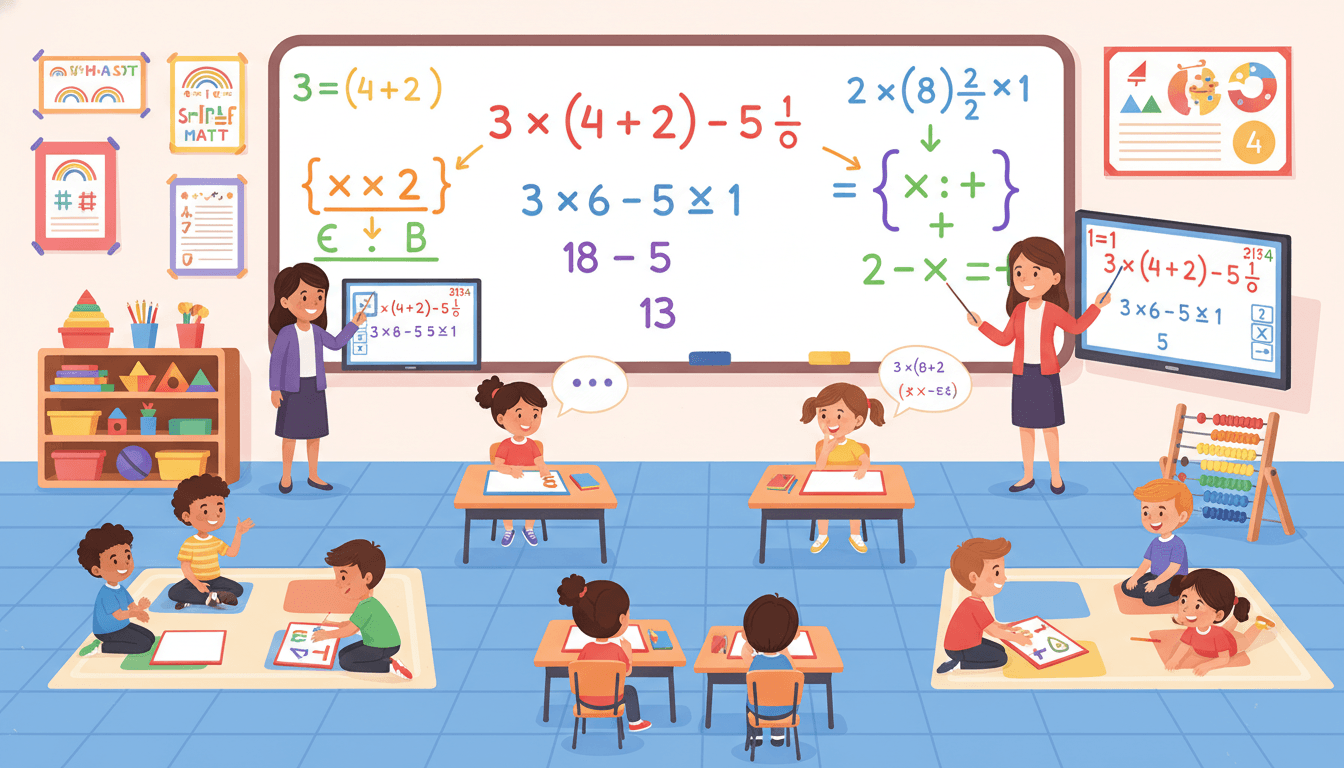
- PEMDAS stands for Parentheses, Exponents, Multiplication/Division (left to right), Addition/Subtraction (left to right).
- Without a consistent order, the same expression could produce different answers - order of operations makes math unambiguous.
- Multiplication and division are performed before addition and subtraction, regardless of their position in the expression.
- Parentheses always take priority - operations inside parentheses are evaluated first.
What Is the Order of Operations?
The order of operations is a set of agreed-upon rules that tells mathematicians the sequence in which to perform operations when an expression contains more than one. Without these rules, the same expression could yield multiple different answers.
PEMDAS is the acronym used in the United States:
- P - Parentheses (or other grouping symbols: brackets, braces)
- E - Exponents (powers and square roots)
- MD - Multiplication and Division (left to right, equal priority)
- AS - Addition and Subtraction (left to right, equal priority)
Memory device: "Please Excuse My Dear Aunt Sally"
Worked Examples
Example 1: 3 + 4 × 2
- Multiply first: 4 × 2 = 8
- Then add: 3 + 8 = 11 (not 14)
Example 2: (3 + 4) × 2
- Parentheses first: 3 + 4 = 7
- Then multiply: 7 × 2 = 14
Example 3: 20 ÷ 4 × 5
- Division and multiplication, left to right: 20 ÷ 4 = 5, then 5 × 5 = 25 (not 1)
Why This Grade?
5th grade (5.OA.A.1, 5.OA.A.2): Students evaluate expressions with parentheses, brackets, or braces. They also write simple expressions to record calculations and interpret them. Exponents are not formally introduced until 6th grade.
The M Before D Myth
PEMDAS lists M before D, but they are not in order of priority - they are equals. Perform multiplication and division as they appear from left to right. The same is true for addition and subtraction.
Incorrect: 8 ÷ 2 × 4 → 8 ÷ 8 = 1 (wrong - divides first because it comes first left to right)
Correct: 8 ÷ 2 = 4, then 4 × 4 = 16
Common Misconceptions
PEMDAS means multiply before divide: M and D are equal priority. Always work left to right within that tier.
Parentheses change the answer: Parentheses don't change rules - they specify which sub-expression to compute first. They're a tool for communication, not a violation of the order.
All problems need all six steps: Many expressions only use 2-3 operations. Students don't need to "go through" every PEMDAS letter - only the operations present in the expression.
Practice Activities
-
Expression matching: Give expressions and four possible answers; students identify the correct one and explain why.
-
Insert parentheses: Give 3 + 2 × 4 = 20 and ask: where do parentheses go to make this true?
-
Left-to-right emphasis: Drill MD and AS left-to-right with chains like 24 ÷ 6 × 2 and 15 - 3 + 7.
-
Expression writing: Describe a multi-step computation in words; students write the expression using correct order of operations.
-
Peer debate: Give a problem like 2 + 3 × 4 and have students argue for different answers, then resolve using PEMDAS.
Frequently Asked Questions
What is the order of operations?
The order of operations is a universal agreement about which operations to perform first in a multi-operation expression. The order is: Parentheses first, then Exponents, then Multiplication and Division (left to right), then Addition and Subtraction (left to right). Without this agreement, the same expression could give different answers depending on how you read it.
What does PEMDAS stand for?
PEMDAS stands for: Parentheses, Exponents, Multiplication, Division, Addition, Subtraction. A common memory device is 'Please Excuse My Dear Aunt Sally.' It is important to note that Multiplication and Division have equal priority and are performed left to right, as are Addition and Subtraction.
Why does multiplication come before addition?
This is a mathematical convention - an agreed-upon rule, not a natural law. The convention exists because it reduces the number of parentheses needed in formulas and expressions. For example, 2 + 3 × 4 is interpreted as 2 + 12 = 14. If you intended addition first, you would write (2 + 3) × 4 = 20.
Is PEMDAS the same as BODMAS?
PEMDAS (US) and BODMAS (British) describe the same order of operations with different names: Brackets/Parentheses, Orders/Exponents, Division/Multiplication, Addition, Subtraction. The result is identical. Both agree that multiplication and division share equal priority and are performed left to right.
What are common mistakes students make with order of operations?
Common mistakes include: (1) Always doing addition before subtraction or multiplication before division, instead of working left to right within each priority tier. (2) Ignoring parentheses. (3) Treating M and D as strictly in that order rather than left to right. For example, 12 ÷ 4 × 3 = 3 × 3 = 9 (not 12 ÷ 12 = 1).
Free Order of Operations Worksheets
Curriculum-aligned printable worksheets for 5th Grade. Download free.