What Are the Properties of Multiplication?
Taught in US schools

Key Takeaways
- The commutative property says you can multiply in any order: 3 × 5 = 5 × 3.
- The associative property lets you regroup factors: (2 × 3) × 4 = 2 × (3 × 4).
- The distributive property breaks multiplication over addition: 6 × 7 = 6 × (5 + 2) = 30 + 12 = 42.
- These properties reduce the number of facts students must memorize and support mental math strategies.
What Are the Properties of Multiplication?
The properties of multiplication are mathematical rules that describe how multiplication behaves. Understanding these properties deepens students' number sense, reduces the number of facts they must memorize, and builds the foundation for algebra.
The five key properties are: commutative, associative, distributive, identity, and zero.
The Five Properties
Commutative Property
Order doesn't change the product.
- 4 × 9 = 9 × 4 (both equal 36)
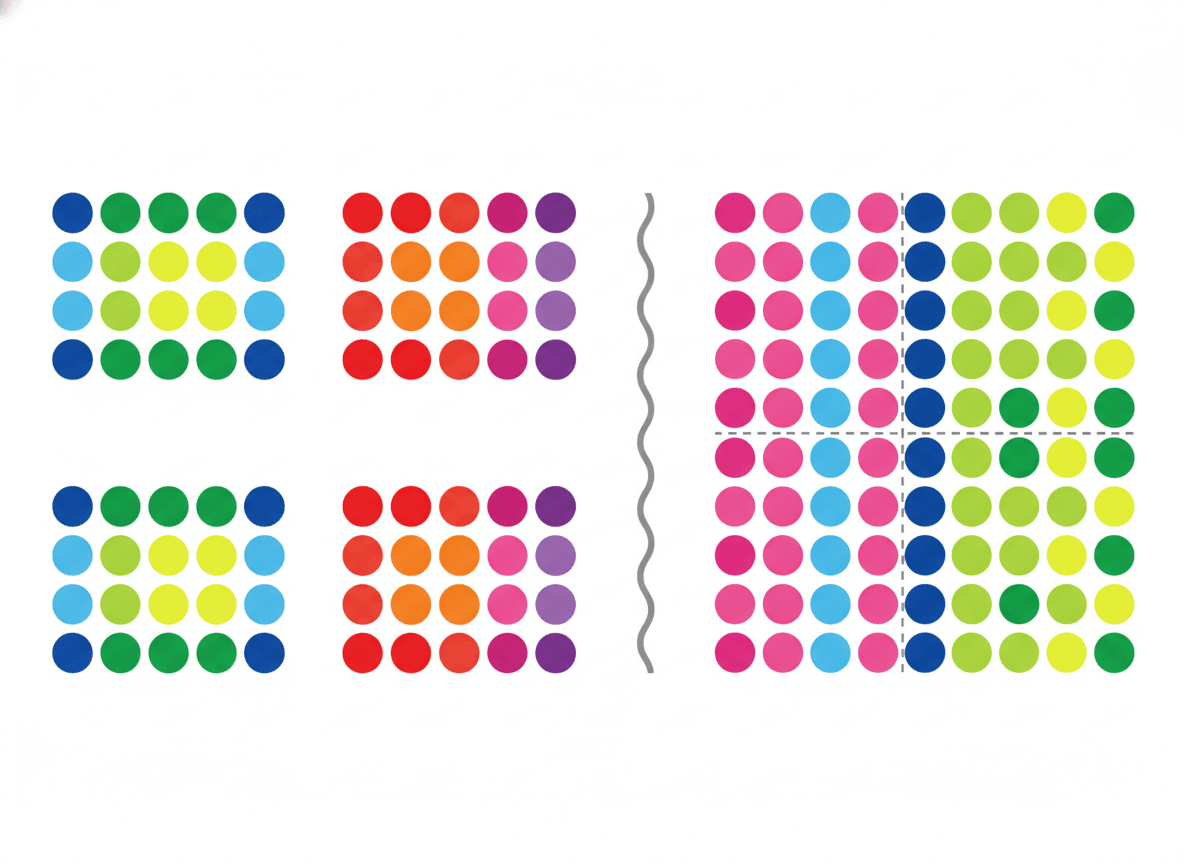
- Arrays show this visually: rotate a 4 × 9 array 90° to see a 9 × 4 array.
Associative Property
Grouping doesn't change the product.
- (2 × 3) × 5 = 2 × (3 × 5) = 30
- Useful for mental math: regroup factors to find easier pairs.
Distributive Property
Multiplication distributes over addition.
- 6 × 8 = 6 × (5 + 3) = (6 × 5) + (6 × 3) = 30 + 18 = 48
- This is the backbone of the area model and multi-digit multiplication.
Identity Property
Multiplying by 1 gives the same number.
- 7 × 1 = 7; 1 × 253 = 253
Zero Property
Multiplying by 0 gives 0.
- 8 × 0 = 0; 0 × 1,000 = 0
What Grade Do Kids Learn These Properties?
3rd grade (3.OA.B.5): Students apply commutative, associative, and distributive properties as strategies to multiply. These are used to derive unknown facts from known ones.
4th grade (4.NBT.B.5): The distributive property is extended to multi-digit multiplication using area models (partial products).
Common Misconceptions
The distributive property applies only to addition: The distributive property also works with subtraction: 6 × 8 = 6 × (10 - 2) = 60 - 12 = 48. Both versions are useful.
The commutative property applies to division: Unlike multiplication, division is NOT commutative. 12 ÷ 4 ≠ 4 ÷ 12. Students who over-generalize from multiplication need a clear correction.
The identity property is trivial: Some students dismiss the identity property as obvious. But understanding why a × 1 = a (multiplying by "one group of") is conceptually important and connects to fraction equivalence (multiplying by 2/2 = 1).
Practice Activities
-
Array rotation: Draw a 3 × 7 array and turn it to show 7 × 3 - same dots, different arrangement.
-
Fact family connection: Show how commutative pairs (5 × 8 and 8 × 5) produce the same product.
-
Distributive decomposition: Practice breaking one factor into friendlier parts (7 × 6 = 7 × 5 + 7 × 1).
-
Area model diagrams: Draw rectangles split into two sections to show the distributive property for 2-digit multiplication.
-
Property detective: Give multiplication equations and ask students to identify which property is being used.
Frequently Asked Questions
What are the properties of multiplication?
The five main properties are: (1) Commutative - order doesn't matter (a × b = b × a). (2) Associative - grouping doesn't matter ((a × b) × c = a × (b × c)). (3) Distributive - multiplication distributes over addition (a × (b + c) = a×b + a×c). (4) Identity - multiplying by 1 gives the same number (a × 1 = a). (5) Zero - multiplying by 0 gives 0 (a × 0 = 0).
Why is the distributive property important?
The distributive property is one of the most powerful tools in elementary and later math. It is the foundation of multi-digit multiplication (area model), mental math strategies, and algebra. When students understand that 7 × 8 = 7 × (5 + 3) = 35 + 21 = 56, they can break difficult facts into easier ones.
How does the commutative property reduce memorization?
Because multiplication is commutative (3 × 7 = 7 × 3), students only need to learn each pair of factors once. The multiplication table has 100 cells, but with commutativity, students only need to master 55 unique facts (the diagonal and one triangle). This is a huge reduction in memory load.
What is the associative property used for?
The associative property lets students regroup factors to make multiplication easier. For example, 5 × 3 × 6 can be computed as (5 × 6) × 3 = 30 × 3 = 90, which is easier than (5 × 3) × 6 = 15 × 6. This is especially useful in multi-step mental math.
When do students learn these properties?
The commutative and associative properties are introduced in 3rd grade as students develop multiplication fluency (3.OA.B.5). The distributive property is also introduced in 3rd grade and deepened in 4th grade when students multiply multi-digit numbers using the area model (4.NBT.B.5).
Free Properties of Multiplication Worksheets
Curriculum-aligned printable worksheets for 3rd – 4th Grade. Download free.