What Are Unit Fractions?
Taught in US schools
Key Takeaways
- A unit fraction has a numerator of 1: 1/2, 1/3, 1/4, 1/8.
- Unit fractions are the building blocks of all other fractions.
- 3/4 means 3 copies of the unit fraction 1/4.
- The larger the denominator, the smaller the unit fraction piece.
What Are Unit Fractions?
A unit fraction is any fraction with a numerator (top number) of 1:
1/2, 1/3, 1/4, 1/5, 1/6, 1/8, 1/10, 1/100...
The word "unit" means one - so a unit fraction represents exactly one equal part of a whole.
Unit fractions are the building blocks of all fractions. This is the core insight of the Common Core approach to fraction instruction: before students work with fractions like 3/4 or 5/6, they need to deeply understand what 1/4 and 1/6 mean.
Unit Fractions as Building Blocks
Once students understand unit fractions, they can think of any fraction as a count of unit fraction pieces:
3/4 = three copies of 1/4 5/6 = five copies of 1/6 7/8 = seven copies of 1/8
This "iterating unit fractions" model - stacking up copies of the unit fraction - makes fraction operations more intuitive and connects fractions to whole-number thinking.
The Key Relationship: Bigger Denominator = Smaller Piece
This is one of the most important concepts in fraction understanding - and one of the most common misconceptions.
1/8 < 1/4, even though 8 > 4
Why? The denominator tells you into how many equal pieces the whole is divided. If a sandwich is cut into 8 equal pieces, each piece is smaller than if it were cut into 4 equal pieces. More cuts → smaller pieces.
Common misconception: Students often think 1/8 is bigger than 1/4 because 8 is bigger than 4 in whole numbers. The fix is to keep the emphasis on the denominator's meaning: "the number of equal pieces in the whole."
Unit Fractions on a Number Line
Unit fractions can be placed on a number line between 0 and 1:
- 1/2 is exactly in the middle between 0 and 1
- 1/3 is one-third of the way from 0 to 1
- 1/4 is one-fourth of the way from 0 to 1
- 1/8 is one-eighth of the way from 0 to 1
This placement makes the size relationships visible - 1/8 is much closer to 0 than 1/2 is.
Non-Unit Fractions from Unit Fractions
Once students understand unit fractions, they build non-unit fractions by iterating:
Starting from 0, jump 1/4, 1/4, 1/4 → you land on 3/4.
This is why the CCSS introduces unit fractions before non-unit fractions: understanding 1/4 is prerequisite to understanding 3/4.
Practice Activities
- Use fraction strips or circle models to show unit fractions physically: one whole divided into 2 equal parts (1/2 each), then 3 (1/3 each), then 4, 6, 8. Count the pieces and connect to the fraction notation.
- Comparison activity: "Which is bigger - 1/3 or 1/5? How do you know? Draw a picture to prove it."
- Number line: students place unit fractions on a 0-to-1 number line and discuss the ordering.
- Iterate to build: give students 1/4 fraction pieces. How many jumps of 1/4 does it take to reach 1? How many to reach 3/4?

Frequently Asked Questions
What is a unit fraction?
A unit fraction is any fraction with a numerator (top number) of 1. Examples: 1/2, 1/3, 1/4, 1/5, 1/8, 1/10. The word 'unit' means 'one' - so a unit fraction represents one equal part of a whole. Unit fractions are the foundational pieces from which all other fractions are built.
How are unit fractions related to other fractions?
Any fraction can be understood as a certain number of unit fraction pieces. For example: 3/4 = three copies of 1/4. 5/6 = five copies of 1/6. 7/8 = seven copies of 1/8. This is the key insight behind the CCSS approach to fractions - students first deeply understand unit fractions before working with fractions with other numerators.
Why do unit fractions get smaller as the denominator gets bigger?
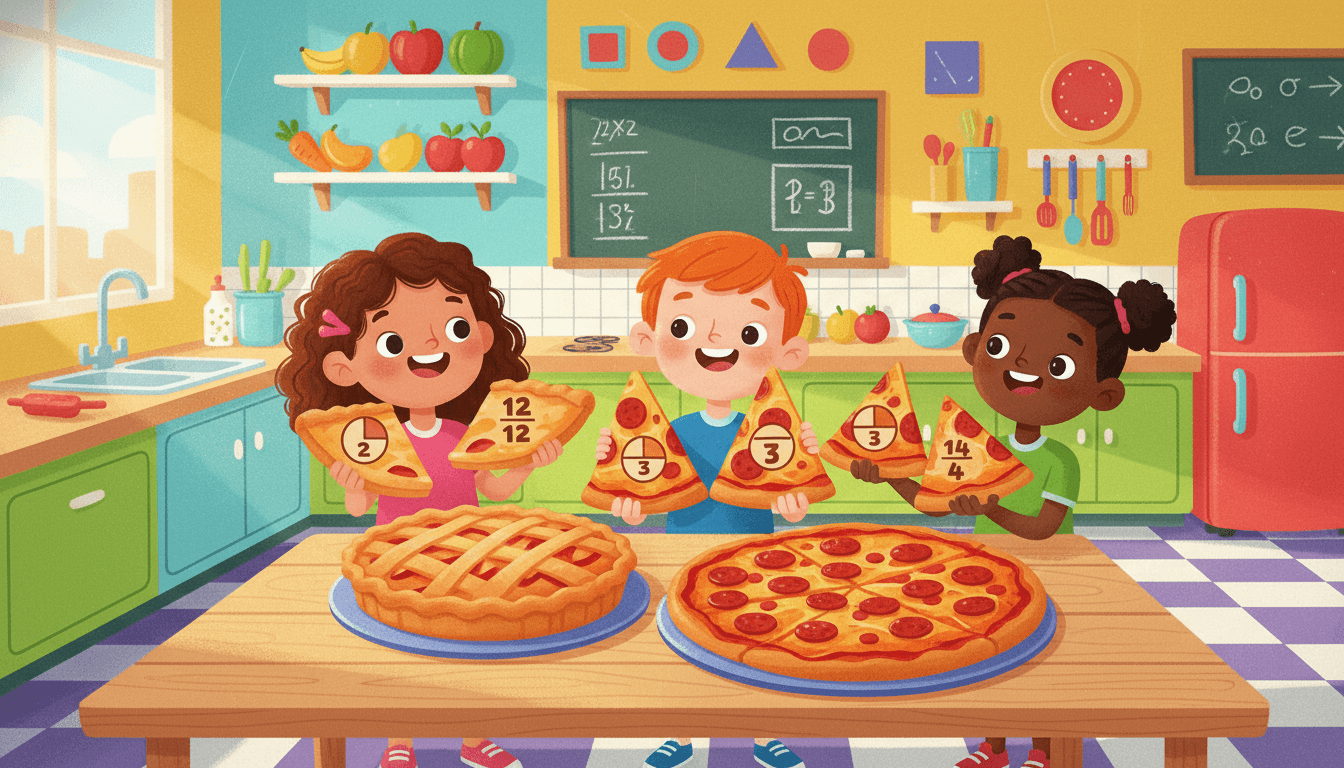
The denominator tells you how many equal pieces a whole is cut into. If a pizza is cut into 4 pieces, each piece (1/4) is bigger than if the same pizza were cut into 8 pieces (1/8). The more pieces you divide the whole into, the smaller each piece. This is counterintuitive for many students - they may think 1/8 is bigger than 1/4 because 8 > 4. Understanding denominators as 'number of equal pieces in a whole' fixes this misconception.
Free Unit Fractions Worksheets
Curriculum-aligned printable worksheets for 2nd – 4th Grade. Download free.