What Are Word Problems?
Taught in US schools
Key Takeaways
- Word problems require translating language into mathematical operations - they test both reading comprehension and math skill.
- There are distinct problem types (join, separate, compare, part-part-whole) that call for different operations.
- The most common error is grabbing numbers and applying a random operation - teach kids to read for meaning first.
- Drawing diagrams (bar models, number lines, pictures) bridges language and mathematics.
Word problems are where math becomes real. They're also where a surprising number of students who are strong at computation hit a wall. The bridge between "understanding arithmetic" and "applying it in context" requires its own instruction.
What Are Word Problems?
A word problem is a math problem presented in written language, describing a situation that can be solved mathematically.
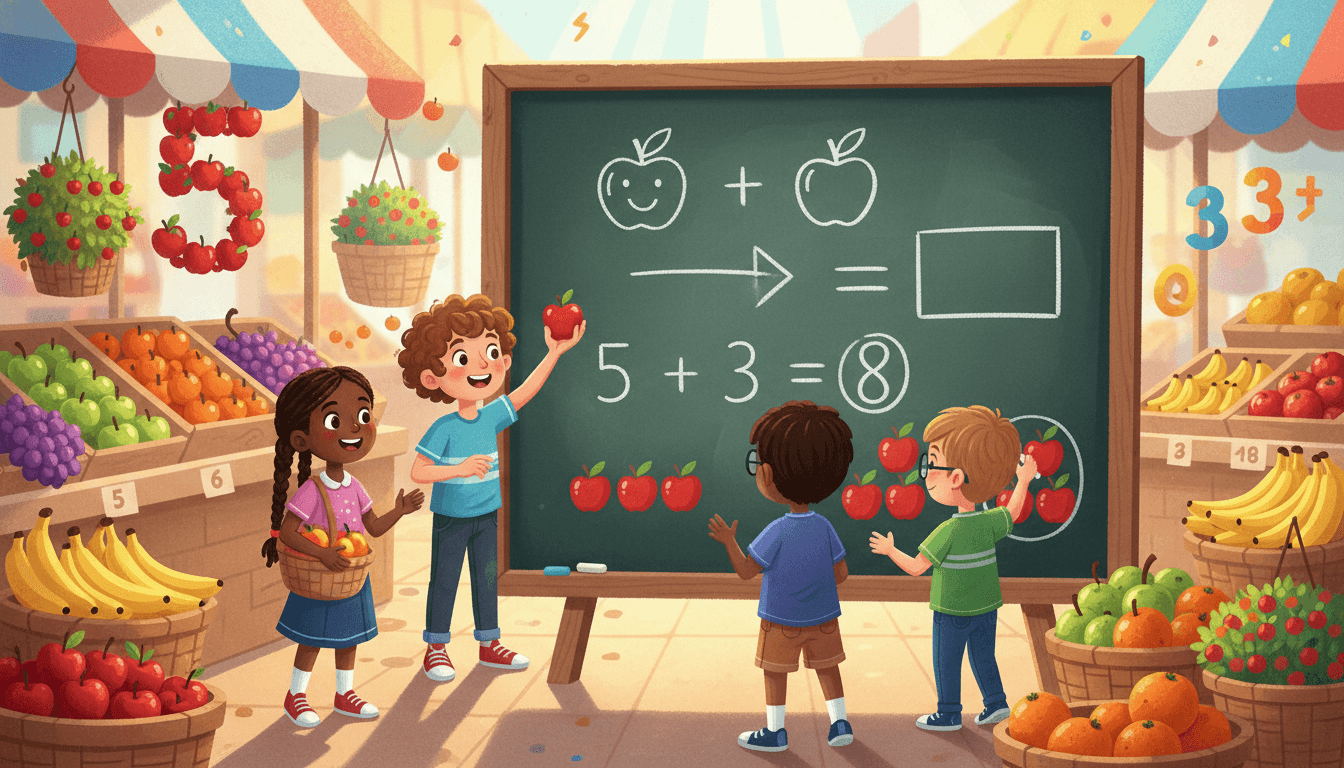
Instead of "7 – 4 = ?", a word problem says: "Marco had 7 apples. He gave 4 to his friend. How many does he have now?"
The mathematical content is the same. But the student must first read and understand the situation, identify the relevant quantities, determine which operation applies, and then execute the computation.
Problem Types
Not all word problems are the same. The structure of the situation determines which mathematical action is needed:
Join problems: A quantity increases. "Maria had 6 books. She bought 4 more. How many does she have?" (Addition - result unknown)
Separate problems: A quantity decreases. "Maria had 10 books. She gave away 4. How many does she have left?" (Subtraction - result unknown)
Compare problems: Two quantities are compared. "Maria has 10 books. Jake has 6. How many more does Maria have?" (Subtraction - difference found) OR "Maria has 4 more books than Jake, who has 6. How many does Maria have?" (Addition)
Part-part-whole problems: Two parts make a total. "There are 6 red and 4 blue marbles. How many total?" (Addition) OR "There are 10 marbles, 6 are red. How many are blue?" (Subtraction)
Multiplicative structures (3rd grade+): Equal groups, arrays, area, comparison. "Each box has 6 crayons. There are 4 boxes. How many crayons?" (Multiplication)
What Grade Do Kids Work on Word Problems?
Word problems appear at every grade level, growing in complexity:
K-1: Simple one-step addition and subtraction problems with small numbers, usually supported by pictures.
2nd Grade: One- and two-step problems. All four addition/subtraction problem types. Introduction to equal groups for multiplication.
3rd Grade: Multiplication and division word problems. Two-step problems mixing operations.
4th Grade: Multi-step problems. Fractions and measurement contexts. Interpreting remainders in division problems.
5th Grade: Fractions, decimals, and whole number operations in multi-step problems. Problems involving rate, ratio, and measurement conversion.
Common Misconceptions
"Look for keyword clues." Keyword strategies ("more = add," "less = subtract," "total = add") fail more often than people think. "How many more" actually means subtraction. "There are 3 more" might mean addition. Teaching kids to read for meaning beats teaching them to grab keywords.
"Always use all the numbers." Some word problems contain irrelevant information. Kids who use every number get wrong answers on problems designed with extras.
"Show the work is writing the equation." Writing "6+4=10" doesn't reveal mathematical thinking. Encourage written explanations, diagrams, or labeled work that shows reasoning.
How to Teach Word Problems
Read for meaning, not numbers. Before anything else, ask: "What's happening in this story?" Kids should be able to retell the problem in their own words before they write a single number.
Vary problem types deliberately. Ensure kids encounter join, separate, compare, and part-whole problems - and expose them to unknowns in all three positions (result, change, start unknown).
Teach bar models (tape diagrams). A simple rectangular diagram representing the quantities in the problem helps students see the structure before computing.
Use problems with realistic, relevant contexts. Problems about things kids care about get more engagement and better reasoning. Sports scores, classroom objects, food quantities - relatable contexts lower the cognitive barrier.
Discuss wrong approaches, not just right answers. "What did you try first? Why didn't that work?" is often more instructive than "Great, that's correct!"
Practice Activities
-
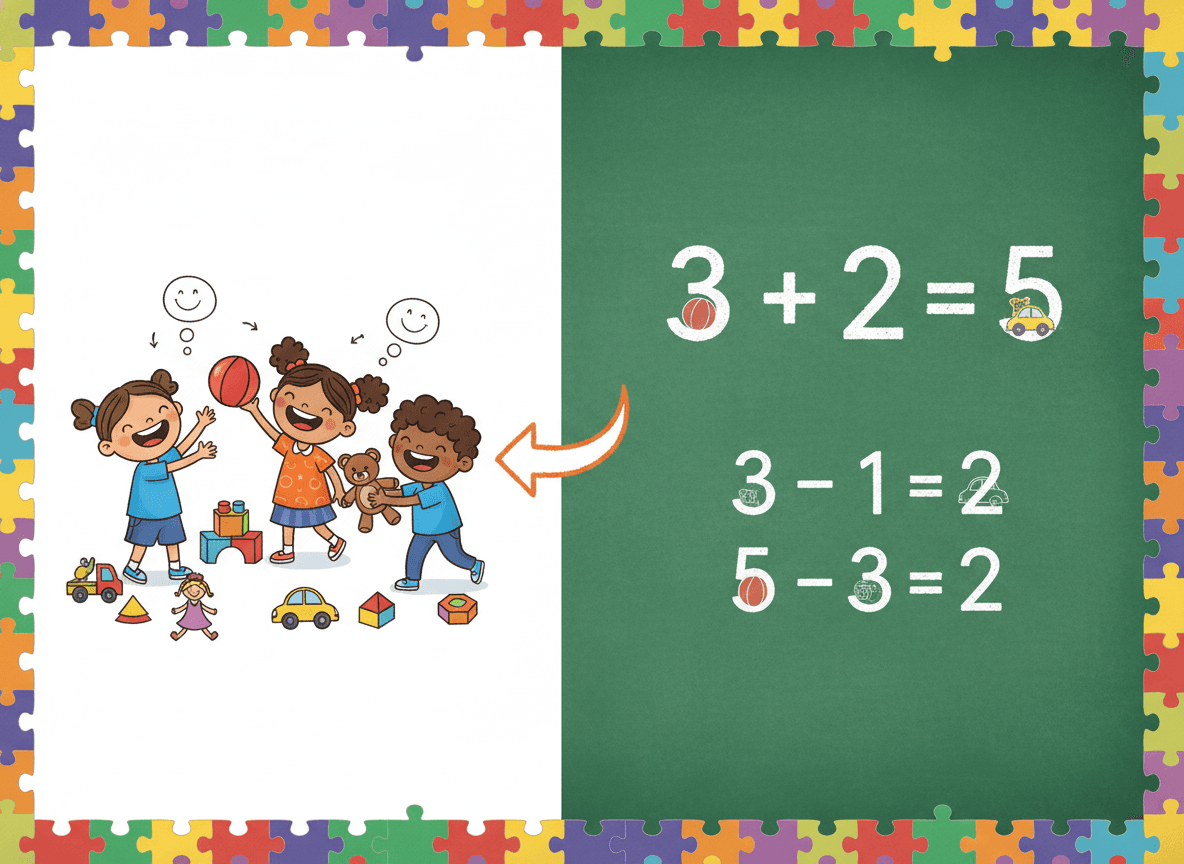
Act it out: Use physical objects to model the situation before writing equations.
-
Draw it first: Sketch a picture or bar model of the problem before computing.
-
Three-reads protocol: Read 1 - what's the situation? Read 2 - what's the question? Read 3 - what information is given?
-
Write your own: Give kids an equation and have them write a word problem to match. Reveals depth of understanding.
-
Two-step problem pairs: Solve the first step, write the new "simpler" problem it creates, then solve step two.
Frequently Asked Questions
Why do kids find word problems harder than computation?
Word problems require two things simultaneously: reading comprehension and mathematical reasoning. A student might be able to compute 47-29 easily but struggle to recognize that 'Maria has 47 stickers and gives away 29' calls for subtraction. The bottleneck is often language comprehension - understanding the situation - rather than the arithmetic itself. For English learners or students with reading difficulties, the language load of word problems can be especially challenging.
What are the main types of addition and subtraction word problems?
Research identifies at least 14 types, but the main categories are: Join (something is added to a group), Separate (something is removed), Part-Part-Whole (two parts make a whole), and Compare (two quantities are compared). Each type has three versions: result unknown, change unknown, or start unknown. Many classrooms only expose kids to 'result unknown' problems, leaving them unprepared for problems where the unknown is in a different position.
What is a bar model and how does it help with word problems?
A bar model (also called a tape diagram) is a rectangular diagram that represents quantities in a problem as bars of proportional length. It provides a visual structure for the problem before any arithmetic begins. For 'Maria has 8 more stickers than Jake. Jake has 15. How many does Maria have?' - drawing Jake's bar (15) and Maria's bar (15+8) makes the structure clear. Bar models are popular in Singapore Math curricula and align well with Common Core's emphasis on mathematical reasoning.
What is the CUBES strategy for word problems?
CUBES is a step-by-step strategy: Circle numbers, Underline the question, Box key words, Eliminate extra info, Solve and check. It's widely taught and gives students a systematic approach. However, researchers note that keyword strategies (like 'more means add') can backfire - 'more' appears in subtraction problems too ('how many more?'). CUBES works better as a problem-reading habit than as a keyword-matching algorithm.
What makes a word problem harder - the numbers or the structure?
The structure (problem type and position of the unknown) is usually more challenging than the number size. A problem asking 'Jake had some stickers. He got 9 more. Now he has 15. How many did he start with?' is harder than 'Jake has 47 stickers and gets 23 more' even though the numbers are smaller. This is because the unknown is in the start position, which requires working backward. Expose kids to all structural types, not just result-unknown problems.
Free Word Problems Worksheets
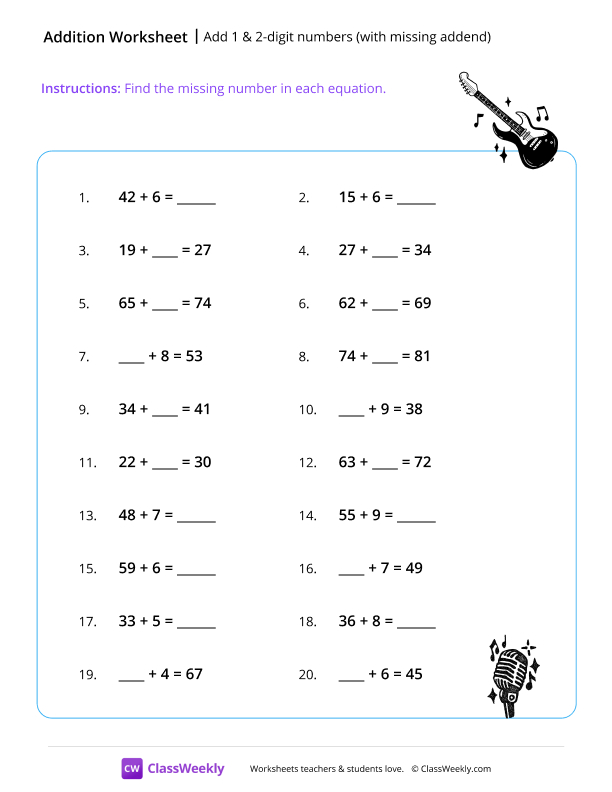
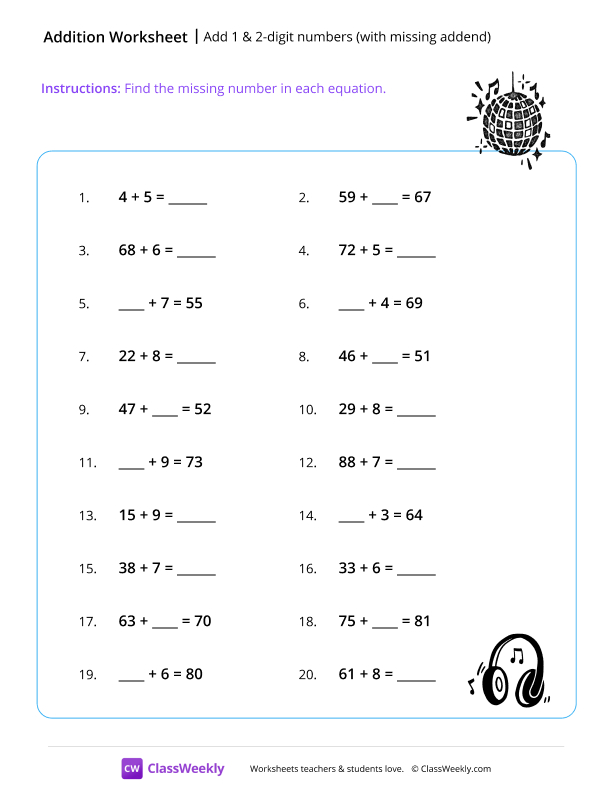
Curriculum-aligned printable worksheets for Kindergarten – 5th Grade. Download free.