

Workbook for Kids with ADHD: How to Choose and Use One
Get 30 days of free worksheet downloads
Key Takeaways
- A good workbook for kids with ADHD has short pages, one skill per page, lots of white space, and directions a child can read in one breath.
- How you use the workbook matters as much as which one you buy: a visible timer, a page or two at a time, and a movement break between pages.
- Make progress something your child can see and touch, like a checklist on the cover, stickers, or a stack of finished pages.
- Workbooks are a practice tool, not a treatment. For individual support, talk with your child's teacher or pediatrician.
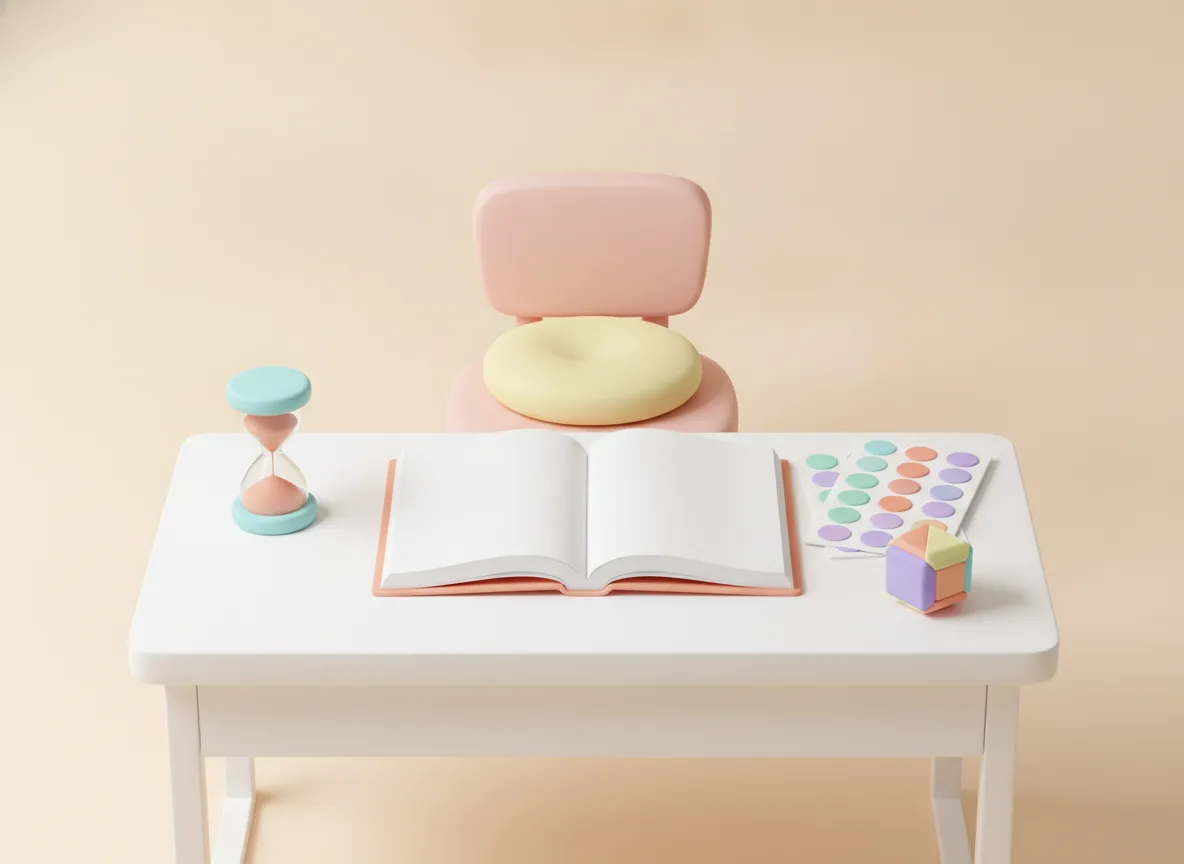
The best workbook for kids with ADHD has short pages, one skill per page, plenty of white space, and directions your child can read in one breath. Just as important is how you use it: a page or two at a time, with a timer, a movement break, and a way for your child to see their progress.
That's the whole idea. Busy, curious, wiggly kiddos can absolutely enjoy workbook time. They just need pages that don't look like a mountain, and a routine that ends before their focus does.
Quick note before we start: everything here is practical, everyday stuff for parents, not medical advice. If you'd like individual support for your child, their teacher or pediatrician is the right person to ask.
If you'd rather skip the hunting, you can build a personalized workbook with only the skills your child is practicing, with their name right on the cover. Read on for what to look for first.
What to Look for in a Workbook for Kids with ADHD
Walk down the workbook aisle and most books look alike. Flip a few pages, though, and the differences jump out fast. Here's what to check.
One skill per page
A page that mixes addition, telling time, and a word problem asks your child to switch gears three times. That's tiring for any kid, and harder for a distractible one. Pick pages that stick to one thing, like "add within 10" or "short a words," so your child can settle into a rhythm.
Short pages with lots of white space
Count the problems. Six to ten on a page feels finishable. Thirty tiny problems crammed edge to edge feels like a wall, even if your child knows every answer.
White space matters too. Big boxes to write in, room between problems, and simple pictures (not busy cartoon scenes in every corner) give the eyes somewhere to rest.
Directions they can read in one breath
"Add the numbers. Write the answer in the box." That's it.
Long, multi-step directions get skimmed, and then the whole page goes wrong. If your child can't repeat the directions back to you, the page is probably too wordy.
A clear finish line
Your child should be able to look at the page and know exactly when they're done. A numbered list, a row of boxes, or a "Done!" star at the bottom all help. Open-ended pages ("write as many words as you can") are lovely for some days, but they're hard to start when focus is low.
The right skills, at the right level
Honestly, this one matters more than anything else on the list. A page that's too hard leads to avoidance. A page that's too easy leads to boredom, and boredom is its own kind of distraction. The sweet spot is a page your child can do mostly on their own, with a little bit of challenge.
Free addition Worksheets


Worksheets and Printables for Kids with ADHD vs a Bound Workbook
There's no single right format. Each one has a real strength, so pick based on your child.
Bound workbooks from the store
Series like Spectrum, Brain Quest, and Kumon are easy to find and well organized. Kumon's math workbooks are built one skill per book, which suits a child who does best with sameness. A bound book also keeps everything in one place, so nothing gets lost under the couch.
The catch is that a bound book follows its own order. If your child is stuck on one skill, you may need to skip around, and a thick book can look intimidating before they even open it. A trick that helps: fold the book open to today's page only, or clip the finished pages together so the "left to do" part stays out of sight.
When is a bound book the better choice? If your child loves a predictable routine and is right on grade level in that subject, a single-skill bound workbook can be a great fit.
Loose printables
Free worksheets and printables for kids with ADHD have one big advantage: you can hand over one page at a time. A single sheet on an empty table looks small and doable. You also control the order completely.
The downside is the hunting. Finding pages that match, at the right level, takes time, and a stack of mismatched printables from five different sites can feel random to a child. You can find plenty of free, grade-sorted options in our free workbooks for kids collection, or grab single pages like these 1st grade addition worksheets to get started.
A personalized workbook
This is the middle ground, and it's the one we built. You answer a short quiz, pick your child's grade and one subject per workbook, and then choose the exact skills they're working on. So if your second grader is stuck on subtraction with regrouping, every page is subtraction with regrouping (the same skill you'd find in our 2nd grade subtraction worksheets), and nothing else.
Your child's name goes on the cover and in the title (think "Maya's Math Adventure"), which gives a lot of kids a real sense of ownership. It's print-ready in about a minute, uses teacher-made, Common Core aligned worksheets, and you can edit the cover and pages afterwards. Access starts with a free trial. If that sounds useful, make a workbook with your child's name on the cover and try a page or two this week.
ADHD Homework Tips for Workbook Time
The workbook is only half the story. The other half is the routine around it. These are simple, practical habits, and a couple of them line up with guidance from the CDC.
Keep sessions short
The CDC's ADHD in the Classroom page suggests making sure assignments are "not long and repetitive," and notes that for children with ADHD, paying attention takes extra effort and can be very tiring.
At home, that translates to one or two pages per sitting. Stop while it's still going well.
Use a timer they can see
A visual timer (the kind where a colored disk shrinks as time passes) turns "how much longer?" into something your child can check on their own.
Set it for a short block, like 8 or 10 minutes, and let your child press start. When it rings, they're done, even if the page isn't. You can finish it next time.
Move between pages
A quick movement break between pages resets the body: ten jumps, a lap around the yard, or carrying the finished page to the fridge. We cover movement breaks and daily structure in depth in our guide to homeschooling a child with ADHD, so here we'll just say: build the break into the workbook routine itself, so it's expected, not earned.
Find your child's best time of day
Right after school is often the worst moment. Most kids need a snack, some fresh air, and a bit of downtime first. Some kids focus best in the morning before school, others after dinner. Try a few times over a week or two and watch which one goes smoothest, then keep it consistent.
Clear the space
One pencil, one eraser, one page. Put away the rest of the book, the other crayons, and anything with a screen. A cleared table tells your child exactly what this moment is for.
Make Progress Visible
For a lot of kids, "you're doing great" is nice to hear but hard to hold on to. Progress they can see and touch sticks much better.
- A checklist on the cover. List each page or each day, and let your child check off the box themselves.
- Stickers. One sticker per finished page. Simple, cheap, and surprisingly motivating.
- A growing stack. Keep finished pages in a folder or clip, so your child can feel it get thicker over the week.
- A progress strip. Draw a "road" with one square per page and color in a square each time.
The point isn't the reward itself. It's that your child can look at the cover and think, "I did all of that." That feeling is what brings them back tomorrow.
Let Your Child Make Choices
A small choice turns "you have to" into "I picked." The CDC page above also suggests giving students choices in how they show what they know, and the same idea works beautifully at home.
Try offering two options, never ten:
- "Do you want the addition page or the number line page first?"
- "Pencil or marker today?"
- "Table or clipboard on the floor?"
- "Two pages now, or one now and one after dinner?"
Both options lead to practice, so you win either way. And your child gets a little bit of control, which honestly cuts down on a lot of pushback.
Celebrate Finishing, Not Perfection
When the timer rings or the page is done, celebrate the finish first. Check the work afterwards, briefly, and pick one thing to fix, not five.
A few ways to mark the moment:
- A high five and a "you stuck with it!"
- Reading the page out loud together, like a little victory lap
- Hanging the best page on the fridge for the day
- Telling another family member at dinner what they finished
Mistakes are normal and useful. They show you which skill to practice next. If the same mistake keeps showing up, that's your cue to go back to an easier page on that skill, not to push harder. (This is one reason choosing the exact skills matters so much: when you can see where your child is stuck, you can pick pages that meet them there.)
When to Ask for More Support
Workbooks are a practice tool. They're not a treatment for ADHD, and they won't replace the support your child might get at school or from their doctor.
If workbook time is a daily battle even with short pages and breaks, if your child seems stuck on the same skills for months, or if you're worried about attention, behavior, or school progress in general, please reach out. Your child's teacher sees them in a different setting and may have ideas or supports to share. Your pediatrician is the right person for questions about attention and next steps. You don't need to figure it out alone.
Ready-to-Use Workbooks by Grade
If you want to start with something ready-made, these collections are a good place to begin:
- Weekly practice packs for 1st grade, which break practice into small, steady chunks
- Free 2nd grade workbooks, sorted by topic
- 3rd grade multiplication workbooks, for focusing on one set of facts at a time
FAQ
What is the best workbook for kids with ADHD? Look for one with short pages, one skill per page, plenty of white space, and simple directions. It should also practice the exact skills your child is working on right now, so every page feels doable and relevant instead of random.
How many workbook pages should a child with ADHD do a day? Start with one or two pages and stop while it's still going well. A finished page and a good mood beat five half-done pages and a meltdown. You can add a page later if your child is asking for more.
Are printables or a bound workbook better for kids with ADHD? Both can work. Loose printables let you hand over one page at a time, which keeps the task looking small. A bound workbook keeps everything in one place and shows progress as the finished pages pile up. Many families use a bound or stapled workbook but tear out or fold back the day's page.
Can a workbook help my child's ADHD? A workbook is a way to practice school skills, not a treatment for ADHD. What a well-chosen workbook can do is make practice time shorter and calmer. For questions about attention, behavior, or support plans, talk with your child's teacher or pediatrician.
What time of day is best for workbook practice? Whenever your child is fed, rested, and has already moved their body. For many kids that's after a snack and some outdoor play, not straight off the school bus. Watch for your child's own best window and keep it consistent.
Keep Reading
- Are Workbooks Good for Kids? When They Help and Don't
- Personalized Worksheets for Kids: What Really Works
Some days the timer will ring after half a page, and that's okay. Short, calm, and finished beats long and tearful every time. Keep the pages small, keep the wins visible, and watch your kiddo go from "do I have to?" to "can I do the sticker now?" 💕

Adi Ackerman
Head Teacher
Adi is the Head Teacher at ClassWeekly, with years of experience teaching elementary students. She designs our curriculum-aligned worksheets and writes practical guides for teachers and parents.
Ready to download? Try ClassWeekly free for 30 days.
Unlimited worksheets for PreK through 5th grade. Cancel anytime.