Adjectives after Linking Verbs
Written by Adi Ackerman, Head Teacher
"Adjectives after Linking Verbs" is written for 4th Grade (Ages 9-10), and it covers Common Core L.4.1.D. If your little one is a year younger but already steady on adjectives adverbs, the page still works. You may just need to read the instructions out loud. And if they are older and adjectives following nouns never quite stuck, this is a short review rather than busywork.

Grade 4 adjectives and adverbs worksheet on adjectives after linking verbs. Underline the adjective that follows the linking verb and describes the subject in each sentence. Printable PDF. Includes an answer key. Part of our adjectives following nouns adjectives adverbs collection. Aligned to Common Core standards.
How do I use this worksheet?
Introduce the skill with a brief whole-class activity, such as calling out examples and asking students to give a thumbs up when they hear adjectives following nouns in a sentence. Then let students work through it independently, since students at this age benefit more from productive struggle than from being walked through each step, referring to a class anchor chart if one is available. When reviewing answers, ask students to explain why an answer is correct rather than just confirming it. These adjectives following nouns worksheets work well as a focused practice activity, a homework assignment, or a warm-up at the start of a language arts lesson.
What students will practice
- Students will identify and correctly use adjectives following nouns in sentences and short passages.
- Students will distinguish adjectives following nouns from related language concepts and apply rules consistently.
- Students will demonstrate understanding of adjectives following nouns through independent reading and discussion, in both reading and their own writing.
Curriculum Links
Common Core State Standards
Language · 4th Grade
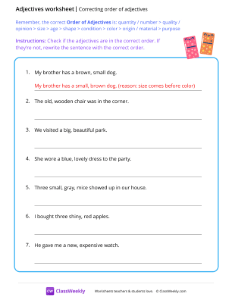
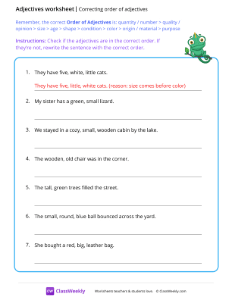
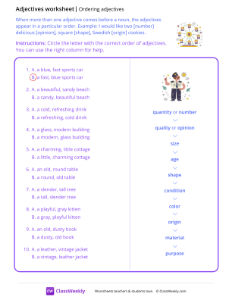
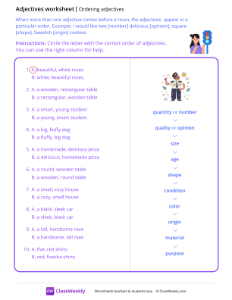
Standard: Order adjectives within sentences according to conventional patterns (e.g., a small red bag rather than a red small bag).
View all L.4.1.D worksheets →Find this in the curriculum
Browse the grade, subject, and topic this belongs to.
FAQ
How do I use this adjectives following nouns worksheet?
⌄
Introduce the skill with a brief whole-class activity, such as calling out examples and asking students to give a thumbs up when they hear adjectives following nouns in a sentence. Then let students work through it independently, since students at this age benefit more from productive struggle than from being walked through each step, referring to a class anchor chart if one is available. When reviewing answers, ask students to explain why an answer is correct rather than just confirming it. These adjectives following nouns worksheets work well as a focused practice activity, a homework assignment, or a warm-up at the start of a language arts lesson.
What does this worksheet teach?
⌄
These adjectives following nouns worksheets for 4th grade give students the targeted language arts practice they need to master this important grammar skill. Students identify, sort, complete, and write using adjectives following nouns through a variety of exercises designed to reinforce both recognition and application. Our adjectives adverbs worksheets connect grammar practice to reading and writing so students see how adjectives following nouns works in real language. Building a solid understanding of adjectives following nouns in 4th grade sets students up for stronger writing and clearer communication in every subject.
Can I use this adjectives following nouns worksheet for homeschool or classroom?
⌄
Yes, both. We made it for 4th Grade adjectives adverbs, and the page works the same whether it lands on a kitchen table or a center rotation. At home, most families go through it together and talk the answers out loud, and that talking is where most of the learning happens with adjectives following nouns. In class it runs well as independent work while you pull a small group. Print one copy or thirty, whichever the day needs.
When do adjectives follow a noun rather than precede it?
⌄
Adjectives follow nouns in predicate positions after linking verbs ('The sky is blue') and in fixed expressions or formal constructions ('the attorney general,' 'something beautiful').
How do predicate adjectives differ from attributive adjectives?
⌄
Attributive adjectives come before the noun ('a blue sky'), while predicate adjectives come after a linking verb and describe the subject ('The sky is blue') - both modify the noun but in different positions.
How does studying post-noun adjectives help with reading comprehension?
⌄
Recognizing adjectives in predicate positions helps students correctly identify what is being described in complex sentences, improving their ability to parse sophisticated text structures.
What adjective and adverb skills do fourth graders learn?
⌄
Fourth graders learn to use adjectives and adverbs with more precision, and one specific skill is ordering multiple adjectives correctly (CCSS L.4.1d). English has an unwritten order for stacked adjectives: opinion, size, age, shape, color, then material, which is why "a lovely little old red wagon" sounds right and "a red old little lovely wagon" does not. Students practice putting adjectives in that natural order without ever memorizing the rule as a list. Fourth grade also covers predicate adjectives, which follow a linking verb and describe the subject ("The soup smells delicious," where delicious describes the soup, not the verb). On the adverb side, students work with relative adverbs (where, when, why) and adverbs that tell how, when, or where an action happens. The through-line is precision: choosing the exact describing word and placing it where it reads naturally. Common confusion comes from mixing up adjectives and adverbs, since many adverbs simply add -ly. Worksheets that ask students to reorder scrambled adjectives, identify the adjective after a linking verb, and pick the precise describing word give the focused practice CCSS L.4.1d expects.
What is a predicate adjective, and how do you teach adjectives that follow linking verbs?
⌄
A predicate adjective is an adjective that comes after a linking verb and describes the subject of the sentence, as in "The lake is calm" or "The bread smells fresh." The trick your fourth grader needs is spotting the linking verb. Linking verbs (is, are, was, seems, feels, looks, smells, tastes, sounds) do not show action, they connect the subject to a word that describes it. So in "The puppy looks sleepy," the word looks links puppy to sleepy, and sleepy describes the puppy, not the looking. Teach it by asking two questions: is this verb an action or a link, and does the describing word tell more about the subject? If both point back to the subject, it is a predicate adjective. A helpful test is to swap the verb for "is": if "The bread is fresh" still makes sense, then smells is working as a linking verb. Worksheets that give sentences with linking verbs and ask students to underline the predicate adjective, then to write their own, make this abstract idea concrete. This work supports the precise describing-word skills fourth graders build under CCSS L.4.1.
How do worksheets help fourth graders use adjectives and adverbs precisely?
⌄
Worksheets turn a fuzzy skill into targeted practice. Precision with adjectives and adverbs is hard to teach through explanation alone, because the rules feel invisible to students. A worksheet that scrambles adjectives and asks students to reorder them ("old, blue, a, comfortable sweater") makes the natural order (CCSS L.4.1d) something they feel rather than memorize. A worksheet that gives sentences with linking verbs trains students to find the predicate adjective and see that it describes the subject. Exercises that ask students to replace a weak, general adjective with a precise one ("nice" becomes "welcoming," "big" becomes "enormous") build the vocabulary that strong writing depends on. And sorting tasks that separate adjectives from adverbs help students stop confusing the two, since many adverbs just add -ly. The most useful sets end by asking students to write their own sentences, because using a word correctly is different from labeling it. Practicing these skills in short, focused doses, then applying them in a sentence of their own, is how fourth graders move from knowing about describing words to choosing them well.
Ratings & Reviews
No reviews yet. Be the first to share what you think.
Reviews are for ClassWeekly members.
Make a Request
Spotted something to fix, or want a worksheet we don't have yet? Tell us and we'll make it.
Worksheet Details
| Grade | 4th Grade |
| Subject | Grammar & Writing |
| Topic | Adjectives Adverbs |
| Standard | L.4.1.D |
| Pages | 1 page |
| Difficulty | Medium |
What is ClassWeekly?
ClassWeekly offers free worksheets and printable learning resources for kids in preschool to grade 5. All worksheets are aligned to Common Core, NGSS, and C3 Framework standards and designed by educators. Become a member to access the full library and download unlimited PDFs.