Write Your Name
Written by Adi Ackerman, Head Teacher
"Write Your Name" is written for Kindergarten (Ages 5-6), and it covers Common Core L.K.1.A. If your little one is a year younger but already steady on handwriting, the page still works. You may just need to read the instructions out loud. And if they are older and writing your name never quite stuck, this is a short review rather than busywork.

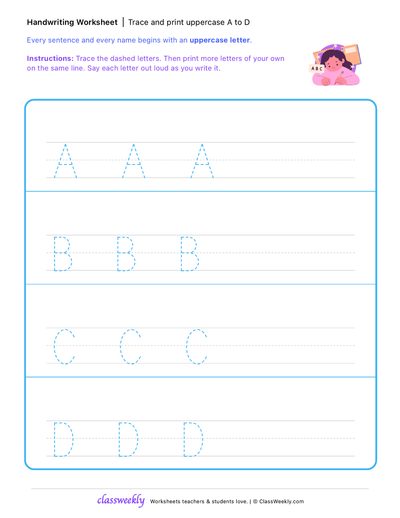
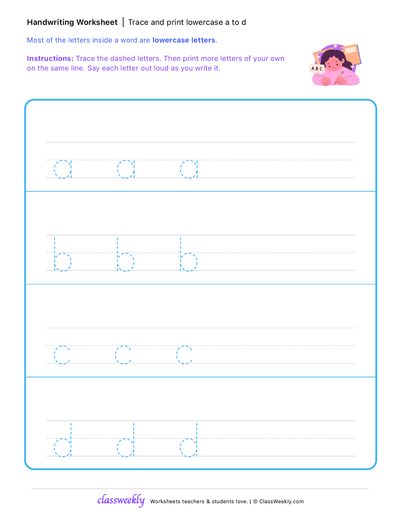
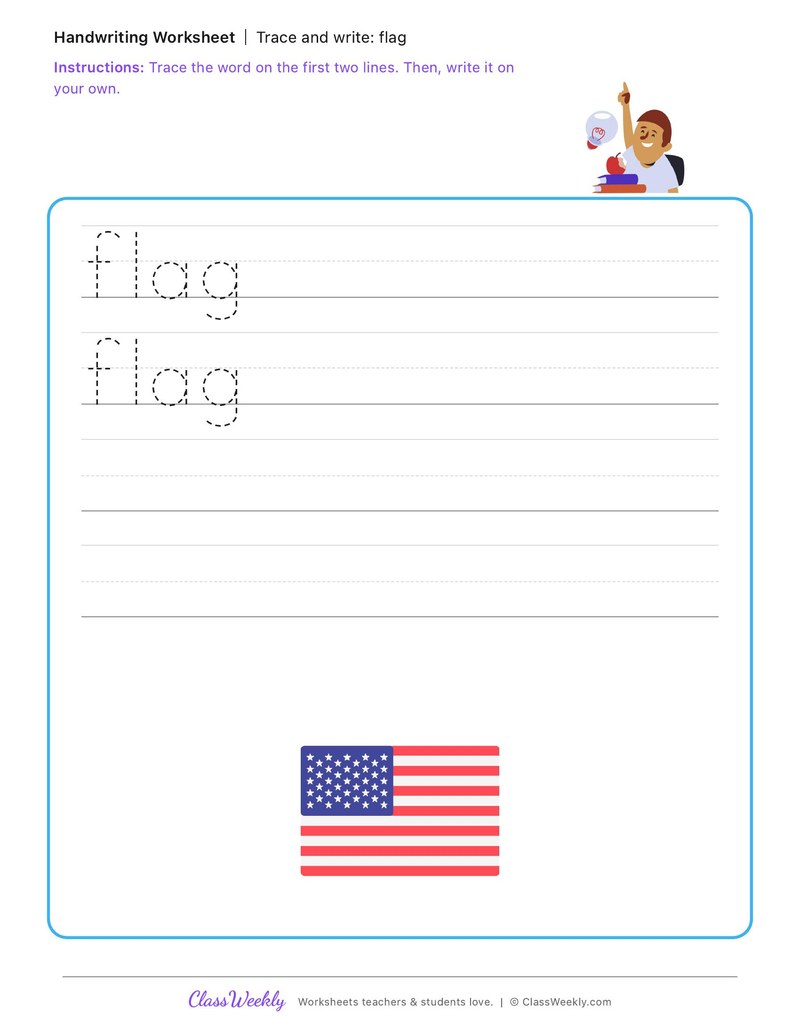
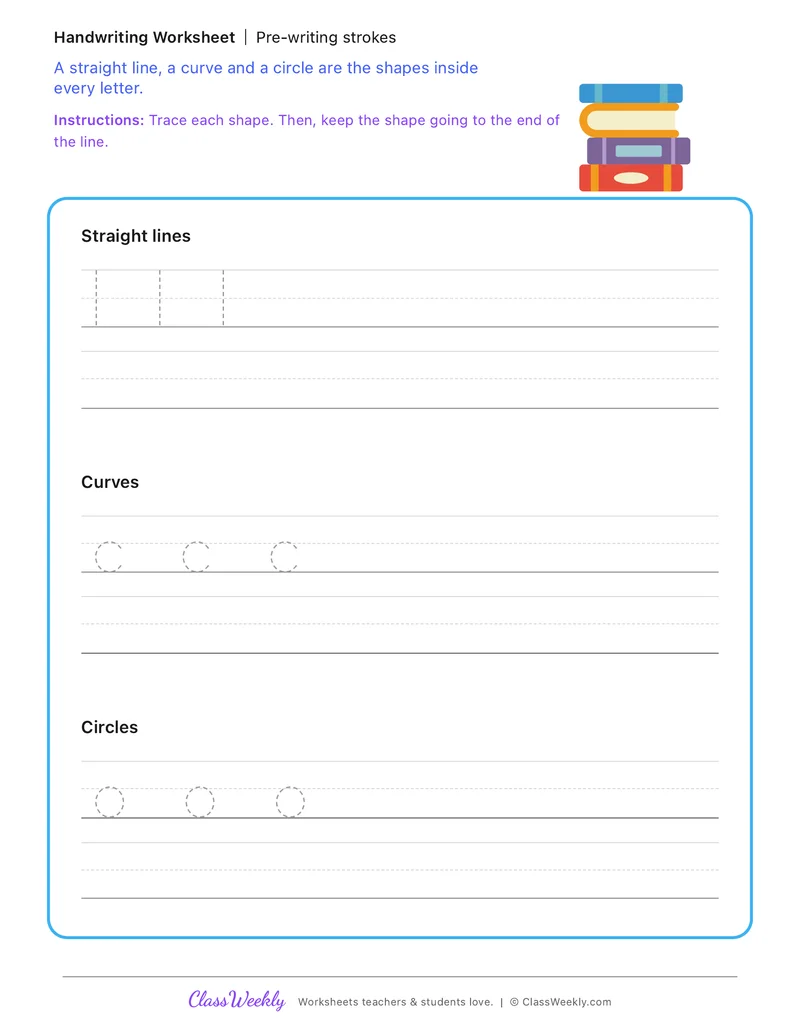
Free printable kindergarten write your name worksheet. Students trace and then independently print their first name using letter formation guides. Part of our writing your name handwriting collection. Aligned to Common Core standards.
How do I use this worksheet?
Introduce the skill with a brief whole-class activity, such as calling out examples and asking students to give a thumbs up when they hear writing your name in a sentence. Then let students work through it with your modeling first (do the first item together on the board), then try the rest with a partner, referring to a class anchor chart if one is available. When reviewing answers, ask students to explain why an answer is correct rather than just confirming it. These writing your name worksheets work well as a focused practice activity, a homework assignment, or a warm-up at the start of a language arts lesson.
What students will practice
- Students will identify and correctly use writing your name in sentences and short passages.
- Students will distinguish writing your name from related language concepts and apply rules consistently.
- Students will demonstrate understanding of writing your name through listening, speaking, and early decoding, in both reading and their own writing.






Curriculum Links
Common Core State Standards
Language · Kindergarten
Standard: Print many upper- and lowercase letters.
View all L.K.1.A worksheets →Find this in the curriculum
Browse the grade, subject, and topic this belongs to.
FAQ
How do I use this writing your name worksheet?
⌄
Introduce the skill with a brief whole-class activity, such as calling out examples and asking students to give a thumbs up when they hear writing your name in a sentence. Then let students work through it with your modeling first (do the first item together on the board), then try the rest with a partner, referring to a class anchor chart if one is available. When reviewing answers, ask students to explain why an answer is correct rather than just confirming it. These writing your name worksheets work well as a focused practice activity, a homework assignment, or a warm-up at the start of a language arts lesson.
What does this worksheet teach?
⌄
These writing your name worksheets for Kindergarten give students the targeted language arts practice they need to master this important grammar skill. Students identify, sort, complete, and write using writing your name through a variety of exercises designed to reinforce both recognition and application. Our handwriting worksheets connect grammar practice to reading and writing so students see how writing your name works in real language. Building a solid understanding of writing your name in Kindergarten sets students up for stronger writing and clearer communication in every subject.
Can I use this writing your name worksheet for homeschool or classroom?
⌄
Yes, both. We made it for Kindergarten handwriting, and the page works the same whether it lands on a kitchen table or a center rotation. At home, most families go through it together and talk the answers out loud, and that talking is where most of the learning happens with writing your name. In class it runs well as independent work while you pull a small group. Print one copy or thirty, whichever the day needs.
What handwriting skills should kindergarteners master?
⌄
By the end of kindergarten, students should be able to print all 26 uppercase and 26 lowercase letters legibly, write their first and last name from memory, and form letters using correct stroke order (top to bottom, left to right). CCSS L.K.1a expects kindergarteners to print many uppercase and lowercase letters. Children should also demonstrate proper pencil grip (tripod grasp with thumb, index, and middle finger), correct paper positioning, and appropriate letter sizing within lined guides. Worksheets with dotted letter forms, directional arrows showing stroke order, and lined practice spaces provide the structured repetition kindergarteners need to develop muscle memory for each letter. Daily handwriting practice of 10 to 15 minutes produces the best results for building fluency without fatiguing small hands. Focus on letter groups that share similar strokes (c, o, a, d, g all start with the same curved stroke) rather than teaching letters in alphabetical order, which research shows is less efficient for motor learning.
How can I improve my kindergartener's handwriting at home?
⌄
Improving kindergarten handwriting at home starts with ensuring proper setup: a well-lit workspace, a chair where the child's feet touch the floor, paper taped down at a slight angle, and a correctly sized pencil (shorter, thicker pencils or triangular grips work well for small hands). Practice in short, focused sessions of 5 to 10 minutes rather than long periods that cause hand fatigue and frustration. Use tracing worksheets with dotted letters and directional arrows so the child builds correct stroke patterns from the start. Have the child trace the letter, then copy it independently next to the model. Focus on one or two letters per session rather than the entire alphabet. Strengthen fine motor skills through complementary activities: cutting with scissors, stringing beads, playing with playdough, and coloring within boundaries. If a child consistently reverses letters (writing b as d), this is developmentally normal through age 7. Worksheets that highlight the difference between commonly reversed letters with visual cues (b has a bat before the ball) help address reversals specifically.
Should kindergarteners learn cursive or print handwriting?
⌄
Kindergarteners should learn print (manuscript) handwriting first. Print letters correspond directly to the typed letters children see in books, on screens, and in classroom materials, making print the natural starting point for literacy instruction. CCSS L.K.1a specifically references printing letters. Most schools introduce cursive in second or third grade after print handwriting is fluent. Some educational approaches (Montessori, for example) introduce cursive first, arguing that the continuous letter flow reduces letter reversals and spacing issues, but the prevailing practice in U.S. schools is print first. Printable handwriting worksheets for kindergarten should focus on proper letter formation using standard print forms with consistent stroke patterns. Look for worksheets that use three-line guides (top line, middle dotted line, bottom line) to help children learn proper letter height and placement. Whether you eventually teach cursive is less important than ensuring children develop fluent, legible print that supports their reading and writing development in the primary grades.
Ratings & Reviews
No reviews yet. Be the first to share what you think.
Reviews are for ClassWeekly members.
Make a Request
Spotted something to fix, or want a worksheet we don't have yet? Tell us and we'll make it.
Worksheet Details
| Grade | Kindergarten |
| Subject | Grammar & Writing |
| Topic | Handwriting |
| Standard | L.K.1.A |
| Pages | 1 page |
| Difficulty | Medium |
What is ClassWeekly?
ClassWeekly offers free worksheets and printable learning resources for kids in preschool to grade 5. All worksheets are aligned to Common Core, NGSS, and C3 Framework standards and designed by educators. Become a member to access the full library and download unlimited PDFs.