The Flamingo
Written by Adi Ackerman, Head Teacher
"The Flamingo - Draw & Write Worksheet" is written for Kindergarten (Ages 3-6), and it covers Common Core RL.K.1. If your little one is a year younger but already steady on reading comprehension, the page still works. You may just need to read the instructions out loud. And if they are older and draw and write never quite stuck, this is a short review rather than busywork.


2 pages in this set
Short passage on The Flamingo, three questions to answer, and a draw and write prompt at the end. Kindergarten reading and early writing together. Part of our draw and write reading comprehension collection. Aligned to Common Core standards.
How do I use this worksheet?
For independent use, have students read page 1 silently or follow along during a read-aloud, then complete page 2 independently. For guided practice, read the passage aloud together as a class, discuss the three questions orally before students write, then give quiet time for the drawing prompt. The drawing step works especially well for students who need more processing time or who express themselves more easily through pictures than words. For differentiation, strong writers can be encouraged to write two sentences per question; students who need support can dictate their answers before writing one word or phrase. These worksheets pair naturally with morning meeting topics, science units, read-alouds, and social-emotional learning lessons. They also work as fast-finisher activities since both pages are self-contained and require no additional materials.
What students will practice
- Students will read or listen to a short nonfiction or narrative passage and answer three comprehension questions in complete or partial sentences.
- Students will respond to a drawing prompt connected to the passage topic, practicing the kindergarten skill of expressing ideas through both writing and illustration.
- Students will build reading stamina, vocabulary, and the ability to locate and recall key details from a text to support written answers.







Curriculum Links
Common Core State Standards
Reading: Literature · Kindergarten
Standard: With prompting and support, ask and answer questions about key details in a text.
View all RL.K.1 worksheets →Find this in the curriculum
Browse the grade, subject, and topic this belongs to.
FAQ
How do I use this draw and write worksheet?
⌄
For independent use, have students read page 1 silently or follow along during a read-aloud, then complete page 2 independently. For guided practice, read the passage aloud together as a class, discuss the three questions orally before students write, then give quiet time for the drawing prompt. The drawing step works especially well for students who need more processing time or who express themselves more easily through pictures than words. For differentiation, strong writers can be encouraged to write two sentences per question; students who need support can dictate their answers before writing one word or phrase. These worksheets pair naturally with morning meeting topics, science units, read-alouds, and social-emotional learning lessons. They also work as fast-finisher activities since both pages are self-contained and require no additional materials.
What does this worksheet teach?
⌄
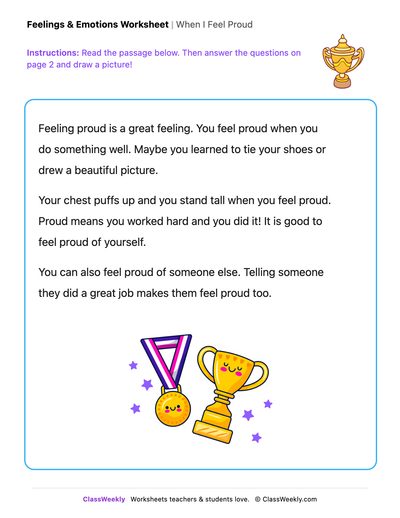
Each Draw & Write worksheet gives kindergarten students a two-page literacy experience built around a single engaging topic. Page 1 contains a short 4-6 sentence reading passage written at a kindergarten level, covering the topic from multiple angles so students gain real knowledge before they respond. A colorful clip art image reinforces the topic visually and helps students who need picture support to access the text. Page 2 asks three comprehension questions tied directly to the passage, each followed by a writing line sized for beginning writers. A large dashed-border drawing box at the bottom of page 2 invites students to draw a picture connected to the drawing prompt, combining written and artistic response in one activity. Topics across the 1,000-worksheet set span feelings and emotions, animals, seasons, community helpers, science concepts, holidays, everyday activities, and creative and imaginative themes, giving teachers a worksheet for nearly any unit or read-aloud.
Can I use this draw and write worksheet for homeschool or classroom?
⌄
Yes, both. We made it for Kindergarten reading comprehension, and the page works the same whether it lands on a kitchen table or a center rotation. At home, most families go through it together and talk the answers out loud, and that talking is where most of the learning happens with draw and write. In class it runs well as independent work while you pull a small group. Print one copy or thirty, whichever the day needs.
What are Draw & Write worksheets and how do they work?
⌄
Draw & Write worksheets are two-page literacy activities designed for kindergarteners. Page 1 contains a short reading passage on a specific topic, written at a kindergarten reading level and supported by a colorful clip art image. Page 2 has three comprehension questions tied directly to the passage, each followed by a writing line, plus a large drawing box at the bottom where students illustrate a drawing prompt related to the topic. The two-page format combines reading, writing, and drawing in one self-contained activity.
What topics are covered in the Draw & Write worksheet collection?
⌄
The collection covers 1,000 different topics across a wide range of kindergarten-appropriate themes: feelings and emotions (What Makes Me Happy, When I Feel Brave), animals (The Elephant, Birds in Spring), seasons and weather (Summer Is Here, A Rainy Day), community helpers (Crossing the Street Safely, The Doctor), science concepts (How Plants Grow, Why We Sleep), holidays and celebrations (My Favorite Holiday, Valentine's Day), everyday activities (Cooking with My Family, My Morning Routine), and imaginative and creative topics (My Dream Pet, Living on the Moon). This variety means teachers can find a worksheet that connects to almost any read-aloud, unit theme, or classroom discussion.
Are Draw & Write worksheets appropriate for students who cannot read independently yet?
⌄
Yes. These worksheets are designed to work as read-alouds: a teacher or parent reads the passage aloud while students follow along, then students answer the comprehension questions with support. The drawing prompt at the bottom is accessible to all students regardless of reading level, since drawing requires no decoding. For writing, students who are not yet writing sentences can draw their answer and label it, write one key word, or dictate their response to an adult. The multimodal format (reading + writing + drawing) ensures every student can participate meaningfully.
How do Draw & Write worksheets align with Common Core standards?
⌄
Each Draw & Write worksheet directly addresses CCSS.ELA-LITERACY.RL.K.1, which asks kindergarteners to ask and answer questions about key details in a text with prompting and support. The three comprehension questions on every worksheet are designed to target key details in the passage. The drawing prompt supports W.K.3, which asks kindergarteners to use a combination of drawing, dictating, and writing to narrate or respond to a topic. For worksheets based on nonfiction topics, RI.K.1 (ask and answer questions about key details in an informational text) is also addressed.
How do preschoolers develop reading comprehension before they can read?
⌄
Reading comprehension for preschoolers is built through listening comprehension. When an adult reads aloud and asks questions like "What happened?" or "Why did the bear feel sad?", the child practices the same thinking skills used in independent reading. Research from the National Early Literacy Panel shows that oral comprehension in preschool strongly predicts reading comprehension in later grades. Worksheets for kindergarten comprehension typically use pictures: children look at a scene and answer questions about what is happening, what might happen next, or how a character feels. These activities develop vocabulary, inference skills, and narrative understanding. Reading aloud for 15 to 20 minutes daily and discussing the story afterward is the single most effective comprehension-building activity for this age group.
What questions should I ask my preschooler during read-aloud time?
⌄
Use a mix of literal and inferential questions. Literal questions check basic understanding: "Who is the story about?" and "Where did they go?" Inferential questions build deeper thinking: "Why do you think she did that?" and "How would you feel if that happened to you?" Prediction questions like "What do you think will happen next?" develop anticipation and engagement. The key is to ask open-ended questions that require more than a yes or no answer. Worksheets that pair a short picture story with three or four comprehension questions replicate this guided questioning format. Research shows that interactive read-alouds, where the child actively participates rather than passively listening, produce significantly greater gains in vocabulary and comprehension than passive read-alouds alone.
What reading comprehension milestones should a 4-year-old reach?
⌄
By age 4, most children can retell a familiar story in their own words with a beginning, middle, and end. They can answer simple "who," "what," and "where" questions about a story they just heard. They should begin making predictions and connecting stories to their own experiences. These milestones align with the preschool foundations that feed into CCSS RL.K.1 (asking and answering questions about key details) in kindergarten. Worksheets that use sequencing activities, where children put three or four pictures in the correct story order, assess and build this retelling ability. If a child struggles to retell stories, try using wordless picture books where the child creates the narrative, building confidence and storytelling skills before adding text-based comprehension demands.
Ratings & Reviews
No reviews yet. Be the first to share what you think.
Reviews are for ClassWeekly members.
Make a Request
Spotted something to fix, or want a worksheet we don't have yet? Tell us and we'll make it.
Worksheet Details
| Grade | Kindergarten |
| Subject | Reading |
| Topic | Reading Comprehension |
| Standard | RL.K.1 |
| Pages | 1 page |
| Difficulty | Medium |
Learn More
What is ClassWeekly?
ClassWeekly offers free worksheets and printable learning resources for kids in preschool to grade 5. All worksheets are aligned to Common Core, NGSS, and C3 Framework standards and designed by educators. Become a member to access the full library and download unlimited PDFs.