Writing Precise Sentences
Written by Adi Ackerman, Head Teacher
"Writing Precise Sentences" is written for 4th Grade (Ages 9-10), and it covers Common Core L.4.3.A. If your little one is a year younger but already steady on sentences, the page still works. You may just need to read the instructions out loud. And if they are older and writing precise sentences never quite stuck, this is a short review rather than busywork.

Grade 4 sentences worksheet on writing precise sentences. Rewrite each vague sentence so it is precise and specific. Printable PDF. Includes an answer key. Part of our writing precise sentences sentences collection. Aligned to Common Core standards.
How do I use this worksheet?
Introduce the skill with a brief whole-class activity, such as calling out examples and asking students to give a thumbs up when they hear writing precise sentences in a sentence. Then let students work through it independently, since students at this age benefit more from productive struggle than from being walked through each step, referring to a class anchor chart if one is available. When reviewing answers, ask students to explain why an answer is correct rather than just confirming it. These writing precise sentences worksheets work well as a focused practice activity, a homework assignment, or a warm-up at the start of a language arts lesson.
What students will practice
- Students will identify and correctly use writing precise sentences in sentences and short passages.
- Students will distinguish writing precise sentences from related language concepts and apply rules consistently.
- Students will demonstrate understanding of writing precise sentences through independent reading and discussion, in both reading and their own writing.


Curriculum Links
Common Core State Standards
Grammar & Writing · 4th Grade
Find this in the curriculum
Browse the grade, subject, and topic this belongs to.
FAQ
How do I use this writing precise sentences worksheet?
⌄
Introduce the skill with a brief whole-class activity, such as calling out examples and asking students to give a thumbs up when they hear writing precise sentences in a sentence. Then let students work through it independently, since students at this age benefit more from productive struggle than from being walked through each step, referring to a class anchor chart if one is available. When reviewing answers, ask students to explain why an answer is correct rather than just confirming it. These writing precise sentences worksheets work well as a focused practice activity, a homework assignment, or a warm-up at the start of a language arts lesson.
What does this worksheet teach?
⌄
These writing precise sentences worksheets for 4th grade give students the targeted language arts practice they need to master this important grammar skill. Students identify, sort, complete, and write using writing precise sentences through a variety of exercises designed to reinforce both recognition and application. Our sentences worksheets connect grammar practice to reading and writing so students see how writing precise sentences works in real language. Building a solid understanding of writing precise sentences in 4th grade sets students up for stronger writing and clearer communication in every subject.
Can I use this writing precise sentences worksheet for homeschool or classroom?
⌄
Yes, both. We made it for 4th Grade sentences, and the page works the same whether it lands on a kitchen table or a center rotation. At home, most families go through it together and talk the answers out loud, and that talking is where most of the learning happens with writing precise sentences. In class it runs well as independent work while you pull a small group. Print one copy or thirty, whichever the day needs.
What does 'writing precisely' mean in 4th grade grammar and composition?
⌄
Writing precisely means choosing words and details that convey exactly what you mean - avoiding vague words like 'nice,' 'big,' or 'went' in favor of specific alternatives like 'generous,' 'towering,' or 'sprinted.'
How do students learn to identify and replace vague language?
⌄
Teachers can highlight commonly vague words (nice, good, thing, very, got, went) and challenge students to replace them with specific words that paint a clearer picture - using word banks or thesaurus tools for support.
How does writing precise sentences support the revision stage of the writing process?
⌄
Precision revision is a key step after drafting - students learn to re-read for vague language and upgrade it, a habit that directly improves the quality and score of their written work.
What sentence skills should a 4th grader master?
⌄
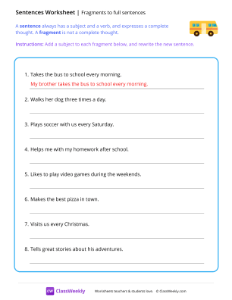
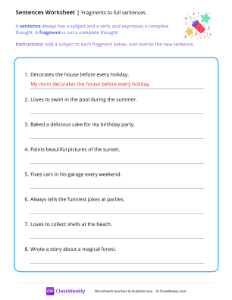
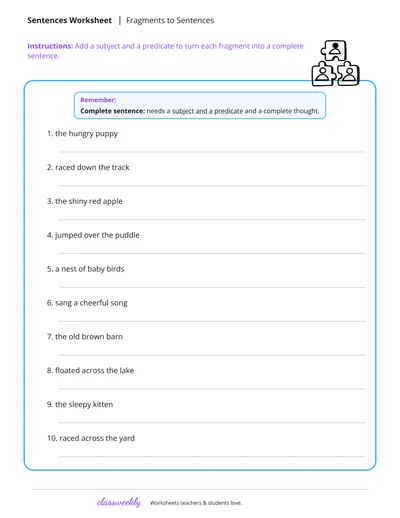
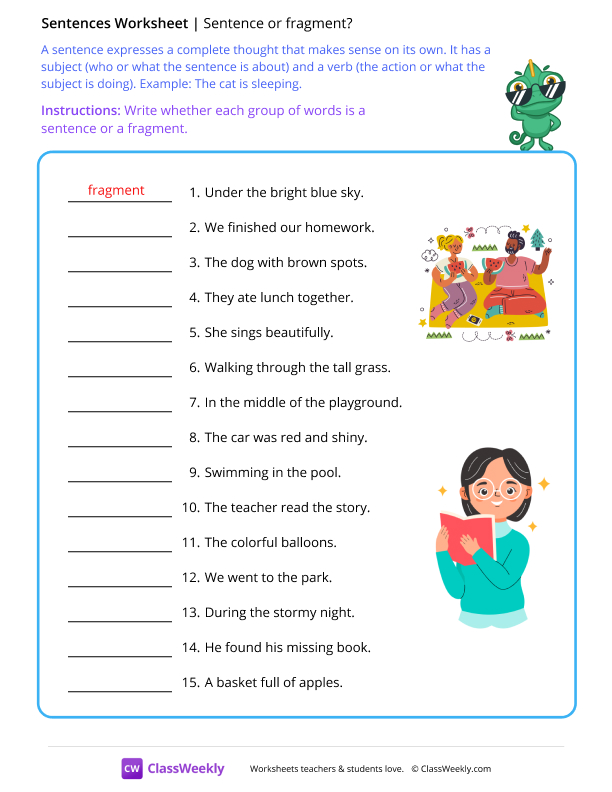
Fourth graders should write complete sentences and fix the two errors that break them: fragments and run-ons (CCSS L.4.1f). By the end of the year, your fourth grader can find the complete subject and complete predicate, tell the difference between a fragment, a run-on, and a full sentence, and repair each one. They learn to join short, choppy sentences into one clear sentence using a comma and a coordinating conjunction (L.4.2c), and to build compound subjects and predicates so their writing flows. Fourth grade also adds sentence variety: classifying the four sentence types (declarative, interrogative, imperative, exclamatory), starting sentences different ways, adding an introductory clause with a comma, and choosing precise words for effect (L.4.3a). They practice subject-verb agreement, including the tricky cases where a phrase sits between the subject and the verb, and they clean up double negatives. The goal is not just correct sentences but varied, purposeful ones. Worksheets that move from spotting fragments and run-ons to combining, expanding, and classifying sentences give students the repeated, targeted practice these standards expect.
How do you teach a 4th grader to fix run-on sentences and fragments?
⌄
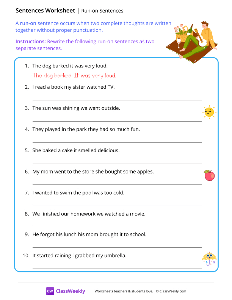
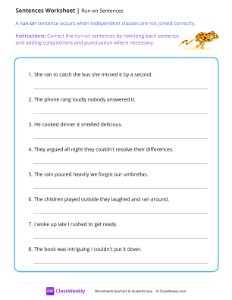
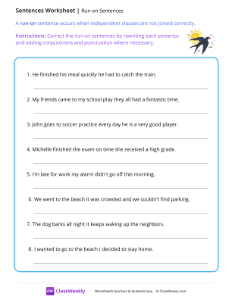
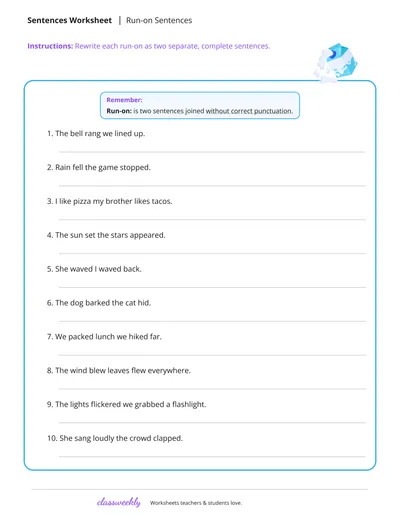
Start by making the definitions concrete. A fragment is missing a subject or a predicate, so it cannot stand alone. A run-on jams two complete thoughts together with no punctuation or joining word. Show both next to a correct sentence so your fourth grader can hear the difference by reading aloud: a run-on leaves you breathless, and a fragment leaves you hanging. Then teach the three fixes for a run-on: split it into two sentences with a period, join the two parts with a comma and a coordinating conjunction like and, but, or so (CCSS L.4.2c), or add a subordinating conjunction such as because. For fragments, have students name what is missing, the who or the what is happening, and add it. The most reliable sequence is spot it, name the error, then fix it, because students who can label the problem repair it far more consistently than students who only guess. Worksheets that mix fragments, run-ons, and correct sentences in one exercise, and ask students to rewrite each incorrect one, build the editing habit that CCSS L.4.1f is really after. Reading the corrected sentence aloud is the final check.
What are the most common sentence mistakes fourth graders make?
⌄
Fourth graders make four sentence errors most often. First, run-ons: two complete thoughts joined with only a comma (a comma splice) or with nothing at all, as in "It was raining we stayed inside." Second, fragments: a group of words missing a subject or a verb that gets punctuated like a full sentence, as in "Because the bus was late." Third, subject-verb agreement slips, especially when a phrase separates the subject from the verb ("The box of markers is on the desk," not "are"). Fourth, double negatives, such as "I do not have no pencil," where two negative words cancel each other out. A fifth, milder issue is sameness: starting every sentence the same way and never combining short ones, which makes writing choppy. Each error has a clean fix, and CCSS L.4.1f expects students to produce complete sentences and correct both fragments and run-ons. Worksheets that target one error at a time, then finish with a proofreading passage that mixes all of them, help students build both specific knowledge and the general editing awareness they need to catch these mistakes in their own writing.
Ratings & Reviews
No reviews yet. Be the first to share what you think.
Reviews are for ClassWeekly members.
Make a Request
Spotted something to fix, or want a worksheet we don't have yet? Tell us and we'll make it.
Worksheet Details
| Grade | 4th Grade |
| Subject | Grammar & Writing |
| Topic | Sentences |
| Standard | L.4.3.A |
| Pages | 1 page |
| Difficulty | Medium |
Learn More
What is ClassWeekly?
ClassWeekly offers free worksheets and printable learning resources for kids in preschool to grade 5. All worksheets are aligned to Common Core, NGSS, and C3 Framework standards and designed by educators. Become a member to access the full library and download unlimited PDFs.