Comparing with adjectives
Written by Adi Ackerman, Head Teacher
"Comparing with adjectives" is written for 3rd Grade (Ages 8-9), and it covers Common Core L.3.1.G. If your little one is a year younger but already steady on adjectives, the page still works. You may just need to read the instructions out loud. And if they are older and comparing with adjectives never quite stuck, this is a short review rather than busywork.

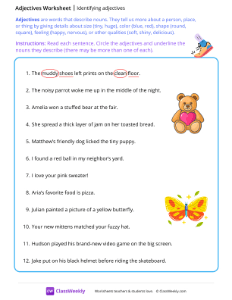
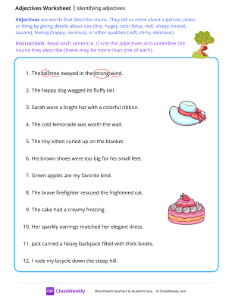
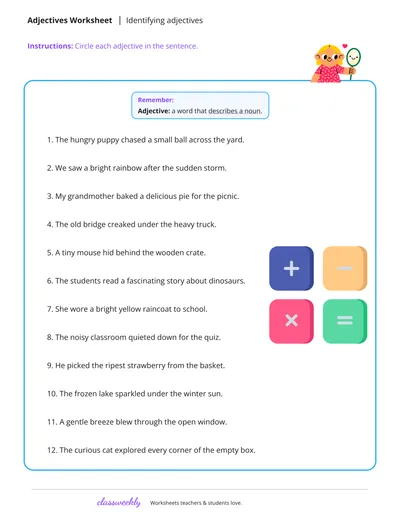
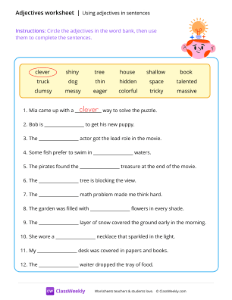
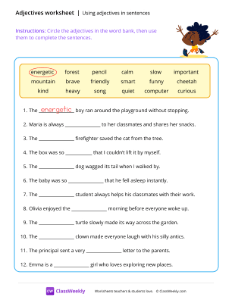
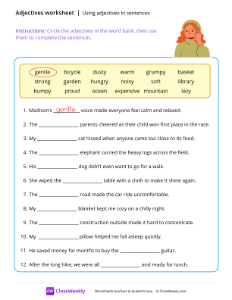
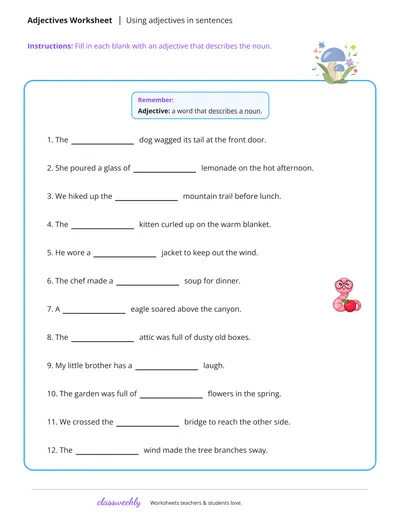
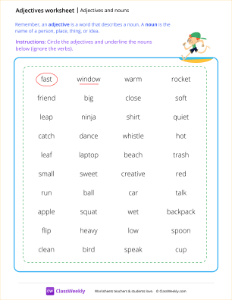
Comparing with adjectives worksheet for 3rd grade: students fill in the blank with the correct comparative or superlative form of the adjective in parentheses. Part of our comparing with adjectives adjectives collection. Aligned to Common Core standards.
How do I use this worksheet?
Introduce the skill with a brief whole-class activity, such as calling out examples and asking students to give a thumbs up when they hear comparing with adjectives in a sentence. Then let students work through it independently, using a partner or small group only if they want to talk through their thinking, referring to a class anchor chart if one is available. When reviewing answers, ask students to explain why an answer is correct rather than just confirming it. These comparing with adjectives worksheets work well as a focused practice activity, a homework assignment, or a warm-up at the start of a language arts lesson.
What students will practice
- Students will identify and correctly use comparing with adjectives in sentences and short passages.
- Students will distinguish comparing with adjectives from related language concepts and apply rules consistently.
- Students will demonstrate understanding of comparing with adjectives through guided and independent practice, in both reading and their own writing.


Curriculum Links
Common Core State Standards
Grammar & Writing · 3rd Grade
Find this in the curriculum
Browse the grade, subject, and topic this belongs to.
FAQ
How do I use this comparing with adjectives worksheet?
⌄
Introduce the skill with a brief whole-class activity, such as calling out examples and asking students to give a thumbs up when they hear comparing with adjectives in a sentence. Then let students work through it independently, using a partner or small group only if they want to talk through their thinking, referring to a class anchor chart if one is available. When reviewing answers, ask students to explain why an answer is correct rather than just confirming it. These comparing with adjectives worksheets work well as a focused practice activity, a homework assignment, or a warm-up at the start of a language arts lesson.
What does this worksheet teach?
⌄
These comparing with adjectives worksheets for 3rd grade give students the targeted language arts practice they need to master this important grammar skill. Students identify, sort, complete, and write using comparing with adjectives through a variety of exercises designed to reinforce both recognition and application. Our adjectives worksheets connect grammar practice to reading and writing so students see how comparing with adjectives works in real language. Building a solid understanding of comparing with adjectives in 3rd grade sets students up for stronger writing and clearer communication in every subject.
Can I use this comparing with adjectives worksheet for homeschool or classroom?
⌄
Yes, both. We made it for 3rd Grade adjectives, and the page works the same whether it lands on a kitchen table or a center rotation. At home, most families go through it together and talk the answers out loud, and that talking is where most of the learning happens with comparing with adjectives. In class it runs well as independent work while you pull a small group. Print one copy or thirty, whichever the day needs.
What is the difference between comparative and superlative adjectives?
⌄
Comparative adjectives compare two things (e.g., 'faster') while superlative adjectives compare three or more (e.g., 'fastest') - both forms are introduced in 3rd grade grammar.
How do students practice comparing with adjectives on these worksheets?
⌄
Students complete sentences using the correct comparative or superlative form, choose between options in context, and write their own comparison sentences about familiar objects or animals.
Where does comparing with adjectives appear in 3rd grade writing?
⌄
Comparison language is used in informative writing (e.g., compare-and-contrast paragraphs) and opinion writing (e.g., 'my dog is the best pet'), making this skill directly applicable to multiple writing genres.
What adjective skills should third graders learn?
⌄
Third graders should use comparative and superlative adjectives correctly, choose adjectives that convey precise meaning, and understand how adjectives function within sentences. CCSS L.3.1g requires students to form and use comparative and superlative adjectives (tall, taller, tallest; good, better, best). Students should know that comparative adjectives compare two things while superlative adjectives compare three or more. They should also understand the rules for forming comparisons: add er/est to short adjectives, use more/most with longer adjectives, and memorize irregular forms (good/better/best, bad/worse/worst). Beyond comparison, third graders develop vocabulary by selecting specific adjectives rather than vague ones, choosing "enormous" instead of "big" or "freezing" instead of "cold." Worksheets that ask students to complete comparison charts, fill in the correct adjective form in context sentences, and replace weak adjectives with stronger ones build comprehensive adjective knowledge.
How do worksheets help third graders use adjectives effectively?
⌄
Worksheets provide structured practice across multiple adjective skills in a focused format. Comparison chart worksheets where students fill in the base, comparative, and superlative forms build the pattern recognition needed for regular and irregular adjectives. Sentence-level worksheets that ask students to choose between "more tall" and "taller" address the common error of using "more" with short adjectives. Descriptive writing worksheets that present a bland sentence and ask students to add specific adjectives improve word choice and writing quality. Error correction worksheets that include incorrect forms like "most biggest" or "gooder" help students identify and fix common mistakes. The most effective worksheets combine identification (underline the adjective), application (choose the correct form), and production (write your own sentence using a comparative adjective). This multi-level approach ensures that students can both recognize and actively use adjectives, moving beyond worksheet practice to transfer these skills into everyday writing, as expected by CCSS L.3.1g.
What are common adjective mistakes third graders make?
⌄
The most common errors include double comparisons ("more bigger," "most fastest"), using comparative forms when superlative is needed ("She is the taller of the three sisters" instead of "tallest"), and struggling with irregular adjective forms (writing "gooder" instead of "better" or "baddest" instead of "worst"). Children also frequently over-rely on basic adjectives like big, small, good, and bad rather than choosing more precise, vivid alternatives. Some students apply the er/est rule to multi-syllable adjectives, producing "beautifuler" instead of "more beautiful." These errors reflect developing understanding of adjective rules and are best addressed through explicit instruction, modeling, and repeated practice. Worksheets that contrast correct and incorrect forms help students build an internal editor. Teachers often use a "tired words" bulletin board where common overused adjectives are listed alongside stronger replacements. With consistent practice aligned to CCSS L.3.1g, these errors typically resolve during the third grade year.
Ratings & Reviews
No reviews yet. Be the first to share what you think.
Reviews are for ClassWeekly members.
Make a Request
Spotted something to fix, or want a worksheet we don't have yet? Tell us and we'll make it.
Worksheet Details
| Grade | 3rd Grade |
| Subject | Grammar & Writing |
| Topic | Adjectives |
| Standard | L.3.1.G |
| Pages | 1 page |
| Difficulty | Medium |
What is ClassWeekly?
ClassWeekly offers free worksheets and printable learning resources for kids in preschool to grade 5. All worksheets are aligned to Common Core, NGSS, and C3 Framework standards and designed by educators. Become a member to access the full library and download unlimited PDFs.