Plural nouns and possession
Written by Adi Ackerman, Head Teacher
"Plural nouns and possession" is written for 3rd Grade (Ages 8-9), and it covers Common Core L.3.2.D. If your little one is a year younger but already steady on punctuation, the page still works. You may just need to read the instructions out loud. And if they are older and plural nouns and possession never quite stuck, this is a short review rather than busywork.

Plural nouns and possession worksheet for 3rd grade: students rewrite each phrase as a plural possessive using an apostrophe. Part of our plural nouns and possession punctuation collection. Aligned to Common Core standards.
How do I use this worksheet?
Introduce the skill with a brief whole-class activity, such as calling out examples and asking students to give a thumbs up when they hear plural nouns and possession in a sentence. Then let students work through it independently, using a partner or small group only if they want to talk through their thinking, referring to a class anchor chart if one is available. When reviewing answers, ask students to explain why an answer is correct rather than just confirming it. These plural nouns and possession worksheets work well as a focused practice activity, a homework assignment, or a warm-up at the start of a language arts lesson.
What students will practice
- Students will identify and correctly use plural nouns and possession in sentences and short passages.
- Students will distinguish plural nouns and possession from related language concepts and apply rules consistently.
- Students will demonstrate understanding of plural nouns and possession through guided and independent practice, in both reading and their own writing.





Curriculum Links
Common Core State Standards
Grammar & Writing · 3rd Grade
Find this in the curriculum
Browse the grade, subject, and topic this belongs to.
FAQ
How do I use this plural nouns and possession worksheet?
⌄
Introduce the skill with a brief whole-class activity, such as calling out examples and asking students to give a thumbs up when they hear plural nouns and possession in a sentence. Then let students work through it independently, using a partner or small group only if they want to talk through their thinking, referring to a class anchor chart if one is available. When reviewing answers, ask students to explain why an answer is correct rather than just confirming it. These plural nouns and possession worksheets work well as a focused practice activity, a homework assignment, or a warm-up at the start of a language arts lesson.
What does this worksheet teach?
⌄
These plural nouns and possession worksheets for 3rd grade give students the targeted language arts practice they need to master this important grammar skill. Students identify, sort, complete, and write using plural nouns and possession through a variety of exercises designed to reinforce both recognition and application. Our punctuation worksheets connect grammar practice to reading and writing so students see how plural nouns and possession works in real language. Building a solid understanding of plural nouns and possession in 3rd grade sets students up for stronger writing and clearer communication in every subject.
Can I use this plural nouns and possession worksheet for homeschool or classroom?
⌄
Yes, both. We made it for 3rd Grade punctuation, and the page works the same whether it lands on a kitchen table or a center rotation. At home, most families go through it together and talk the answers out loud, and that talking is where most of the learning happens with plural nouns and possession. In class it runs well as independent work while you pull a small group. Print one copy or thirty, whichever the day needs.
What is the difference between a plural noun and a possessive noun?
⌄
A plural noun simply means more than one (dogs, teachers) and uses no apostrophe, while a possessive noun shows ownership (the dog's leash, the teachers' lounge) and requires an apostrophe.
Where does the apostrophe go for a plural possessive noun?
⌄
For regular plural nouns ending in 's,' the apostrophe goes after the 's' (e.g., 'the students' books') - for irregular plurals not ending in 's,' add apostrophe-s (e.g., 'the children's toys').
How do these worksheets help address the 'greengrocers apostrophe' error?
⌄
The habit of adding apostrophes to all plurals (e.g., 'apple's' on a sign) is very common - worksheets that contrast plural and possessive forms help students ask 'is there ownership here?' before adding an apostrophe.
What punctuation skills should third graders master?
⌄
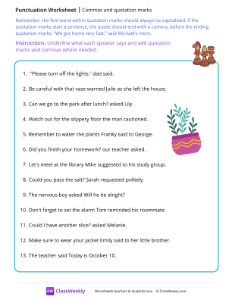
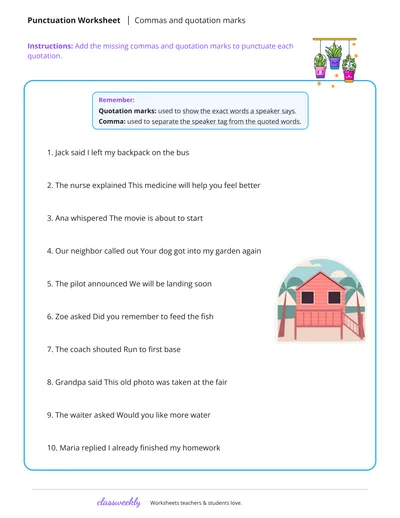
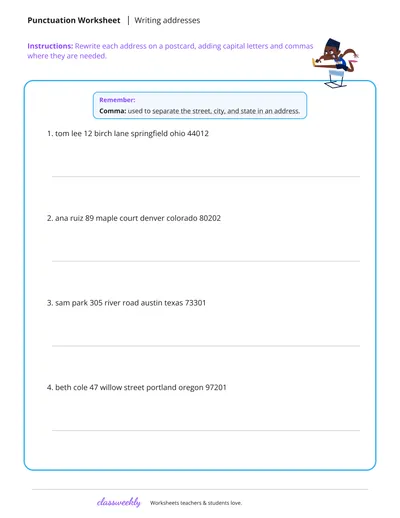
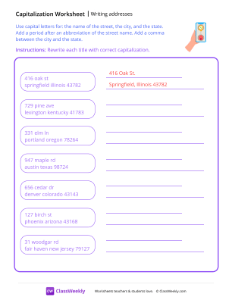
Third graders should master commas in addresses, commas and quotation marks in dialogue, possessive apostrophes, and commas in series. CCSS L.3.2b requires using commas in addresses (Portland, Oregon), CCSS L.3.2c covers commas and quotation marks in dialogue, and CCSS L.3.2d addresses forming possessives with apostrophes. Dialogue punctuation is the major new skill at this level: students learn to place quotation marks around the exact words a character says, use a comma to separate the dialogue from the speaker tag, and capitalize the first word of the quoted speech. Students also refine their use of commas in a series and in compound sentences. Worksheets that present unpunctuated dialogue and ask students to add all necessary punctuation marks provide focused practice on this complex skill. Activities that combine multiple punctuation rules in a single editing passage develop the integrated application students need for their own writing.
How do I teach dialogue punctuation to a third grader?
⌄
Dialogue punctuation has multiple components, so teach them one at a time. Start with quotation marks: they go around the exact words someone says, like a frame around a picture. Practice with simple examples: She said, "Hello." Then add the comma rule: a comma separates the speaker tag (she said) from the quote when the tag comes first. Next, teach that when the quote comes first, the comma or punctuation goes inside the closing quotation mark: "Hello," she said. Finally, show that a new paragraph begins each time the speaker changes. Use color coding: highlight quotation marks in one color, commas in another, and capital letters in a third. Worksheets that progress through these steps, starting with "add the quotation marks" and building to "punctuate this entire dialogue passage," scaffold the learning effectively. Having students write a short dialogue between two characters puts all the rules together. CCSS L.3.2c makes dialogue punctuation a priority third grade skill.
What are the most common punctuation errors in third grade?
⌄
The most common third grade punctuation errors center on dialogue and possessives. In dialogue, students frequently forget the comma between the speaker tag and the quote (She said "Hello" instead of She said, "Hello"), place quotation marks around the speaker tag along with the speech, or forget to capitalize the first word inside quotation marks. With possessives, students confuse plural s and possessive s (writing "the dogs bone" or "the dog's are barking"), and struggle with plural possessives (writing "the girls's" instead of "the girls'"). Comma splices also emerge as students attempt longer sentences: "I like pizza, I like tacos" instead of using a conjunction or period. Run-on sentences become more common as students write more complex ideas without the punctuation tools to manage them. Worksheets that target each error type separately, combined with regular proofreading practice where students edit a paragraph containing several common mistakes, build the automatic checking skills aligned with CCSS L.3.2 expectations.
Ratings & Reviews
No reviews yet. Be the first to share what you think.
Reviews are for ClassWeekly members.
Make a Request
Spotted something to fix, or want a worksheet we don't have yet? Tell us and we'll make it.
Worksheet Details
| Grade | 3rd Grade |
| Subject | Grammar & Writing |
| Topic | Punctuation |
| Standard | L.3.2.D |
| Pages | 1 page |
| Difficulty | Medium |
Learn More
What is ClassWeekly?
ClassWeekly offers free worksheets and printable learning resources for kids in preschool to grade 5. All worksheets are aligned to Common Core, NGSS, and C3 Framework standards and designed by educators. Become a member to access the full library and download unlimited PDFs.