Estimate First, Then Solve
Written by Adi Ackerman, Head Teacher
"Estimate First, Then Solve" is written for 3rd Grade (Ages 8-9), and it covers Common Core 3.OA.D.8. If your little one is a year younger but already steady on word problems mixed, the page still works. You may just need to read the instructions out loud. And if they are older and reasonable answers never quite stuck, this is a short review rather than busywork.
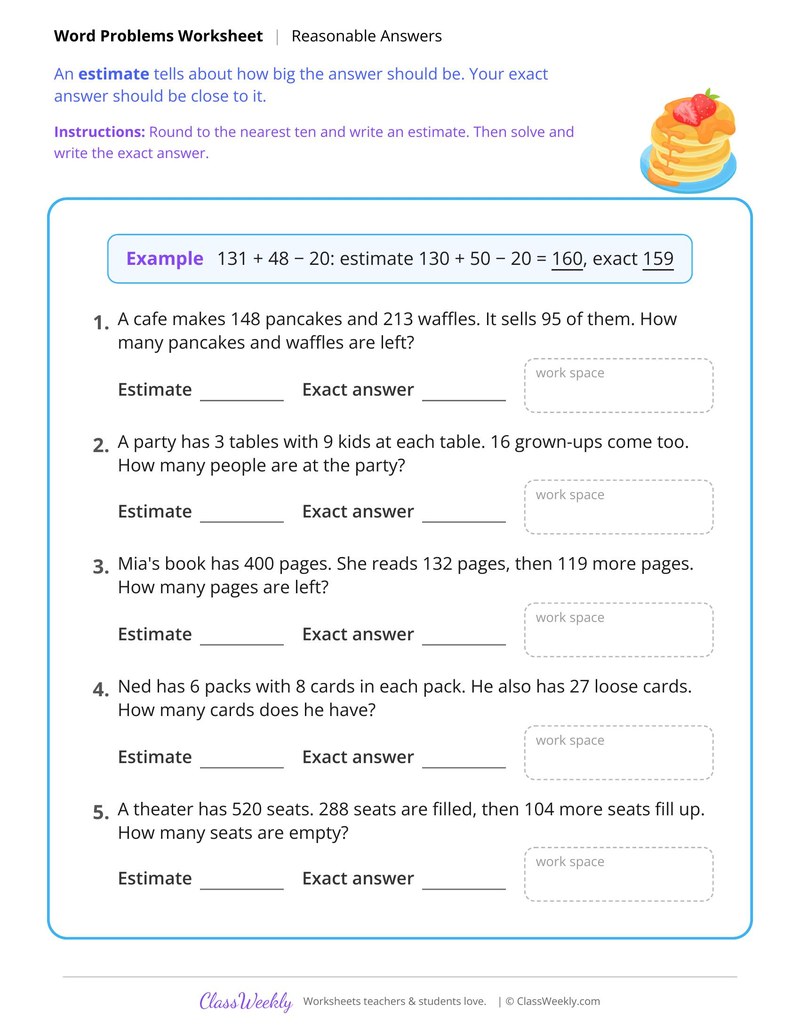
3rd grade math worksheet: round to the nearest ten to estimate, then solve exactly, for stories about pancakes, waffles and a party. Answer key included. Part of our reasonable answers word problems mixed collection. Aligned to Common Core standards.
How do I use this worksheet?
Before your child solves, ask for a quick guess of about how big the answer will be. After solving, ask whether the answer is close to that guess.
What students will practice
- Students will round to the nearest ten and write an estimate.
- Students will solve each two step story and write the exact answer.
- Students will check that the exact answer is close to the estimate.


Curriculum Links
Common Core State Standards
Operations and Algebraic Thinking · 3rd Grade
Standard: Solve two-step word problems using the four operations. Represent these problems using equations with a letter standing for the unknown quantity. Assess the reasonableness of answers using mental computation and estimation strategies including rounding.
View all 3.OA.D.8 worksheets →Find this in the curriculum
Browse the grade, subject, and topic this belongs to.
FAQ
How do I use this reasonable answers worksheet?
⌄
Before your child solves, ask for a quick guess of about how big the answer will be. After solving, ask whether the answer is close to that guess.
What does this worksheet teach?
⌄
Round to the nearest ten to estimate, then solve exactly, for stories about pancakes, waffles and a party. The directions on the page read: Round to the nearest ten and write an estimate. Then solve and write the exact answer. The page opens with a worked example, and an answer key is included.
Can I use this reasonable answers worksheet for homeschool or classroom?
⌄
Yes, both. We made it for 3rd Grade word problems mixed, and the page works the same whether it lands on a kitchen table or a center rotation. At home, most families go through it together and talk the answers out loud, and that talking is where most of the learning happens with reasonable answers. In class it runs well as independent work while you pull a small group. Print one copy or thirty, whichever the day needs.
How do you decide if an answer is reasonable?
⌄
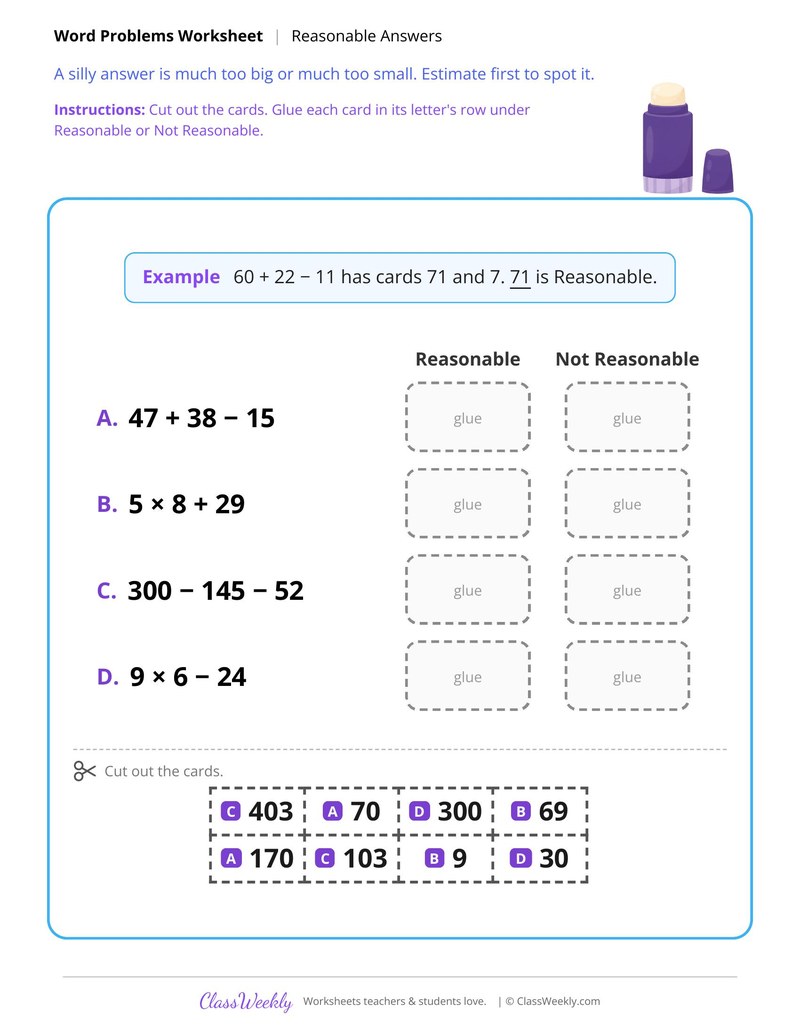
Round the numbers and estimate. If the answer is far from your estimate, it is not reasonable. For 61 + 29 − 18 = 112, the estimate is 70, so 112 is not reasonable.
What is a friendly number?
⌄
A friendly number is easy to work with, such as the nearest ten or hundred. 52 + 47 − 21 is about 50 + 50 − 20, or about 80.
Why estimate before solving?
⌄
An estimate tells about how big the answer should be. If the exact answer is far from it, children know to check their work.
Ratings & Reviews
No reviews yet. Be the first to share what you think.
Reviews are for ClassWeekly members.
Make a Request
Spotted something to fix, or want a worksheet we don't have yet? Tell us and we'll make it.
Worksheet Details
| Grade | 3rd Grade |
| Subject | Math |
| Topic | Word Problems Mixed |
| Standard | 3.OA.D.8 |
| Pages | 1 page |
| Difficulty | Medium |
What is ClassWeekly?
ClassWeekly offers free worksheets and printable learning resources for kids, from preschool up. All worksheets are aligned to Common Core, NGSS, and C3 Framework standards and designed by educators. We also have free online learning games for thousands of skills, and kids' answers turn into a progress report for the grown-up. Start a free 30-day trial to download the worksheets.