
Word definitions Worksheets
Written by Adi Ackerman, Head Teacher
Ages 8-9 · 2 worksheets · 2 total pages · Free previews · Print-ready PDFs
Free printable word definitions worksheets for 3rd grade students (Ages 8-9). Part of our word definitions vocabulary collection. All worksheets are aligned to Common Core standards.
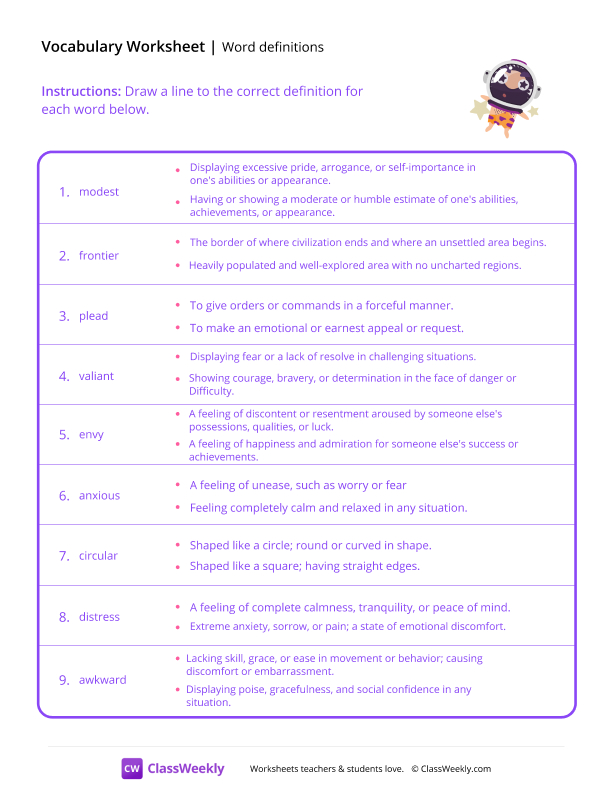
Preview of Word definitions - Cave Astronaut. 2 variations available.
All Word definitions Worksheets


Worksheet Details
| Grade | 3rd Grade |
| Subject | Reading |
| Topic | Vocabulary |
| Standard | L.4.4 |
| Pages | 2 pages |
| Difficulty | Medium |
Learn More
FAQ
What grade level are these word definitions worksheets for?
⌄
These word definitions worksheets are designed for 3rd Grade students (Ages 8-9). Print any one in the set for targeted practice, or download them together as a packet.
Can I use these for homeschool or the classroom?
⌄
Yes. These worksheets work for homeschool, classroom, and tutoring. Use them as a morning warm-up, an independent center activity, or a fast-finisher task.
What vocabulary skills should third graders master?
⌄
Third graders should use context clues to determine word meaning (CCSS L.3.4a), use knowledge of prefixes, suffixes, and root words to decode unfamiliar words (L.3.4b, L.3.4c), understand literal and nonliteral (figurative) language (L.3.5a), distinguish shades of meaning among related words (L.3.5c), and use glossaries and dictionaries to verify word meanings (L.3.4d). Third-grade vocabulary expectations increase dramatically because students encounter content-area words in science and social studies that are essential for comprehension. Worksheets that teach vocabulary strategies (context clues, word parts, reference tools) rather than just definitions help students become independent word learners. Research shows that students who know effective vocabulary strategies learn new words at a faster rate than students who rely on memorization alone, creating a widening advantage over time.
How do you teach context clues to third graders?
⌄
Teach five types of context clues: definition clues (the author defines the word in the same sentence), synonym clues (a familiar word with similar meaning appears nearby), antonym clues (an opposite word provides a contrast), example clues (examples illustrate the meaning), and inference clues (the overall situation suggests the meaning). Model each type explicitly: "The arid desert had not seen rain in months. The word 'desert' and 'no rain' are clues that 'arid' means very dry." Worksheets that highlight the unknown word and ask students to identify the type of clue and the meaning build strategic thinking. Practice with passages from content areas (science, social studies) helps students apply context clue strategies where they need them most. Over time, students should use context clues automatically as their first strategy when encountering an unfamiliar word.
Why is vocabulary especially important in third grade?
⌄
Third grade is when the "fourth-grade slump" begins to take shape. Students who lack sufficient vocabulary struggle to comprehend the increasingly complex texts used in science, social studies, and math word problems. Research by Biemiller shows that vocabulary differences at the start of third grade predict comprehension performance through middle school. Third graders need approximately 8,000 to 10,000 word families in their vocabulary to comprehend grade-level text. Building vocabulary requires both wide reading (encountering words in context) and direct instruction (learning specific words explicitly). Worksheets that pre-teach content-area vocabulary before reading assignments prevent comprehension breakdowns. Teaching word relationships (synonyms, antonyms, categories, word families) helps students organize new vocabulary into their existing knowledge network, making new words easier to remember and use.
What is ClassWeekly?
ClassWeekly offers free worksheets and printable learning resources for kids in preschool to grade 5. All worksheets are aligned to Common Core, NGSS, and C3 Framework standards and designed by educators. Become a member to access the full library and download unlimited PDFs.