Financial Literacy Lesson Plan for 3rd Grade
A ready-to-teach financial literacy lesson for 3rd Grade, built around earning income, scarcity and cost, planned spending, credit and interest, savings plans and money choices. Print the plan, print the practice pages, and you are set.
- Time
- 45 min
- Steps
- 5
- Practice pages
- 6
- Standard
- 3.OA.A.3
Lesson flow
45 minLearning objectives
By the end, students can:
- Explain what income is
- Name things that change how much a worker earns
- Multiply hourly pay by hours worked
Materials
Tick off as you get ready:
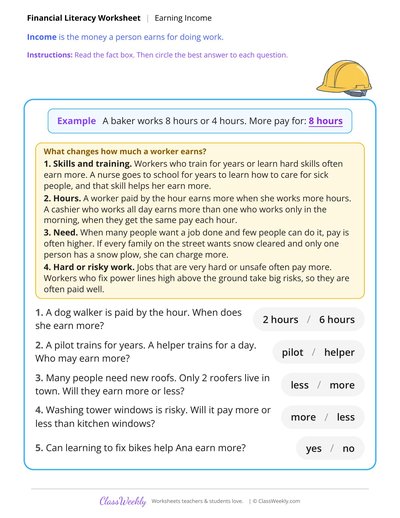
- What Changes How Much People Earn
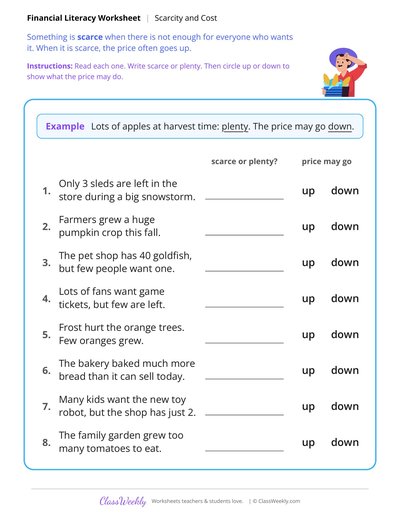
- Scarce or Plenty Sort
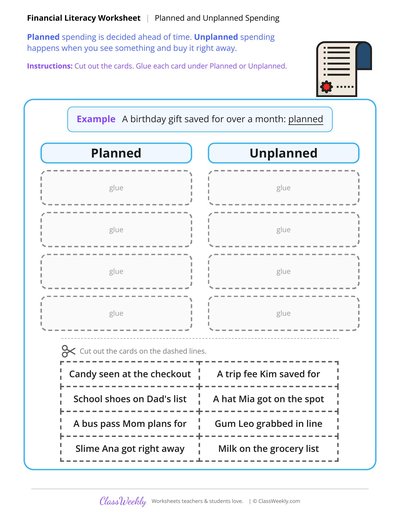
- Planned or Unplanned Spending Sort
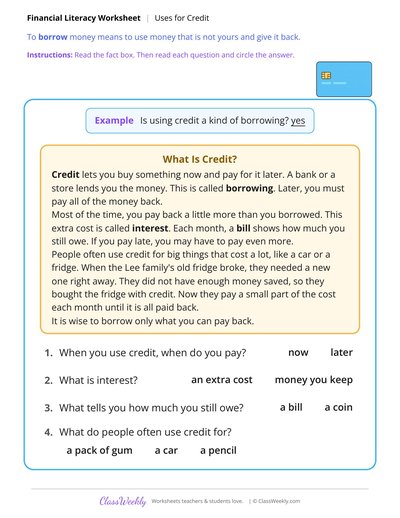
- What Is Credit Read and Answer
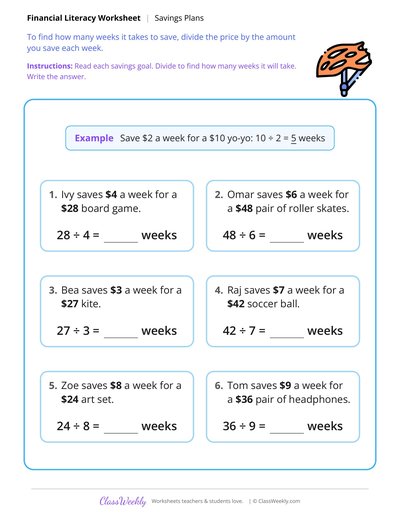
- Weeks to Reach a Savings Goal
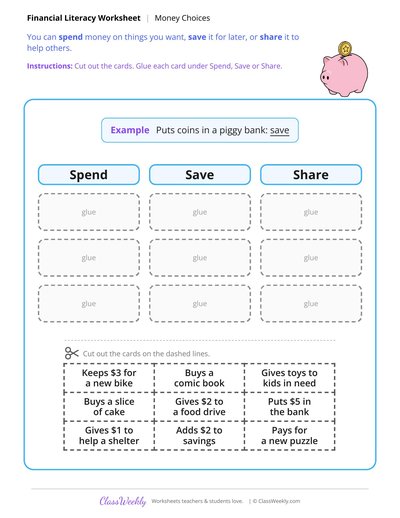
- Spend, Save or Share Sort
- Pencils, and whiteboard space for the modeled examples
Lesson steps
- 1
Warm up together
5 min · 0-5Open with a quick count-around or number talk that touches financial literacy. Ask students where they have seen financial literacy outside of math class. You are listening for who already has the vocabulary and who does not, so keep it light and let several students answer.
- 2
Model it
I do10 min · 5-15Work two examples of financial literacy on the board, thinking out loud the whole way. Say the quiet parts: what you notice first, which step you do next, and why. Deliberately make one small error on the second example and let the class catch it.
- 3
Practice together
We do10 min · 15-25Work three more problems as a class. Ask a different student to supply each step rather than the whole answer. If a step stalls, drop back to concrete objects or a drawing before moving on.
- 4
Independent practice
You do15 min · 25-40Hand out "What Changes How Much People Earn". Students work independently while you circulate. Note who is fluent, who is counting on fingers, and who has not started, because that grouping drives tomorrow's small group.
- 5
Close the loop
5 min · 40-45Pull the class back. Ask one student to explain a problem they got right and one to name something that is still confusing. End on the confusion, not the success, so students learn that naming a gap is normal.
Check for understanding
Collect the practice pages and sort them into three piles: fluent, developing, and not yet. Any student in the third pile needs financial literacy retaught in a small group before the class moves on.
Differentiation
Extra support
Students who stall: pull them into a small group and rebuild financial literacy with concrete materials or a simpler text before asking for the written work again. Do not send the page home as homework, it will just rehearse the misunderstanding.
Extension
Students who finish early: ask them to write their own financial literacy problem for a partner to solve, then check the partner's work. Creating a problem is harder than solving one and it surfaces whether they really understand financial literacy.
Skills covered
- Earning income
- Scarcity and cost
- Planned and unplanned spending
- Uses for credit
- Savings plans
- Financial decisions