Paragraphs & Passages Lesson Plan for 3rd Grade
A ready-to-teach paragraphs & passages lesson for 3rd Grade, built around finding the main idea and key details, answering with text evidence, reading maps, tables and timelines, naming a story's theme, and telling fantasy, historical fiction and science fiction apart. Print the plan, print the practice pages, and you are set.
- Time
- 47 min
- Steps
- 5
- Practice pages
- 9
- Standards
- RF.3.4, RI.3.1, RL.3.1
Lesson flow
47 minLearning objectives
By the end, students can:
- Read a short passage and visualize the described scenes
- Create an illustration that reflects key details from the text
- Demonstrate reading comprehension through drawing and labeling
Materials
Tick off as you get ready:
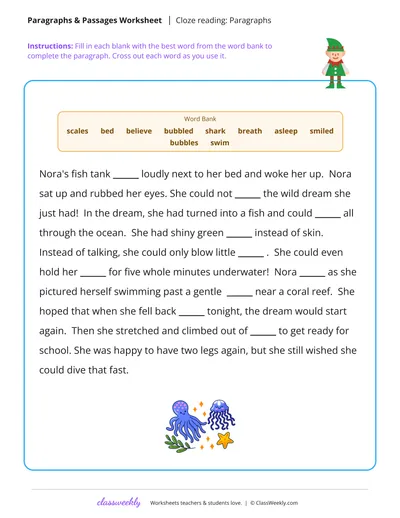
- Cloze reading: Paragraphs
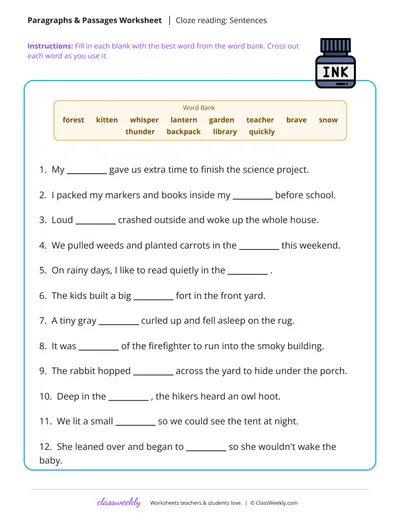
- Cloze reading: Sentences
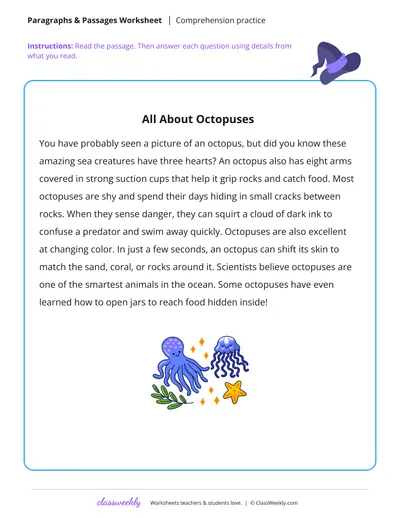
- Comprehension practice
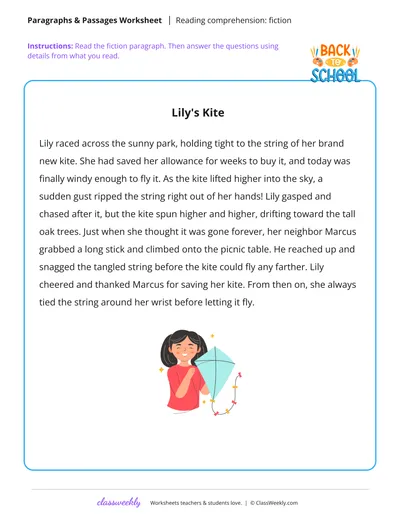
- Reading comprehension: fiction
- Reading comprehension: nonfiction
- Read and illustrate the passages
- Pencils, and whiteboard space for the modeled examples
Lesson steps
- 1
Build the background
5 min · 0-5Bring the real tool: a ruler, a clock, coins, a tally chart. Ask what paragraphs & passages is used for before what it is called.
- 2
Read aloud and think aloud
I do10 min · 5-15Model paragraphs & passages with the actual object, reading it aloud twice. Deliberately misread it once so students learn that checking is part of the method.
- 3
Guided practice
We do12 min · 15-27Read a second passage together. This time students find the evidence and you record it. Push every answer back to the text with "what words told you that?"
- 4
Independent practice
You do15 min · 27-42Hand out "Cloze reading: Paragraphs". Students read and answer on their own. Circulate and ask individuals to point to the line in the text that supports their answer.
- 5
Share and close
5 min · 42-47Two or three students share an answer and the evidence behind it. Restate paragraphs & passages one final time in the students' own words, not yours.
Check for understanding
Ask each student to point to the evidence in the text for one of their answers. A student who has the right answer but cannot find the line has not yet learned paragraphs & passages.
Differentiation
Extra support
Students who stall: pull them into a small group and rebuild paragraphs & passages with concrete materials or a simpler text before asking for the written work again. Do not send the page home as homework, it will just rehearse the misunderstanding.
Extension
Students who finish early: ask them to write their own paragraphs & passages problem for a partner to solve, then check the partner's work. Creating a problem is harder than solving one and it surfaces whether they really understand paragraphs & passages.
Skills covered
- Read and illustrate the passages
- Reading comprehension: nonfiction
- Reading comprehension: fiction
- Cloze reading: Sentences
- Cloze reading: Paragraphs
- Read and recall
- Comprehension practice
- Nonfiction passages
- Fiction passages
- Fantasy passages
- Historical fiction passages
- Science fiction passages