The Environment Lesson Plan for 3rd Grade
A ready-to-teach the environment lesson for 3rd Grade, built around natural resources and how people use them, coal and wind energy, and saving resources. Print the plan, print the practice pages, and you are set.
- Time
- 45 min
- Steps
- 5
- Practice pages
- 6
- Standards
- 4-ESS3-1, 5-ESS3-1
Lesson flow
45 minLearning objectives
By the end, students can:
- Identify the natural resource an everyday object is made from
- Trace a manufactured item back to its source material on Earth
- Explain why some natural resources need to be used carefully
Materials
Tick off as you get ready:
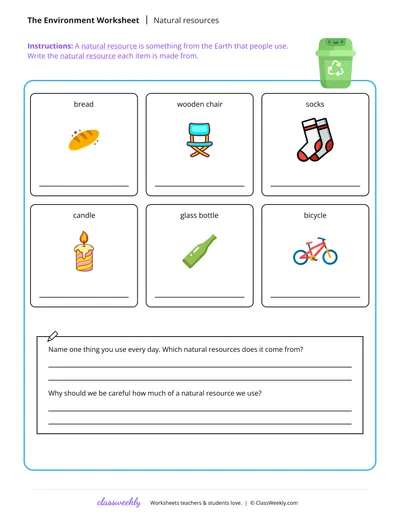
- Natural resources
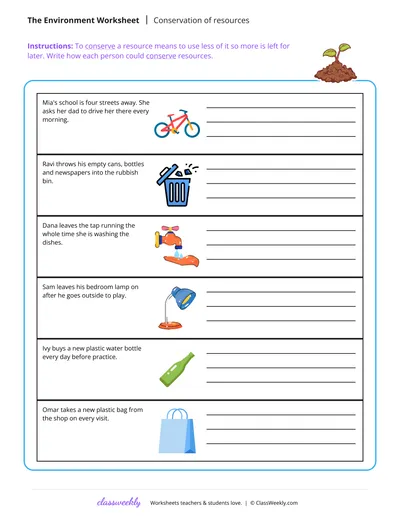
- Conservation of resources
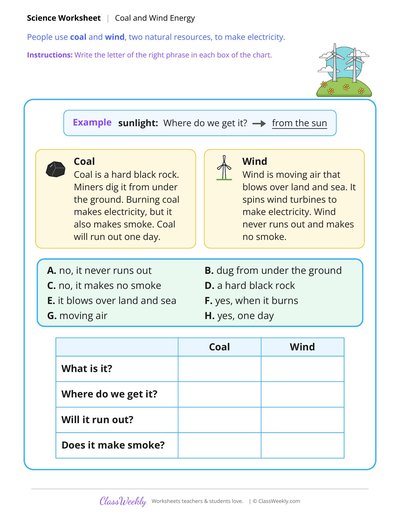
- Coal and Wind Compare Chart
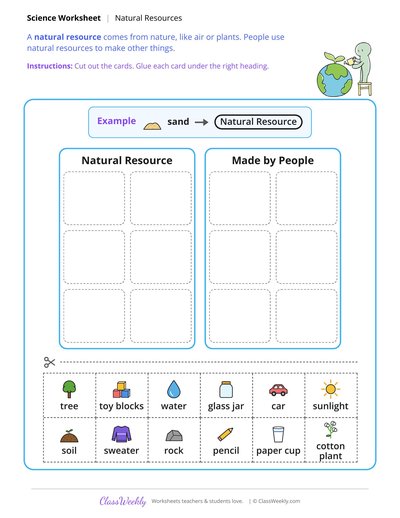
- Natural or Made by People Sort
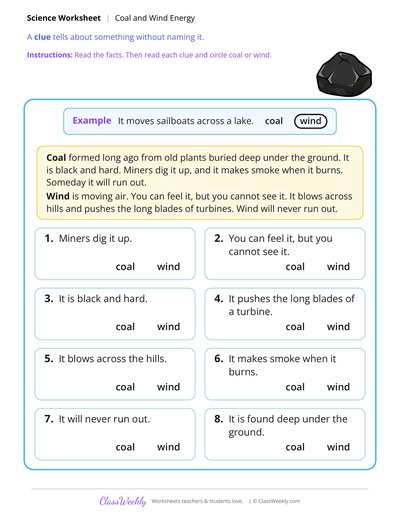
- Coal or Wind Read the Clues
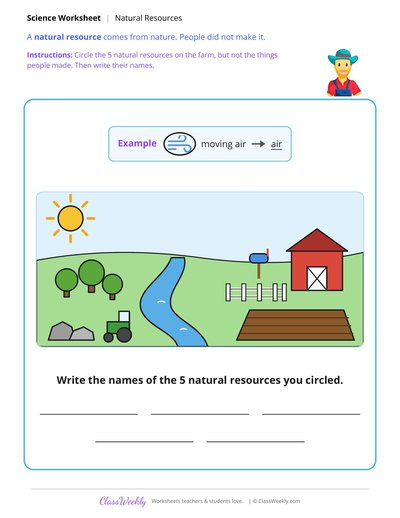
- Natural Resource Hunt on a Farm
- Pencils, and whiteboard space for the modeled examples
Lesson steps
- 1
Ask the question
5 min · 0-5Open with a question about the environment that students cannot answer yet. Take predictions and record them without correcting anything. Wrong predictions are the point: you will come back to them.
- 2
Explore
12 min · 5-17Students investigate the environment through a hands-on activity, a demonstration, or a set of images. Their job is to notice and describe, not to be right yet.
- 3
Explain
10 min · 17-27Now give the vocabulary and the explanation for the environment. Tie it directly back to what students just observed and to the predictions on the board. Name which predictions held up.
- 4
Independent practice
You do13 min · 27-40Hand out "Natural resources". Students record what they learned and answer the questions independently. Circulate and press for "how do you know?"
- 5
Extend the thinking
5 min · 40-45Ask where else the environment shows up outside the classroom. Collect two or three examples and leave the question open for tomorrow.
Check for understanding
Ask students to explain the environment to a partner in one sentence, then write that sentence down. Collect the sentences: they show you exactly which part of the idea did not land.
Differentiation
Extra support
Students who stall: pull them into a small group and rebuild the environment with concrete materials or a simpler text before asking for the written work again. Do not send the page home as homework, it will just rehearse the misunderstanding.
Extension
Students who finish early: ask them to write their own the environment problem for a partner to solve, then check the partner's work. Creating a problem is harder than solving one and it surfaces whether they really understand the environment.
Skills covered
- Natural resources
- Environmental impact
- Renewable energy
- Conservation
- Pollution
- Energy resources