Simplifying fractions (proper and improper fractions)
Written by Adi Ackerman, Head Teacher
"Simplifying fractions (proper and improper fractions)" is written for 3rd Grade (Ages 8-9), and it covers Common Core 3.NF.A.3. If your little one is a year younger but already steady on fractions and decimals, the page still works. You may just need to read the instructions out loud. And if they are older and simplifying fractions (proper and improper fractions) never quite stuck, this is a short review rather than busywork.

Free printable simplifying fractions (proper and improper fractions) worksheet for 3rd grade students. Part of our simplifying fractions (proper and improper fractions) collection. Aligned to Common Core standards.
How do I use this worksheet?
Before handing out the worksheet, briefly introduce the concept with a short oral warm-up or a visual model on the board. Let students work through it independently, using a partner or small group only if they want to talk through their thinking, encouraging them to talk through their thinking: "What strategy are you using? How do you know that is right?" After completing the worksheet, review any missed problems together and discuss the reasoning rather than just the answer. For extra support, let students use manipulatives or draw pictures alongside the written problems. These simplifying fractions (proper and improper fractions) worksheets work well as daily practice, homework, or a focused review activity.
What students will practice
- Students will recognize and apply simplifying fractions (proper and improper fractions) concepts using visual models and written strategies.
- Students will solve problems involving simplifying fractions (proper and improper fractions) with increasing accuracy and confidence.
- Students will connect simplifying fractions (proper and improper fractions) skills to real-world situations and explain their reasoning clearly.

Adding like fractions
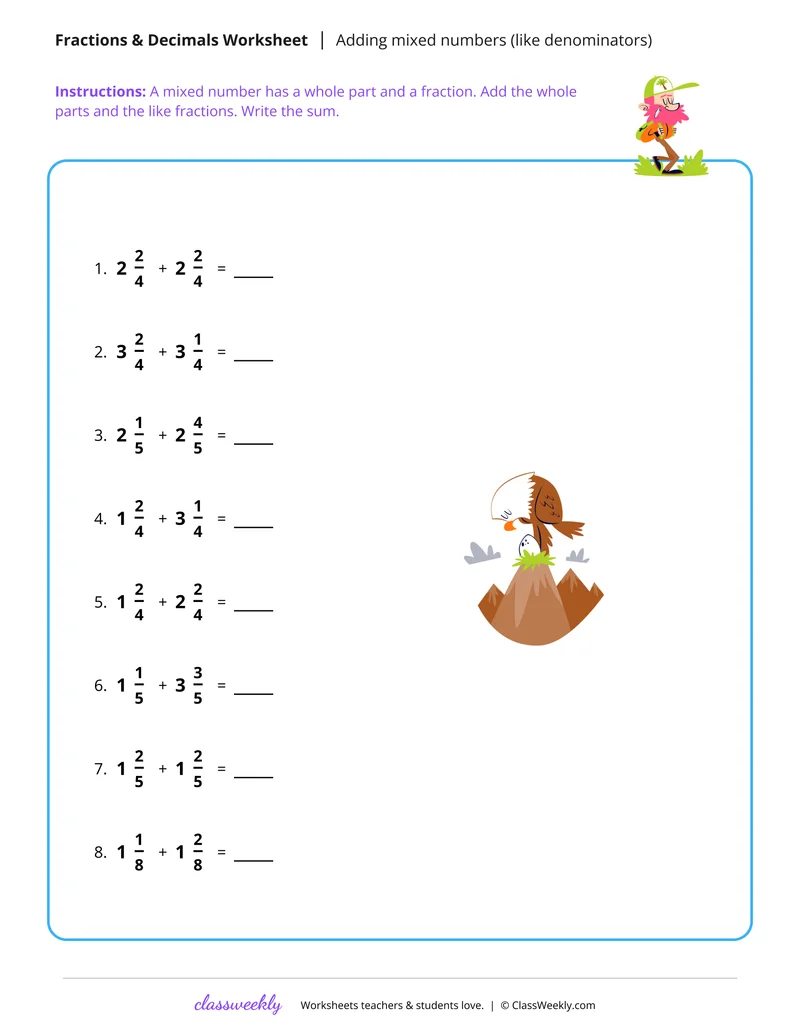
Adding mixed numbers (like denominators)

Completing whole numbers (improper fractions)

Completing whole numbers (mixed numbers)

Subtracting like fractions (denominators 2-12)
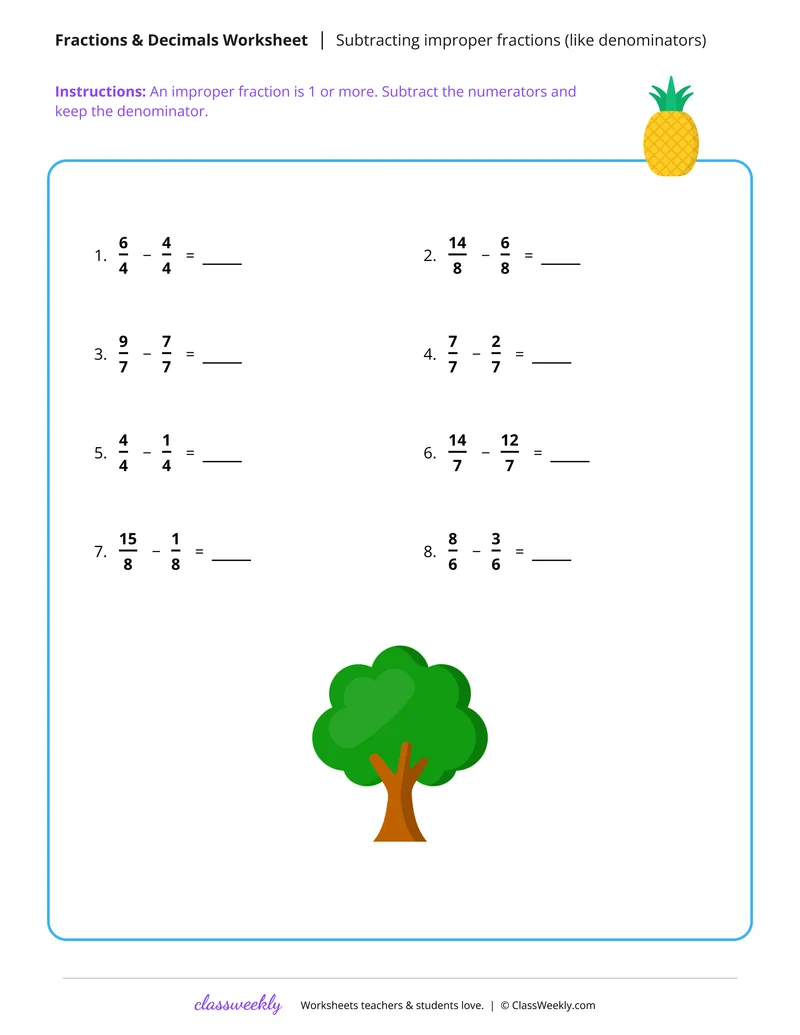
Subtracting improper fractions (like denominators)

Subtracting a fraction from whole number

Subtracting a fraction from a mixed number
Curriculum Links
Common Core State Standards
Number and Operations-Fractions · 3rd Grade
Standard: Explain equivalence of fractions in special cases, and compare fractions by reasoning about their size.
View all 3.NF.A.3 worksheets →Find this in the curriculum
Browse the grade, subject, and topic this belongs to.
FAQ
How do I use this simplifying fractions (proper and improper fractions) worksheet?
⌄
Before handing out the worksheet, briefly introduce the concept with a short oral warm-up or a visual model on the board. Let students work through it independently, using a partner or small group only if they want to talk through their thinking, encouraging them to talk through their thinking: "What strategy are you using? How do you know that is right?" After completing the worksheet, review any missed problems together and discuss the reasoning rather than just the answer. For extra support, let students use manipulatives or draw pictures alongside the written problems. These simplifying fractions (proper and improper fractions) worksheets work well as daily practice, homework, or a focused review activity.
What does this worksheet teach?
⌄
These simplifying fractions (proper and improper fractions) worksheets for 3rd grade give students the structured, hands-on practice they need to build confidence and fluency. Students work through a range of problem formats, from visual models and diagrams to written equations and word problems, so they encounter simplifying fractions (proper and improper fractions) from every angle. Each worksheet is designed to build on prior knowledge while introducing the level of challenge appropriate for 3rd grade. Practicing simplifying fractions (proper and improper fractions) at this stage strengthens the mathematical foundations that support more advanced concepts in later grades.
Can I use this simplifying fractions (proper and improper fractions) worksheet for homeschool or classroom?
⌄
Yes, both. We made it for 3rd Grade fractions and decimals, and the page works the same whether it lands on a kitchen table or a center rotation. At home, most families go through it together and talk the answers out loud, and that talking is where most of the learning happens with simplifying fractions (proper and improper fractions). In class it runs well as independent work while you pull a small group. Print one copy or thirty, whichever the day needs.
Does the simplification process differ between proper and improper fractions?
⌄
No - the process is the same: find the GCF of numerator and denominator, then divide both by it, regardless of whether the fraction is proper or improper.
Should students convert improper fractions to mixed numbers after simplifying?
⌄
Sometimes - if the problem asks for simplest form as a mixed number, yes; otherwise, a simplified improper fraction is a complete and correct answer.
What prerequisite knowledge do students need for this worksheet?
⌄
Students should know how to find factors of numbers up to about 50 and understand the concept of the greatest common factor before simplifying fractions independently.
What fraction skills do 3rd graders learn?
⌄
They learn that a fraction such as 1/4 is one of 4 equal parts of a whole (CCSS 3.NF.A.1), place fractions on a number line (3.NF.A.2) and find and compare equivalent fractions (3.NF.A.3). The pages build these skills with shapes, fraction strips, number lines, sets of counters and recipes.
How do you compare two fractions in 3rd grade?
⌄
Compare only wholes of the same size. With the same denominator, the greater numerator is greater, so 5/8 > 3/8. With the same numerator, the smaller denominator has bigger parts, so 1/3 > 1/6. Compare and Circle the Reason asks children to pick the reason that proves each comparison.
How does a number line help with fractions?
⌄
Count the equal parts from 0 to 1 to find the denominator, then count jumps from 0 to find the numerator. A fraction farther to the right is larger, so on a sixths line 5/6 is larger than 1/6. Two fractions at the same point, such as 1/4 and 2/8, are equivalent.
Do these fractions worksheets have answer keys?
⌄
Most sheets come with an answer key. A few hands on pages, such as Fold Paper Strips Into Equal Parts and Equal Parts Two Ways on Dot Grids, are open folding and drawing tasks without one. Many sheets open with a worked example.
Ratings & Reviews
No reviews yet. Be the first to share what you think.
Reviews are for ClassWeekly members.
Make a Request
Spotted something to fix, or want a worksheet we don't have yet? Tell us and we'll make it.
Worksheet Details
| Grade | 3rd Grade |
| Subject | Math |
| Topic | Fractions And Decimals |
| Standard | 3.NF.A.3 |
| Pages | 1 page |
| Difficulty | Medium |
What is ClassWeekly?
ClassWeekly offers free worksheets and printable learning resources for kids, from preschool up. All worksheets are aligned to Common Core, NGSS, and C3 Framework standards and designed by educators. We also have free online learning games for thousands of skills, and kids' answers turn into a progress report for the grown-up. Start a free 30-day trial to download the worksheets.
Adding like fractions
Adding mixed numbers (like denominators)
Completing whole numbers (improper fractions)
Completing whole numbers (mixed numbers)
Subtracting like fractions (denominators 2-12)
Subtracting improper fractions (like denominators)
Subtracting a fraction from whole number
Subtracting a fraction from a mixed number