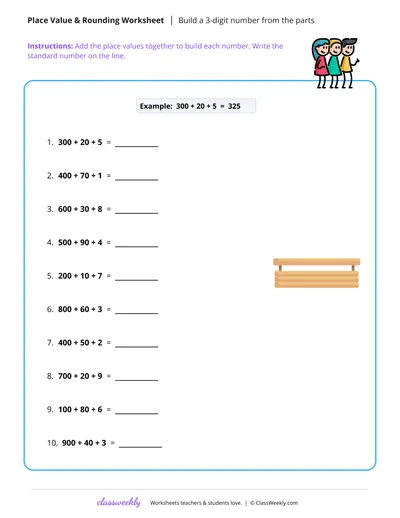
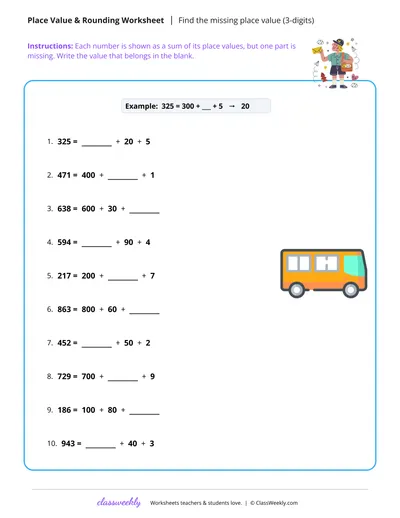
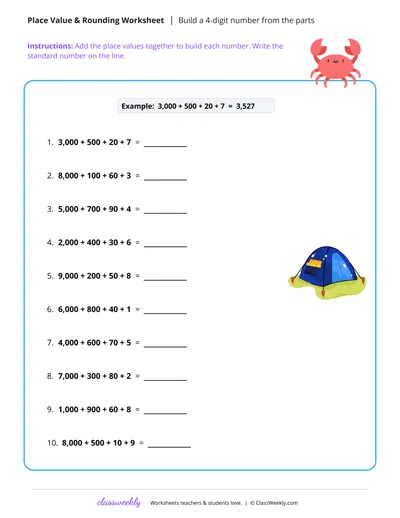
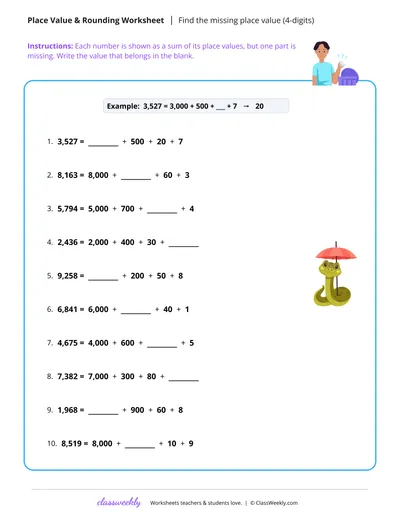
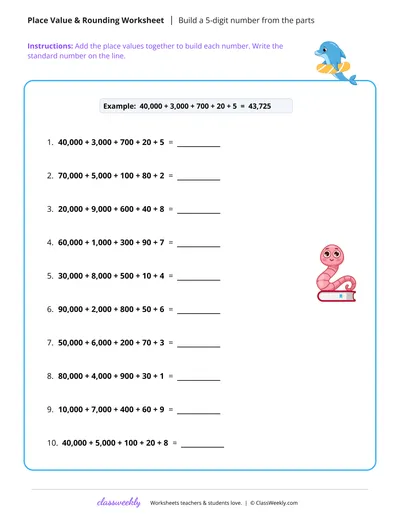
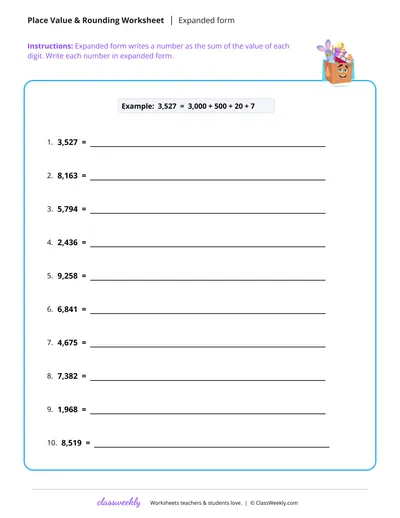
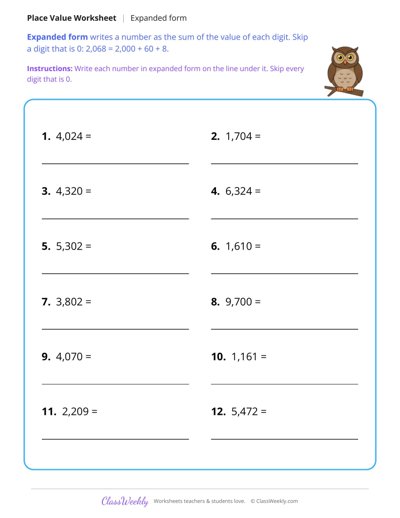
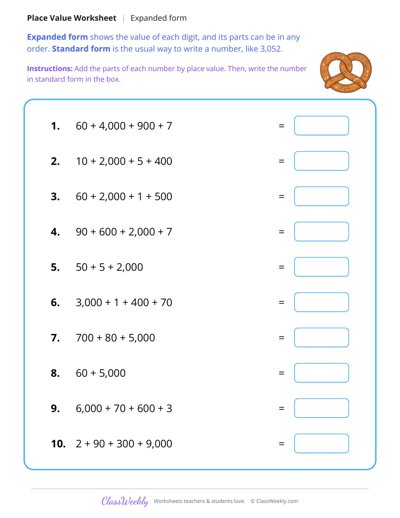
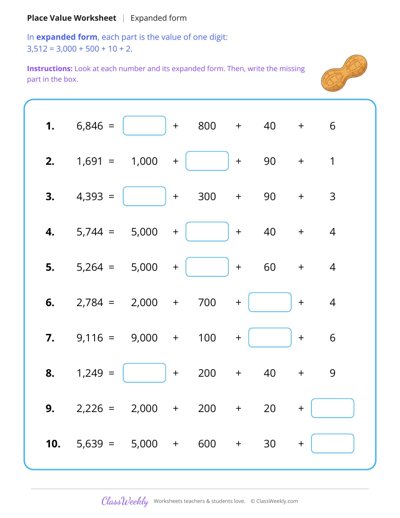
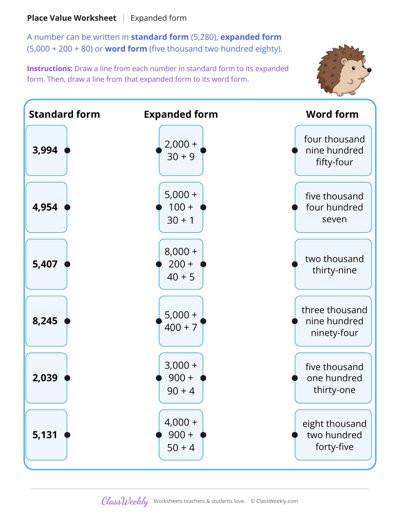
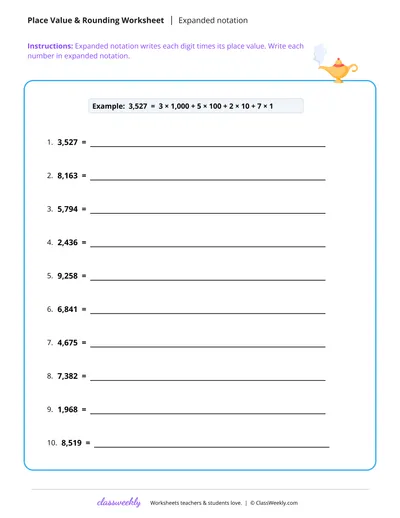
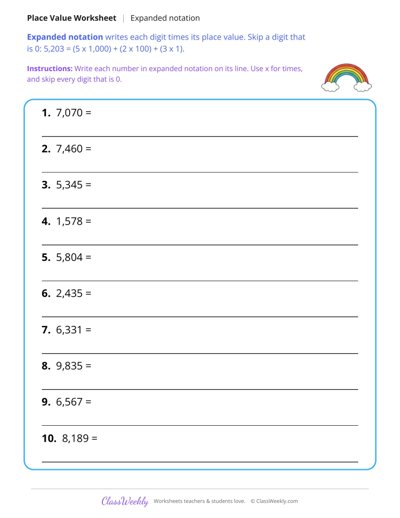
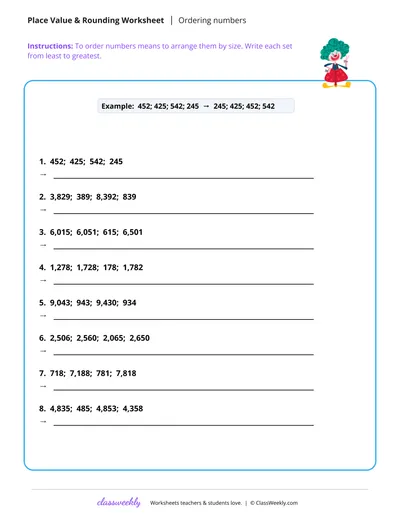
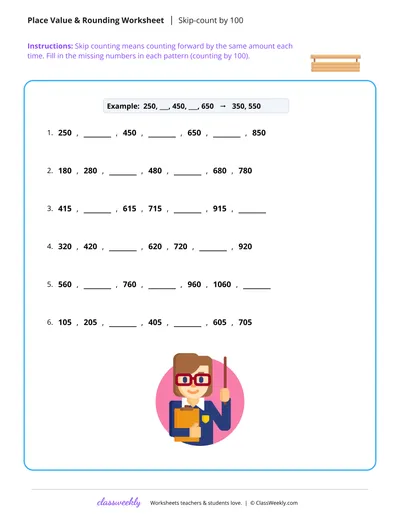
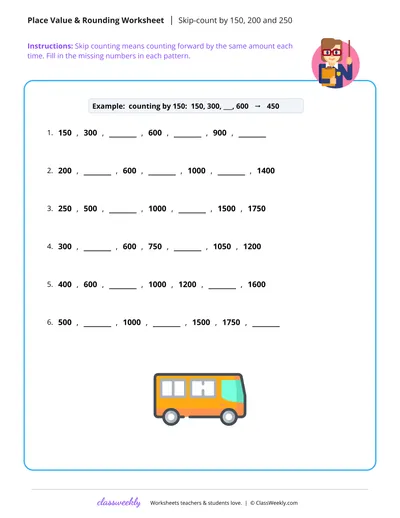
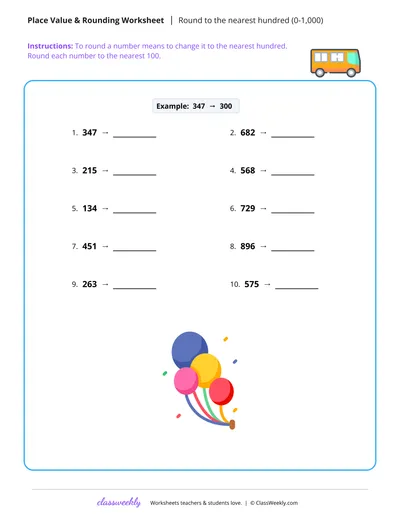
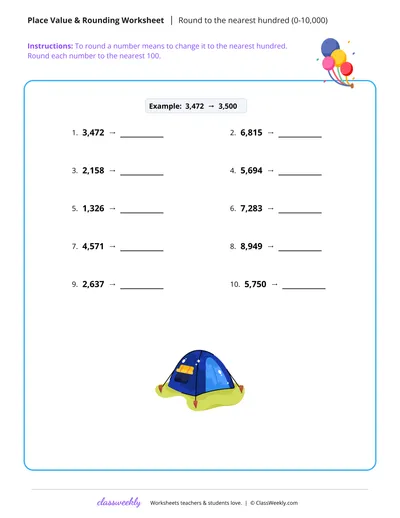
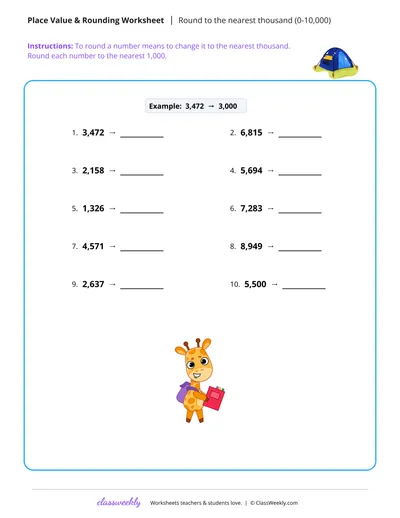
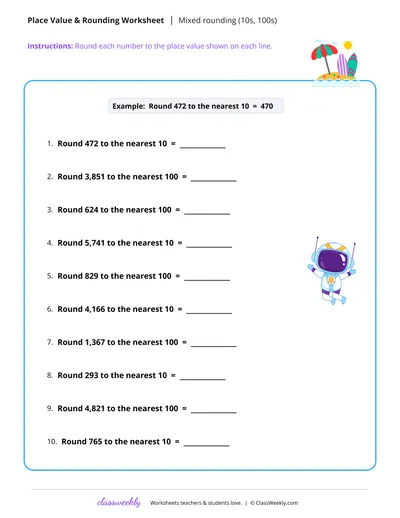
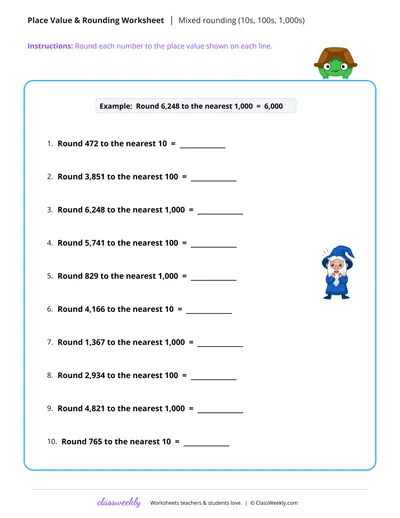
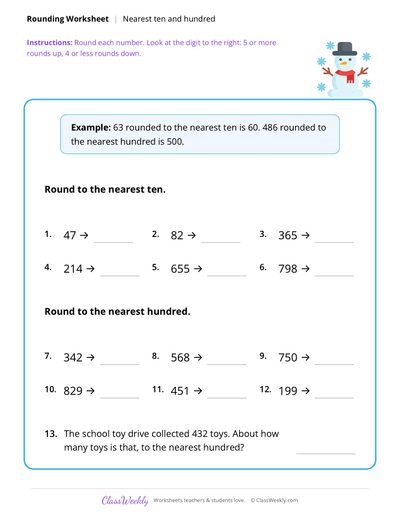
Place value tells what a digit is worth from its place in a number, so the 4 in 4,024 is worth 4,000. These place value and rounding worksheets for 3rd grade hold 25 sheets, each with an answer key. Children build 3, 4 and 5 digit numbers from their parts, find a missing place value and the value of a digit, and write numbers in expanded form and expanded notation, then rebuild them in standard form. Other pages skip count by 100, 150, 200 and 250, compare and order numbers, and round to the nearest ten, hundred and thousand (CCSS 3.NBT.A.1). Expanded Form of Numbers With Zeros, Match Standard, Expanded and Word Form and Rebuild Numbers From Expanded Notation work with 4 digit numbers.
Third graders should use place value understanding to round whole numbers to the nearest 10 or 100 (CCSS 3.NBT.A.1) and fluently add and subtract within 1,000 using strategies based on place value (3.NBT.A.2). They should understand that in multi-digit numbers, a digit in one place represents ten times what it represents in the place to its right. Students should read, write, and compare numbers up to the thousands and use expanded form. Worksheets that present numbers in standard, expanded, and word form and ask students to convert between them build flexible place value understanding. This knowledge is the foundation for the multi-digit multiplication and division work that begins in fourth grade.
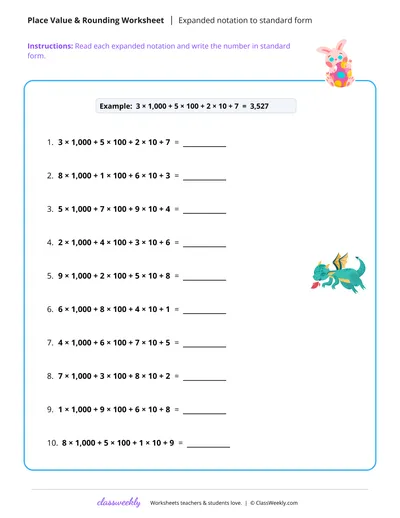
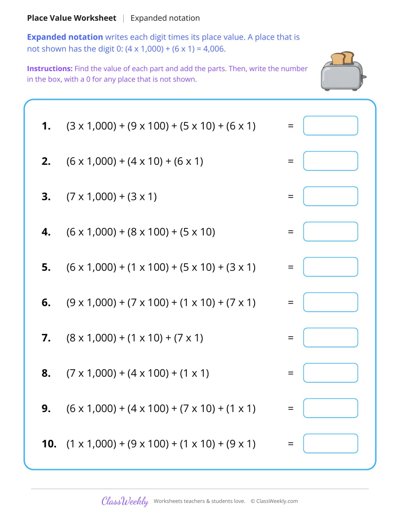
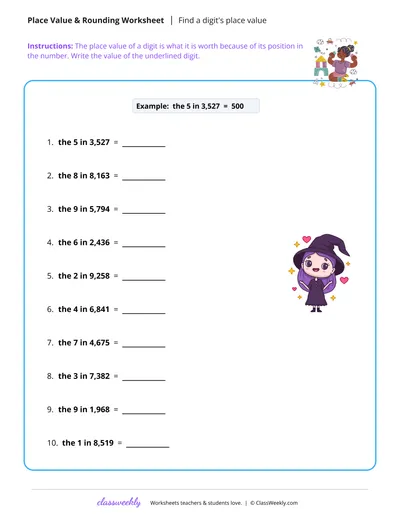
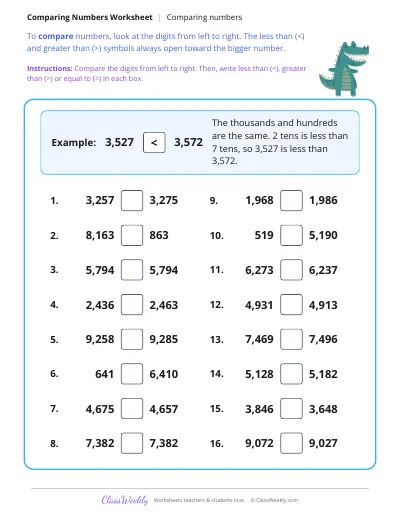
24 printable 3rd grade place value and rounding worksheets in 18 skill sets, in the order they appear on this page: build a 3-digit number from the parts; find the missing place value (3-digits); build a 4-digit number from the parts; find the missing place value (4-digits); build a 5-digit number from the parts; expanded form; expanded notation; expanded notation to standard form; find a digit's place value; comparing numbers; ordering numbers; skip-count by 100; and 6 more.
Start with number lines showing the benchmarks. To round 67 to the nearest 10, draw a number line from 60 to 70 and place 67 on it. Since 67 is closer to 70, it rounds to 70. The common rule (if the digit is 5 or more, round up) should be taught after children understand why it works through number line visualization. For rounding to the nearest 100, use a number line from 200 to 300 and place numbers on it. Worksheets that combine number line visualization with practice using the digit-based rule help children internalize both the concept and the procedure. Always ask students to estimate before computing so rounding becomes a practical tool, not just an isolated skill.
Rounding develops estimation skills that are used throughout mathematics and daily life. When third graders round before computing, they can check whether their exact answer is reasonable. For example, 387 plus 214 should be close to 400 plus 200 equals 600, so an answer of 6,001 would signal an error. Rounding also simplifies mental math: estimating the cost of groceries or the time needed for activities requires rounding. The Common Core places rounding in third grade because students now work with numbers large enough that estimation becomes genuinely useful. Worksheets that pair rounding exercises with estimation of sums and differences teach children to use rounding as a practical tool, building the number sense that supports all future math work.
Expanded form adds the value of each digit, so 2,068 = 2,000 + 60 + 8. Expanded notation writes each digit times its place value, so 5,203 = (5 x 1,000) + (2 x 100) + (3 x 1). In both, a digit that is 0 is skipped.
More math worksheets
Explore all of our 3rd grade math worksheets, covering place value and rounding, addition, subtraction, multiplication, and more.
ClassWeekly offers free worksheets and printable learning resources for kids, from preschool up. All worksheets are aligned to Common Core, NGSS, and C3 Framework standards and designed by educators. We also have free online learning games for thousands of skills, and kids' answers turn into a progress report for the grown-up. Start a free 30-day trial to download the worksheets.