Static Electricity True or False
Written by Adi Ackerman, Head Teacher
"Static Electricity True or False" is written for 3rd Grade (Ages 8-9), and it covers NGSS 3-PS2-3. If your little one is a year younger but already steady on electricity and magnetism, the page still works. You may just need to read the instructions out loud. And if they are older and static electricity never quite stuck, this is a short review rather than busywork.
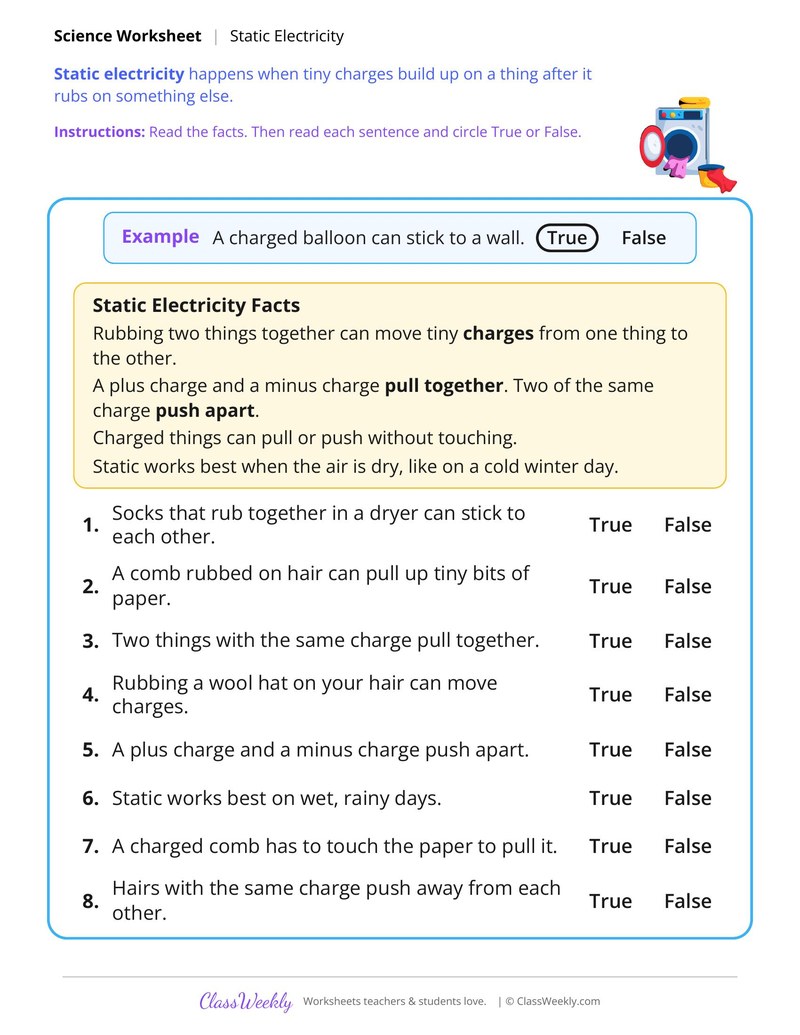
3rd grade science worksheet: read static electricity facts and circle true or false for sentences about dryer socks and a rubbed comb. Answer key included. Part of our static electricity collection. Aligned to NGSS standards.
How do I use this worksheet?
Rub a balloon on a sweater and hold it over torn tissue paper while your child watches. Try again on a humid day and compare the results.
What students will practice
- Students will read that rubbing two things together can move tiny charges.
- Students will learn that opposite charges pull together and the same charges push apart.
- Students will mark sentences about socks, a comb and paper bits true or false.
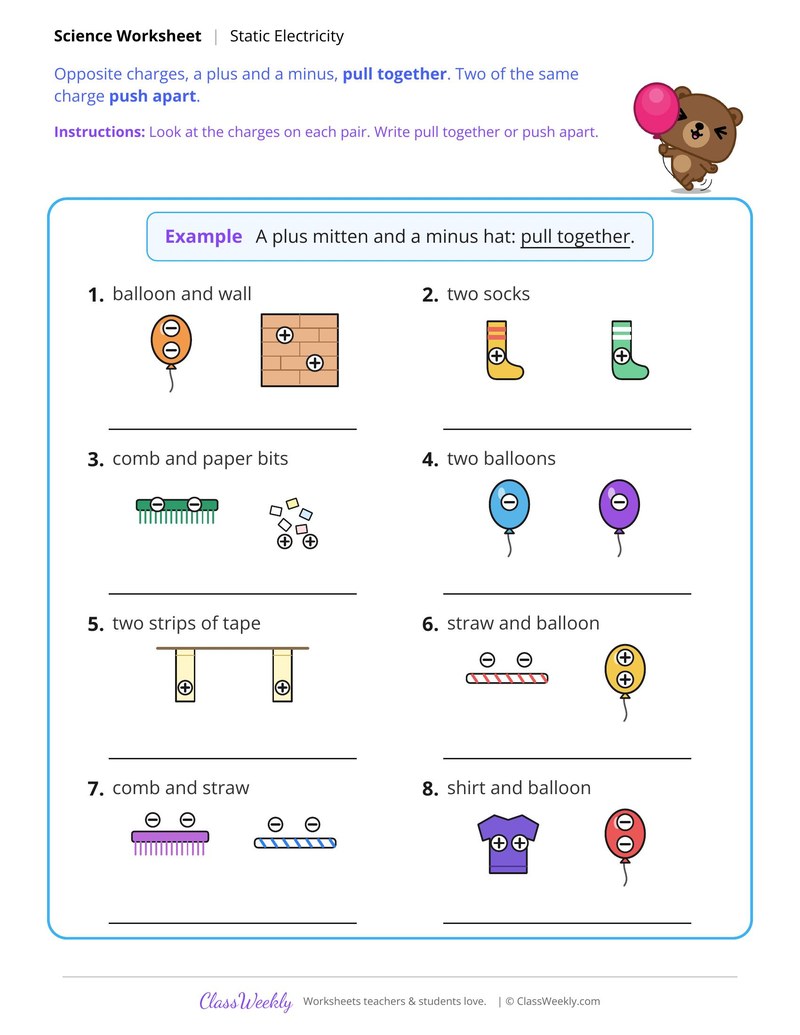
Pull Together or Push Apart? Charged Objects
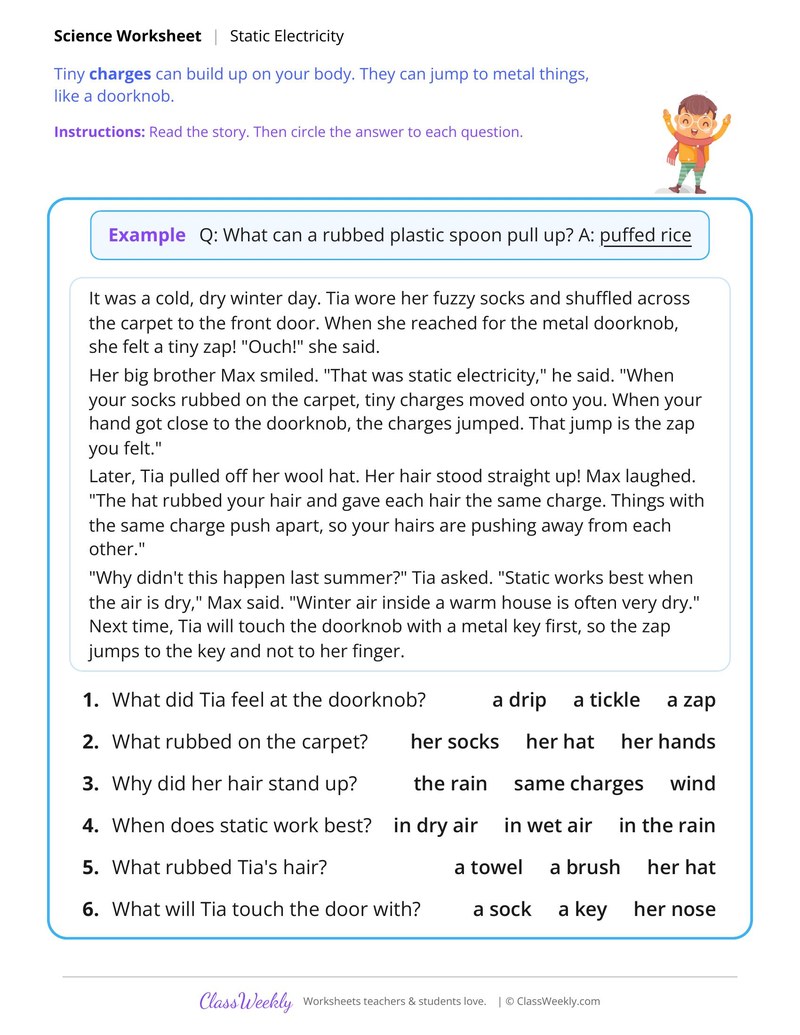
A Shock From the Doorknob, Read and Answer
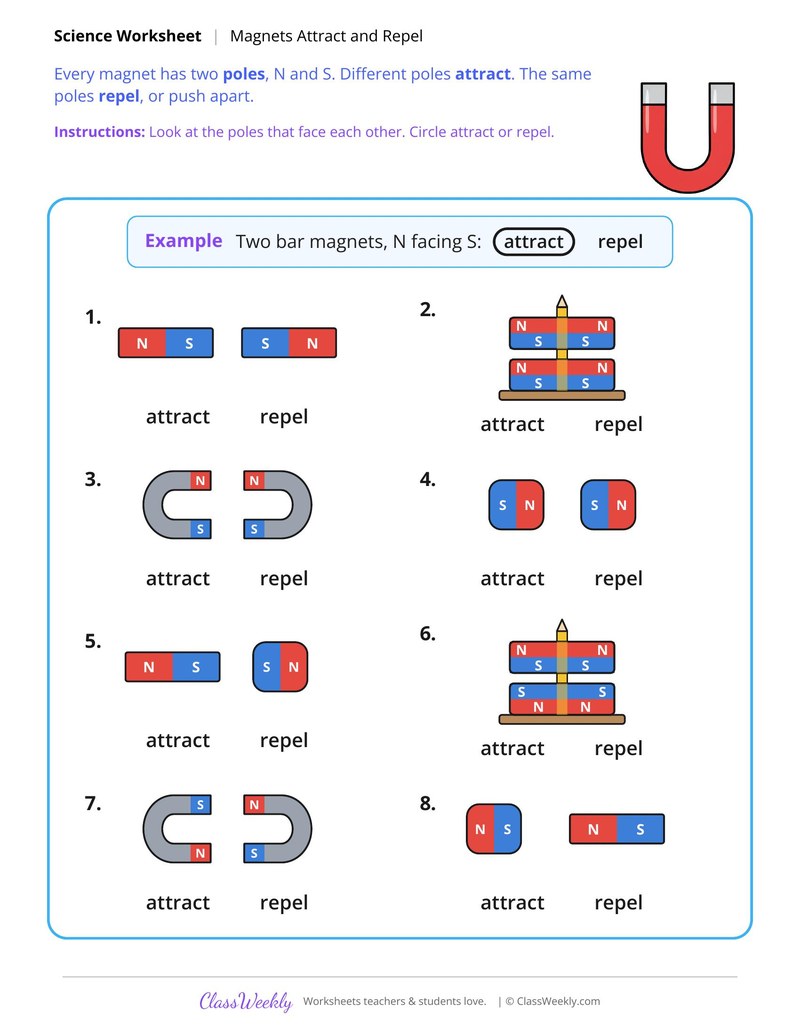
Will They Stick or Push Apart? Circle
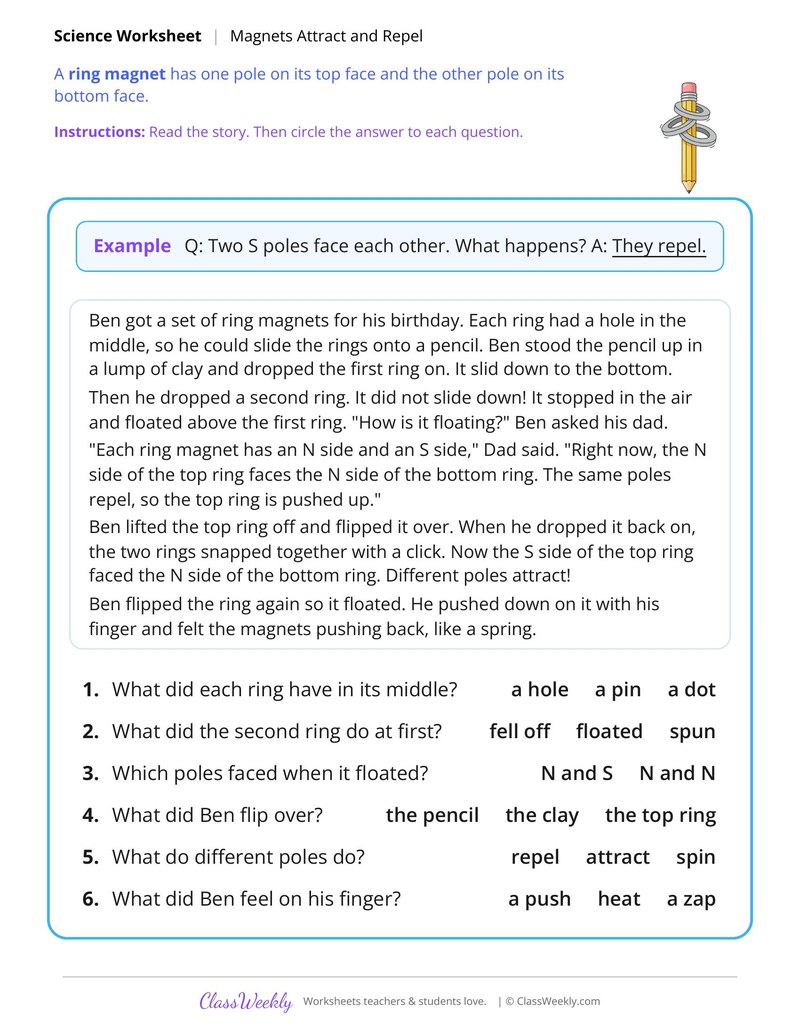
Floating Ring Magnets, Read and Answer
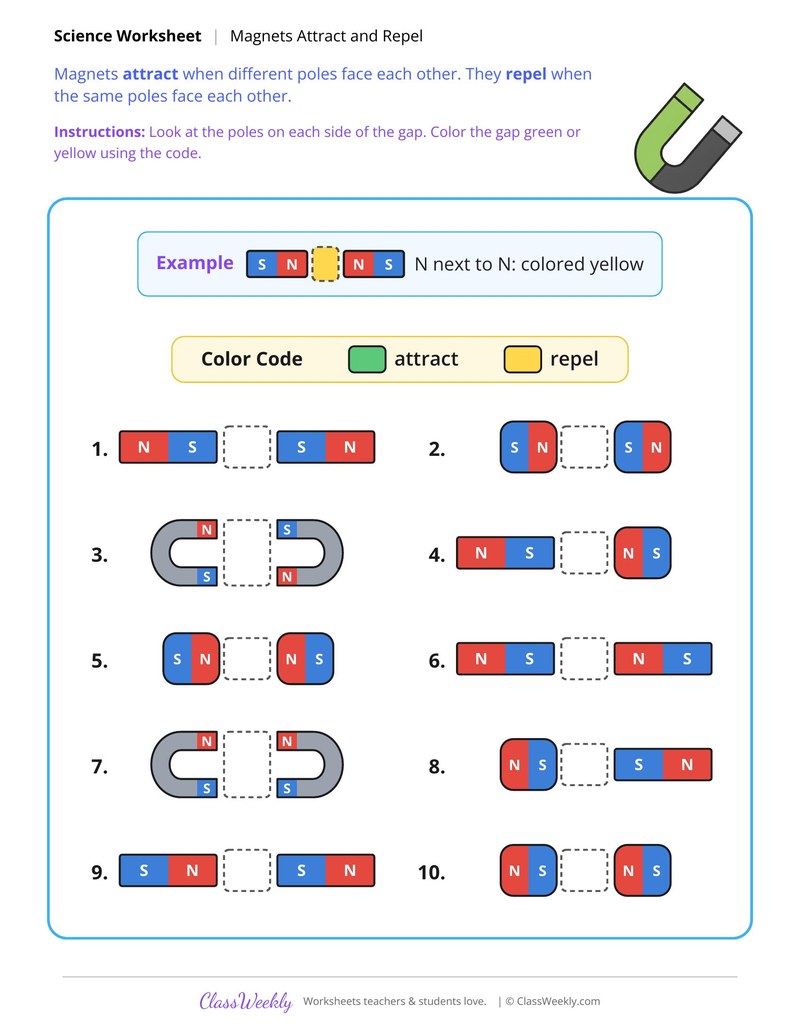
Magnet Pairs Color by Code
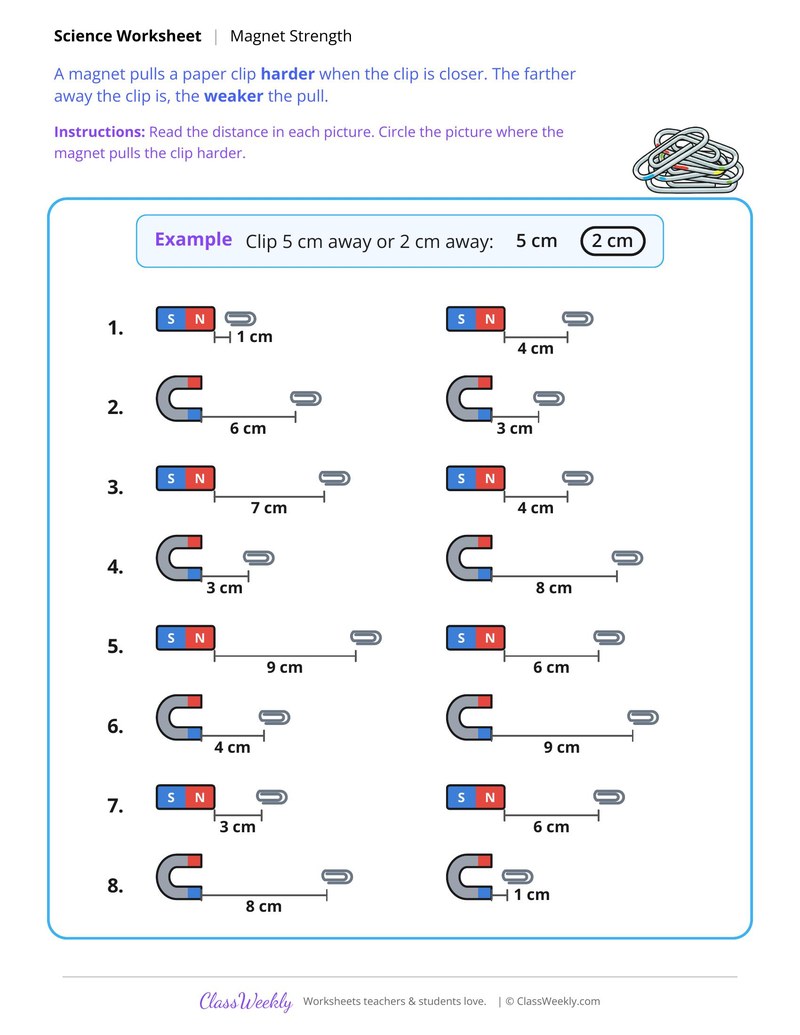
Closer or Farther? Circle the Stronger Pull
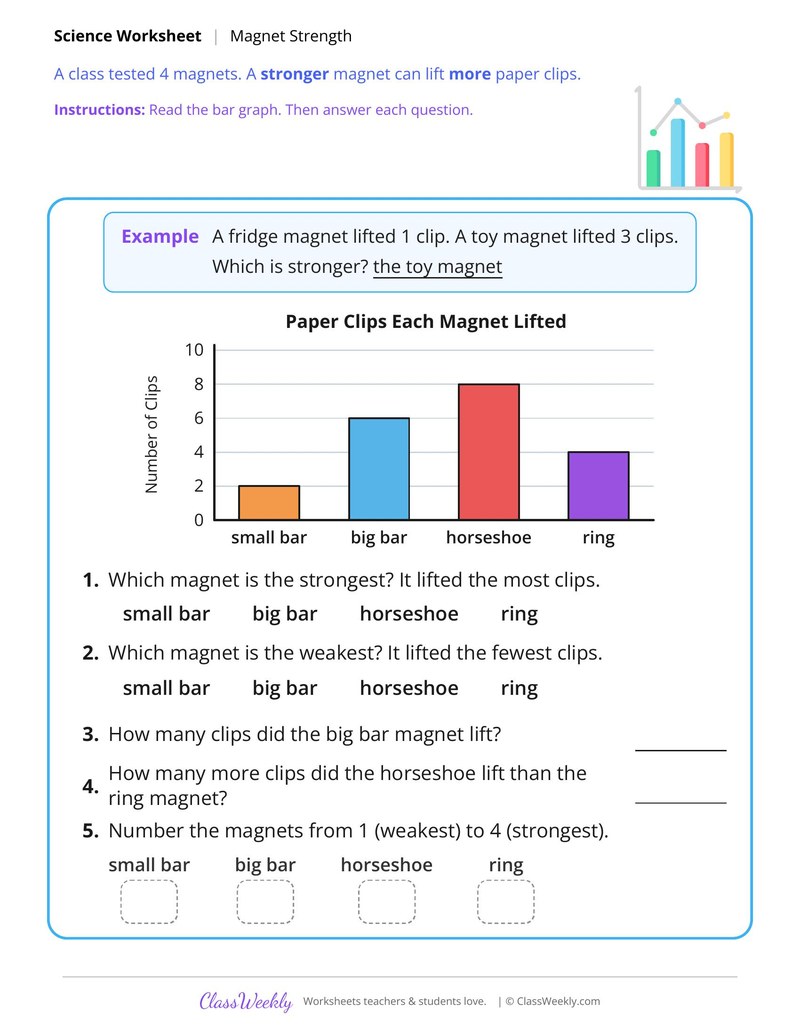
Paper Clip Test, Read a Bar Graph
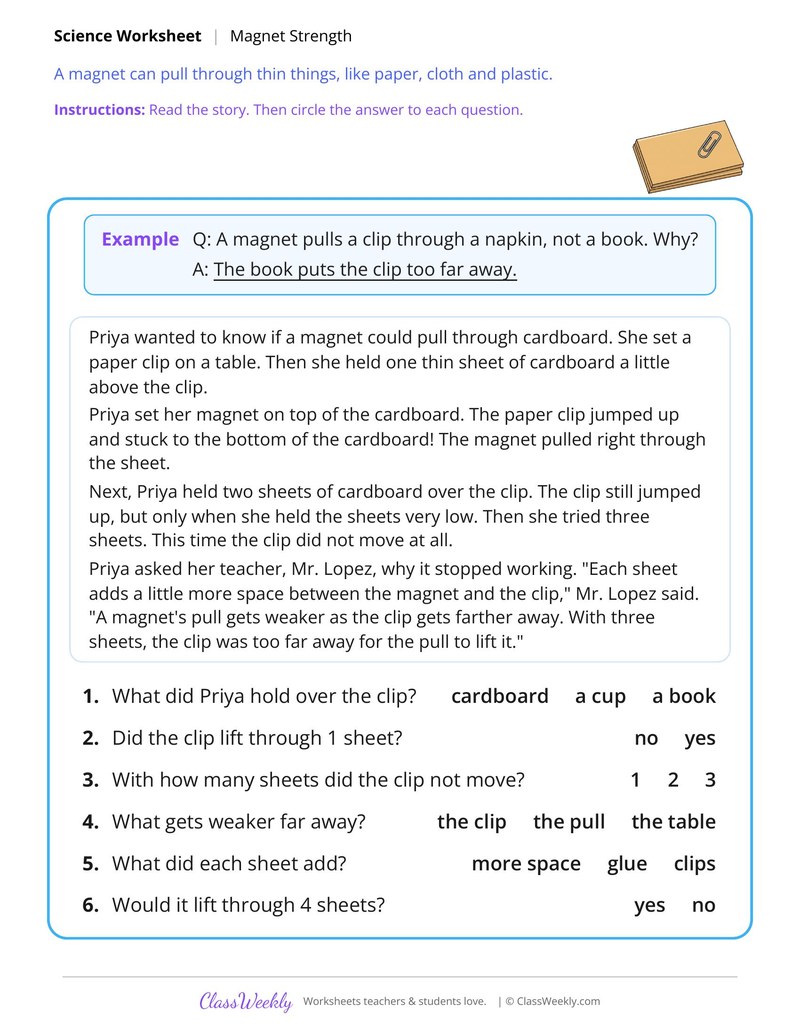
Pulling Through Cardboard, Read and Answer
Curriculum Links
Next Generation Science Standards
Science · 3rd Grade
Find this in the curriculum
Browse the grade, subject, and topic this belongs to.
FAQ
How do I use this static electricity worksheet?
⌄
Rub a balloon on a sweater and hold it over torn tissue paper while your child watches. Try again on a humid day and compare the results.
What does this worksheet teach?
⌄
Read static electricity facts and circle true or false for sentences about dryer socks and a rubbed comb. The directions on the page read: Read the facts. Then read each sentence and circle True or False. The page opens with a worked example, and an answer key is included.
Can I use this static electricity worksheet for homeschool or classroom?
⌄
Yes, both. We made it for 3rd Grade electricity and magnetism, and the page works the same whether it lands on a kitchen table or a center rotation. At home, most families go through it together and talk the answers out loud, and that talking is where most of the learning happens with static electricity. In class it runs well as independent work while you pull a small group. Print one copy or thirty, whichever the day needs.
What does static electricity teach third graders?
⌄
Static electricity teaches students that all objects are made of tiny charged particles, and that when charges build up on a surface, they can attract or repel other objects and eventually discharge as a spark. Third graders explore familiar examples like hair standing up after a balloon rub, clingy laundry, and doorknob shocks, and connect those experiences to the underlying concept of charge transfer. It builds early atomic thinking in an age-appropriate, observable way.
When do third graders learn about static electricity?
⌄
Static electricity is typically introduced in Grade 3 as part of the electricity and magnetism unit, often alongside magnets and contact vs. non-contact forces. At ages 8-9, students find static electricity fascinating because the effects are so visible and surprising, hair floating, paper scraps jumping, making it one of the most memorable units of the year. Simple demonstrations with balloons and tissue paper are standard accompaniments.
How can I use these worksheets at home?
⌄
Rub a balloon on your child's hair, let them observe the effects, and then use the worksheet to explain what's happening in terms of positive and negative charges. The observation and explanation activities in the worksheets are easy to do independently once your child has had a hands-on experience to anchor the concepts. This is a topic where a two-minute kitchen experiment can make an entire worksheet feel easy and satisfying to complete.
When do magnets attract and when do they repel?
⌄
Every magnet has an N pole and an S pole. Different poles facing each other attract, and the same poles facing each other repel, or push apart. That is why a ring magnet can float above another ring when two N sides face each other.
Does distance change a magnet's pull?
⌄
Yes. A magnet pulls a paper clip harder when the clip is closer, and the pull gets weaker as the clip moves farther away. In one story, a magnet lifts a clip through one sheet of cardboard but not through three.
What is static electricity?
⌄
Static electricity happens when tiny charges build up on something after it rubs on something else, like socks on a carpet. A plus and a minus charge pull together, two of the same charge push apart, and charges can jump to a metal doorknob as a small zap.
Do these worksheets have answer keys?
⌄
Yes. Every electricity and magnetism sheet has an answer key, and each one opens with a worked example.
Ratings & Reviews
No reviews yet. Be the first to share what you think.
Reviews are for ClassWeekly members.
Make a Request
Spotted something to fix, or want a worksheet we don't have yet? Tell us and we'll make it.
Worksheet Details
| Grade | 3rd Grade |
| Subject | Science |
| Topic | Electricity and Magnetism |
| Standard | 3-PS2-3 |
| Pages | 1 page |
| Difficulty | Medium |
Learn More
What is ClassWeekly?
ClassWeekly offers free worksheets and printable learning resources for kids, from preschool up. All worksheets are aligned to Common Core, NGSS, and C3 Framework standards and designed by educators. We also have free online learning games for thousands of skills, and kids' answers turn into a progress report for the grown-up. Start a free 30-day trial to download the worksheets.
Pull Together or Push Apart? Charged Objects
A Shock From the Doorknob, Read and Answer
Will They Stick or Push Apart? Circle
Floating Ring Magnets, Read and Answer
Magnet Pairs Color by Code
Closer or Farther? Circle the Stronger Pull
Paper Clip Test, Read a Bar Graph
Pulling Through Cardboard, Read and Answer