Mass and Force True or False
Written by Adi Ackerman, Head Teacher
"Mass and Force True or False" is written for 3rd Grade (Ages 8-9), and it covers NGSS 3-PS2-1. If your little one is a year younger but already steady on forces and motion, the page still works. You may just need to read the instructions out loud. And if they are older and force and motion never quite stuck, this is a short review rather than busywork.
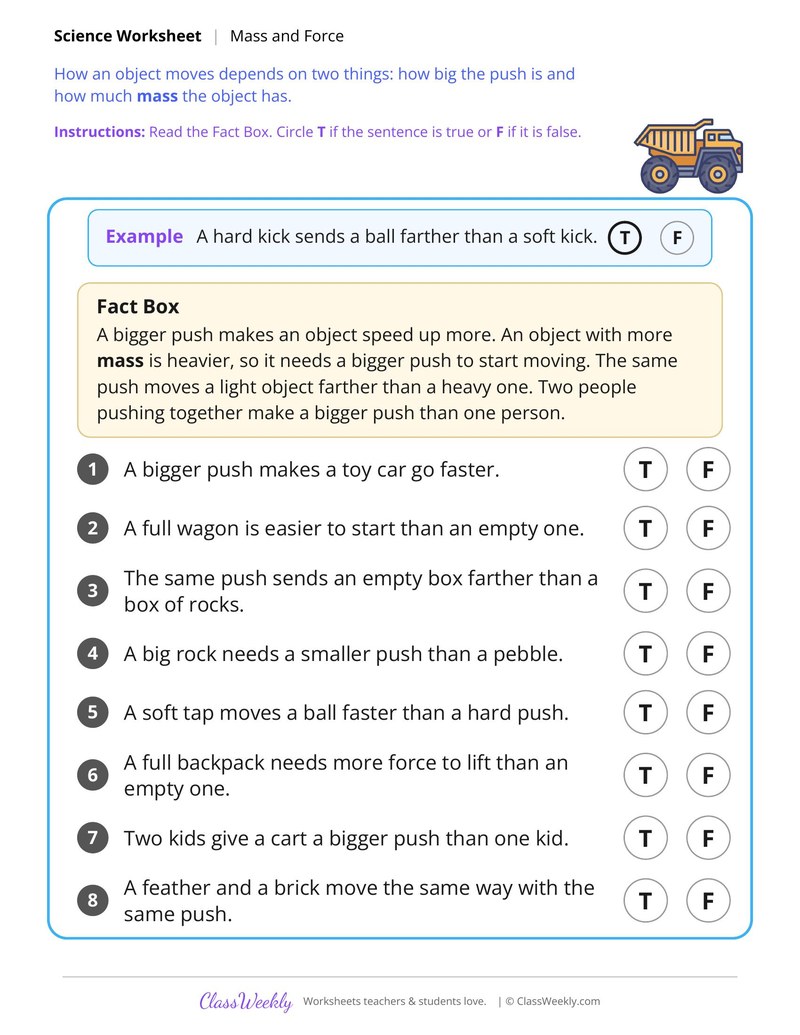
3rd grade science worksheet: read a fact box on push size and mass and circle T or F for sentences about toy cars and full wagons. Answer key included. Part of our force and motion collection. Aligned to NGSS standards.
How do I use this worksheet?
Roll a ball with a soft push and then a hard push and ask your child which went farther. During a game, name each force you see, like the kick that starts the ball and the grass that slows it.
What students will practice
- Students will read a fact box about the size of a push and the mass of an object.
- Students will mark sentences about a toy car, a full wagon and a big rock true or false.
- Students will recall that two people pushing together make a bigger push.

Curriculum Links
Next Generation Science Standards
Science · 3rd Grade
Find this in the curriculum
Browse the grade, subject, and topic this belongs to.
FAQ
How do I use this force and motion worksheet?
⌄
Roll a ball with a soft push and then a hard push and ask your child which went farther. During a game, name each force you see, like the kick that starts the ball and the grass that slows it.
What does this worksheet teach?
⌄
Read a fact box on push size and mass and circle T or F for sentences about toy cars and full wagons. The directions on the page read: Read the Fact Box. Circle T if the sentence is true or F if it is false. The page opens with a worked example, and an answer key is included.
Can I use this force and motion worksheet for homeschool or classroom?
⌄
Yes, both. We made it for 3rd Grade forces and motion, and the page works the same whether it lands on a kitchen table or a center rotation. At home, most families go through it together and talk the answers out loud, and that talking is where most of the learning happens with force and motion. In class it runs well as independent work while you pull a small group. Print one copy or thirty, whichever the day needs.
What does force and motion teach third graders?
⌄
It teaches that every force is either a push or a pull, and that forces are what start, stop, or change the way something moves. Third graders learn to spot forces in ordinary situations such as opening a door or pushing a trolley. This is the foundation for balanced and unbalanced forces later in the unit.
When do third graders learn about force and motion?
⌄
Force and motion opens the Grade 3 physical science unit and comes before gravity, friction, and magnets. Children ages 8-9 have plenty of everyday experience of pushing and pulling, so the lesson mostly gives names to things they already do. It leads into predicting how an object will move.
How can I use these worksheets at home?
⌄
Ask your child to label the forces they use during an ordinary task, such as opening the fridge or riding a bike. Have them say push or pull out loud each time. Once they start noticing forces everywhere, the sorts and the bowling and soccer step pages become easy.
What is a force in 3rd grade science?
⌄
A force is a push or a pull. A push moves a thing away from you and a pull moves it toward you. Sheets ask children to name the force when someone opens a refrigerator door, kicks a ball or tugs a kite string.
What are balanced and unbalanced forces?
⌄
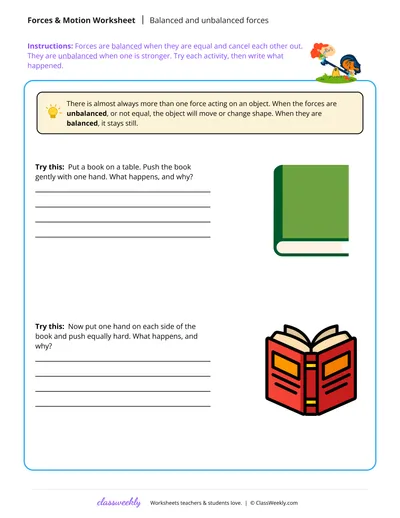
Balanced forces are equal and point opposite ways, so the object does not start to move, like a tug of war rope when both sides pull just as hard. Unbalanced forces make an object move toward the stronger force. Children read force arrows and circle which way each crate moves.
How do you compare speed?
⌄
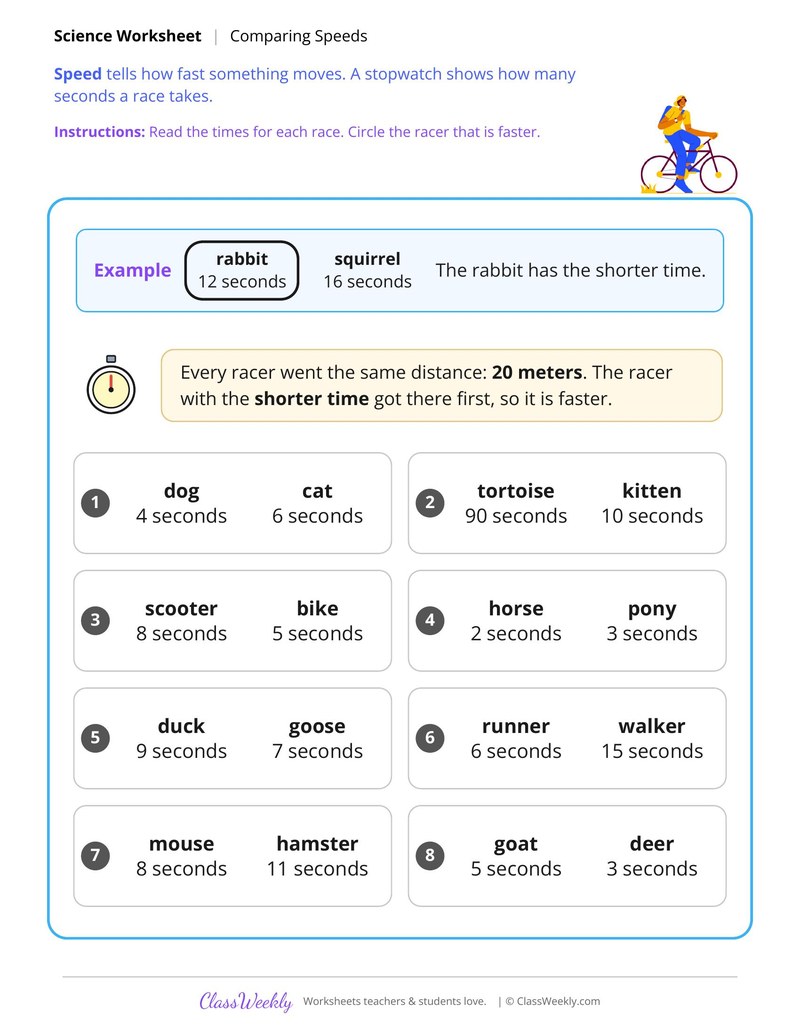
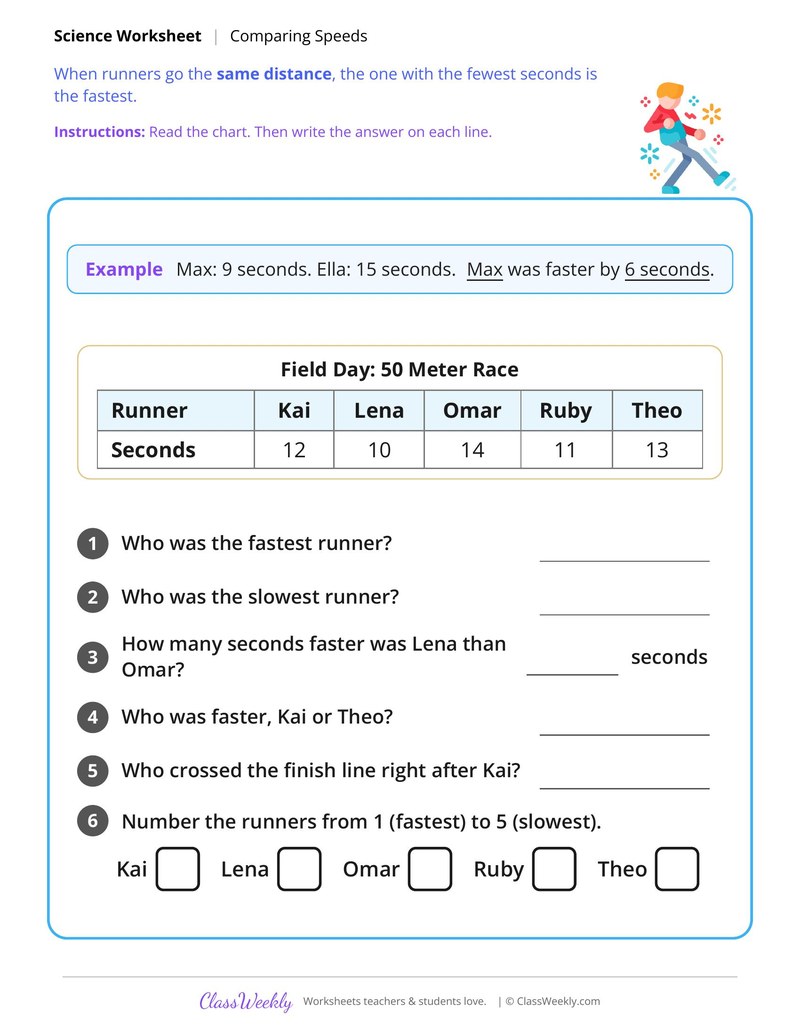
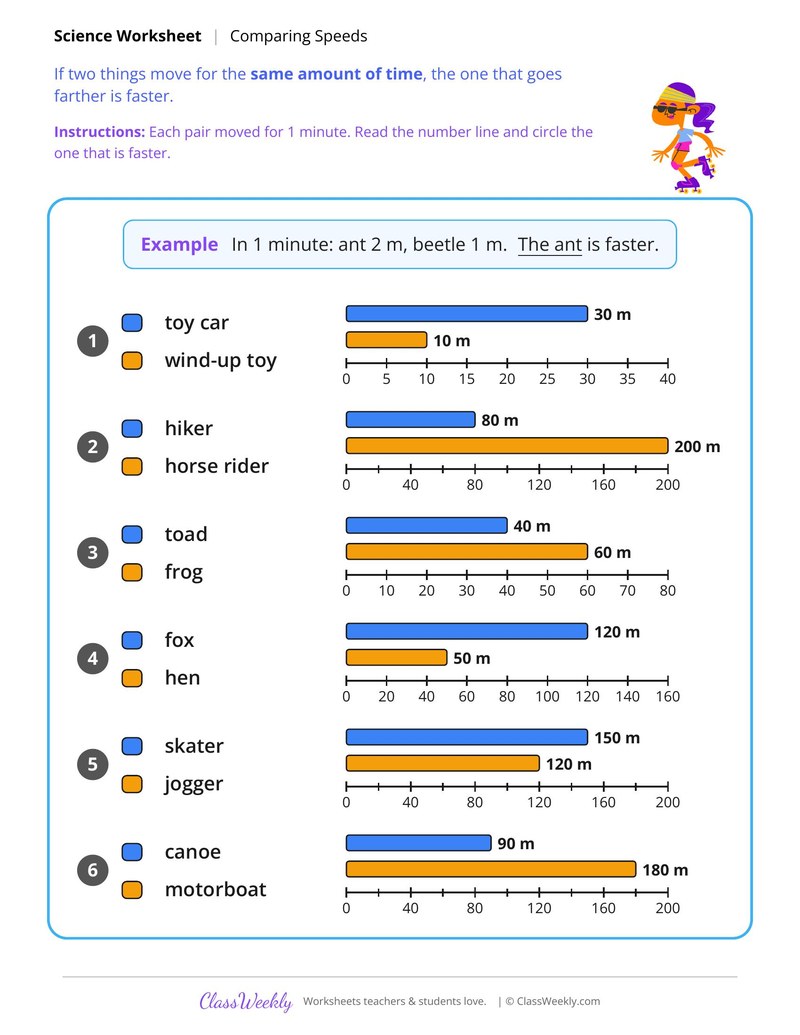
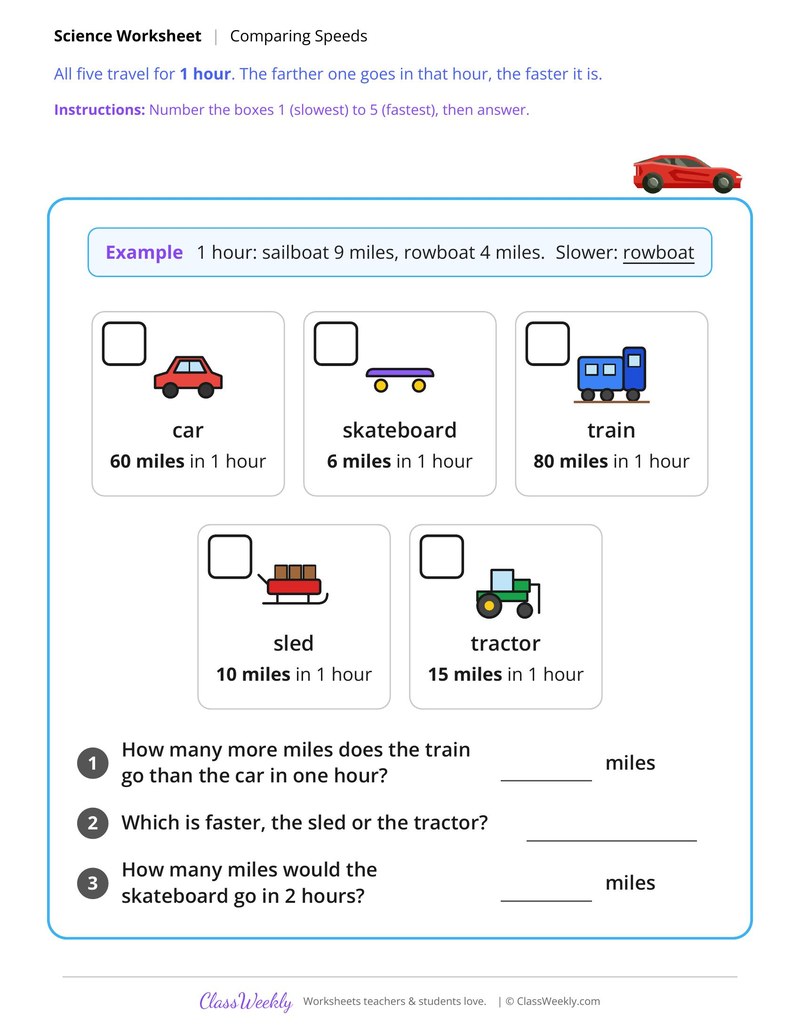
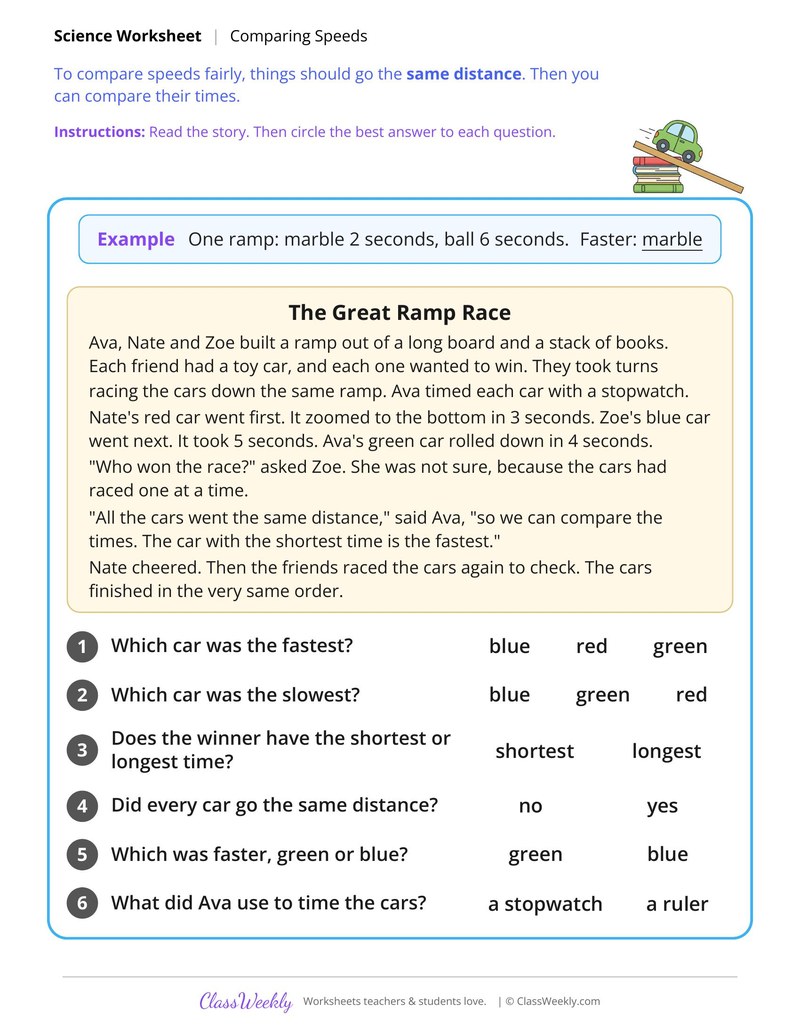
If things go the same distance, the one with the shorter time is faster. If they move for the same time, the one that goes farther is faster. The speed sheets use stopwatch times, a field day race chart and number lines to practice both ways.
Why does a heavier object need a bigger push?
⌄
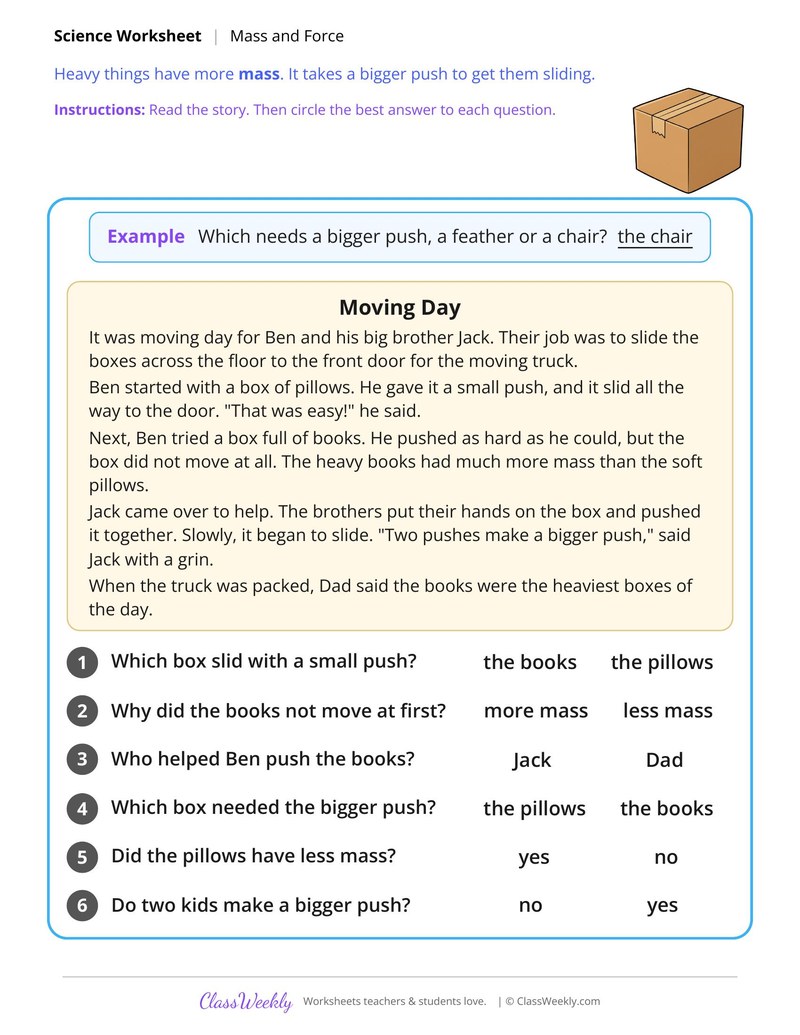
An object with more mass is heavier, so it needs a bigger push to start moving. The same push sends a light ball farther than a heavy one, and two people pushing together make a bigger push than one, as the Moving Day story shows.
Do the forces and motion sheets have answer keys?
⌄
Most sheets come with an answer key. Every sheet also opens with a worked example at the top of the page.
Ratings & Reviews
No reviews yet. Be the first to share what you think.
Reviews are for ClassWeekly members.
Make a Request
Spotted something to fix, or want a worksheet we don't have yet? Tell us and we'll make it.
Worksheet Details
| Grade | 3rd Grade |
| Subject | Science |
| Topic | Forces and Motion |
| Standard | 3-PS2-1 |
| Pages | 1 page |
| Difficulty | Medium |
What is ClassWeekly?
ClassWeekly offers free worksheets and printable learning resources for kids, from preschool up. All worksheets are aligned to Common Core, NGSS, and C3 Framework standards and designed by educators. We also have free online learning games for thousands of skills, and kids' answers turn into a progress report for the grown-up. Start a free 30-day trial to download the worksheets.