Measuring in Science Lesson Plan for 3rd Grade
A ready-to-teach measuring in science lesson for 3rd Grade, built around choosing units of time and length, writing unit abbreviations, and picking the best measuring tool. Print the plan, print the practice pages, and you are set.
- Time
- 45 min
- Steps
- 5
- Practice pages
- 6
Lesson flow
45 minLearning objectives
By the end, students can:
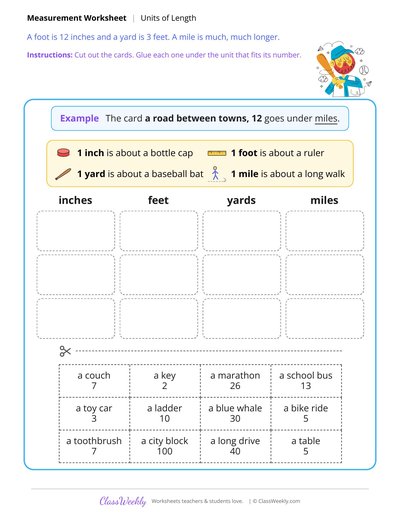
- Choose the unit of time that fits an activity
- Tell if a time is reasonable
- Use units of time in a story
Materials
Tick off as you get ready:
Lesson steps
- 1
Ask the question
5 min · 0-5Bring the real tool: a ruler, a clock, coins, a tally chart. Ask what measuring in science is used for before what it is called.
- 2
Explore
12 min · 5-17Model measuring in science with the actual object, reading it aloud twice. Deliberately misread it once so students learn that checking is part of the method.
- 3
Explain
10 min · 17-27Now give the vocabulary and the explanation for measuring in science. Tie it directly back to what students just observed and to the predictions on the board. Name which predictions held up.
- 4
Independent practice
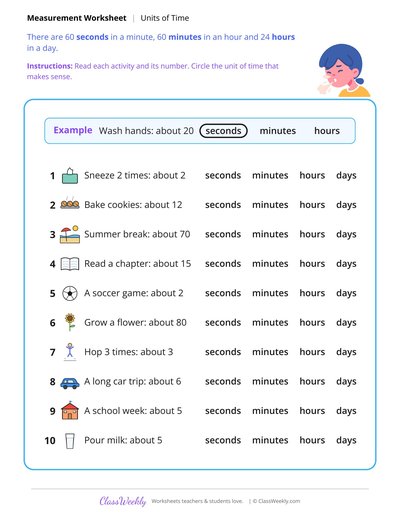
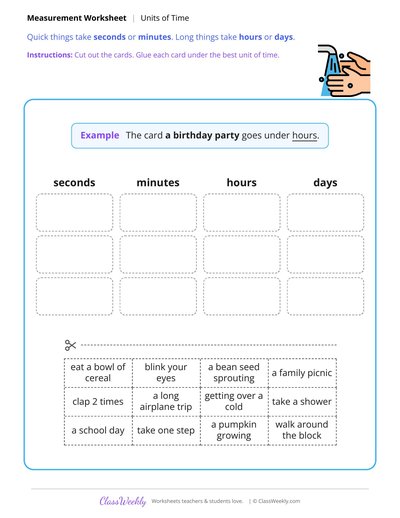
You do13 min · 27-40Hand out "Seconds, Minutes, Hours or Days Circle". Students record what they learned and answer the questions independently. Circulate and press for "how do you know?"
- 5
Extend the thinking
5 min · 40-45Ask where else measuring in science shows up outside the classroom. Collect two or three examples and leave the question open for tomorrow.
Check for understanding
Ask students to explain measuring in science to a partner in one sentence, then write that sentence down. Collect the sentences: they show you exactly which part of the idea did not land.
Differentiation
Extra support
Students who stall: pull them into a small group and rebuild measuring in science with concrete materials or a simpler text before asking for the written work again. Do not send the page home as homework, it will just rehearse the misunderstanding.
Extension
Students who finish early: ask them to write their own measuring in science problem for a partner to solve, then check the partner's work. Creating a problem is harder than solving one and it surfaces whether they really understand measuring in science.
Skills covered
- Units of time
- Units of distance
- Abbreviating units
- Measuring tools