What Is an Integer?
Taught in US schools

Key Takeaways
- Integers include all positive whole numbers, all negative whole numbers, and zero.
- Integers do NOT include fractions or decimals.
- Negative integers are less than zero; positive integers are greater than zero.
- Integers are represented on a number line, with negative numbers to the left of zero.
What Is an Integer?
An integer is any whole number - positive, negative, or zero.
The set of integers includes:
... -4, -3, -2, -1, 0, 1, 2, 3, 4 ...
Integers continue infinitely in both directions on the number line.
Integers include:
- Positive whole numbers: 1, 2, 3, 100, 1,000
- Negative whole numbers: -1, -2, -3, -100
- Zero: 0
Integers do NOT include:
- Fractions: 1/2, 3/4
- Decimals: 0.5, 3.7, -2.5
Integers on the Number Line
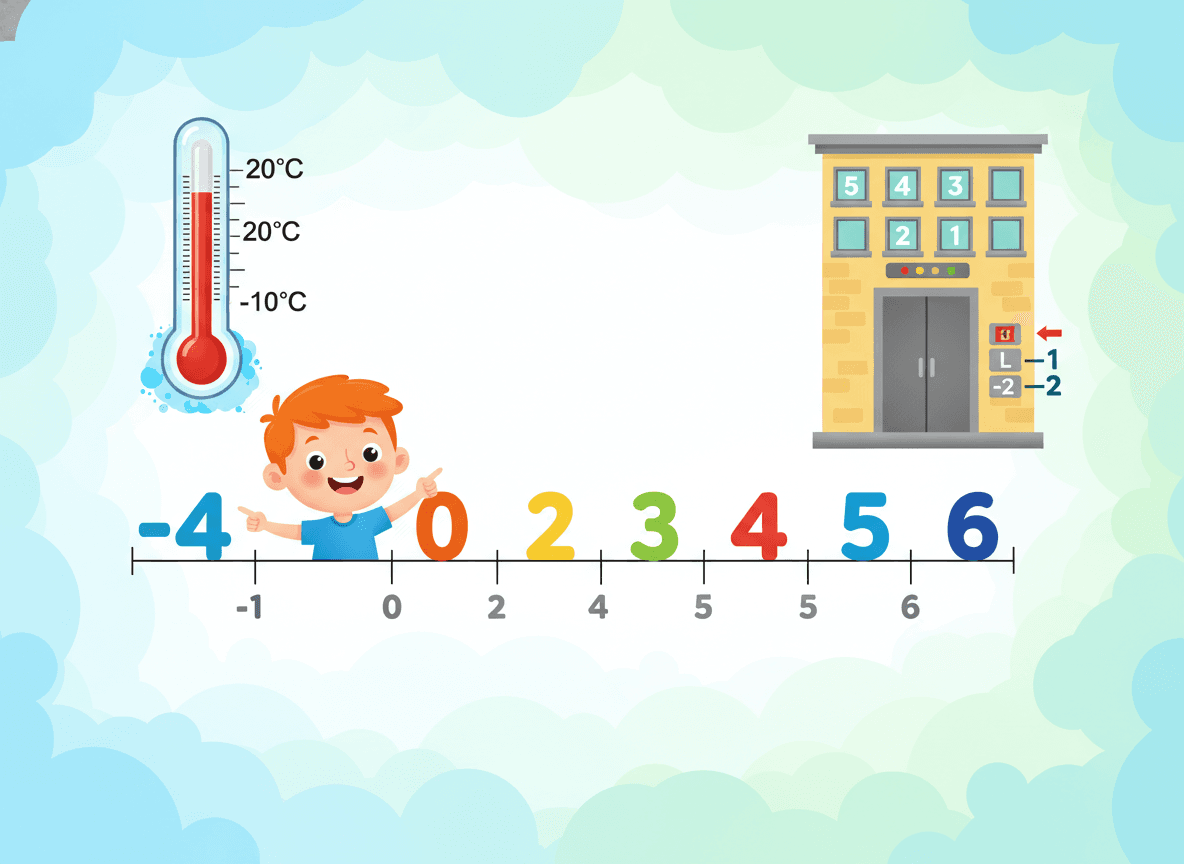
A number line is the clearest way to visualize integers. Zero sits in the middle. Positive integers extend to the right, negative integers extend to the left.
← -4 -3 -2 -1 0 1 2 3 4 →
Key relationships:
- Every positive integer has a negative counterpart called its opposite: the opposite of 3 is -3
- The absolute value of an integer is its distance from zero, regardless of sign: |−5| = 5 and |5| = 5
- As you move left on the number line, numbers get smaller: -5 < -2 < 0 < 3
Comparing Integers
When comparing two integers, the one farther to the right on the number line is greater.
-3 < -1 (because -1 is to the right of -3) 0 > -5 (because 0 is to the right of -5) -10 < 2 (because 2 is to the right of -10)
Common mistake: students often think -10 is greater than -2 because 10 is greater than 2. Remind them to think about the number line - -10 is farther from zero in the negative direction.
Real-World Contexts for Integers
Integers make sense in the context of:
-
Temperature: 5°F above zero = +5; 12°F below zero = -12
-
Elevation: 200 feet above sea level = +200; 282 feet below sea level = -282
-
Money: earning $20 = +20; owing $15 = -15
-
Football: a 7-yard gain = +7; a 3-yard loss = -3
-
Floors in a building: floor 3 = +3; basement level 2 = -2
Practice Activities
- Draw a large number line on the floor with tape. Give students integer cards and have them stand in the correct position. Quiz: who is standing closest to zero? Farthest left?
- "Real-world integers" - give students scenarios (temperature, elevation, money) and have them write the integer that represents each situation.
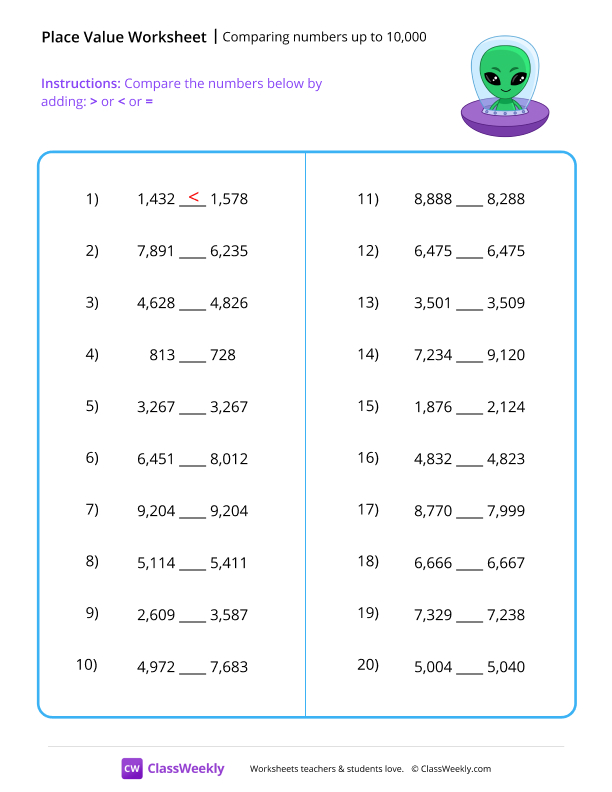
- Compare integers using <, >, =. Mix positive and negative comparisons to address the common misconception.
- Plot integers on a number line and use them to answer questions: "What integer is 3 to the right of -2?" "What is the opposite of -7?"
Frequently Asked Questions
What is an integer?
An integer is any whole number - either positive, negative, or zero. The set of integers includes: ...,-3, -2, -1, 0, 1, 2, 3,... and so on in both directions. Integers do not include fractions (like 1/2) or decimals (like 3.7). Every whole number you count with is a positive integer; the mirror image below zero is a negative integer.
What is the difference between an integer and a whole number?
Whole numbers include only 0, 1, 2, 3, 4... (zero and the positive whole numbers). Integers include whole numbers AND their negative counterparts: ...-3, -2, -1, 0, 1, 2, 3... So all whole numbers are integers, but not all integers are whole numbers (negative integers like -5 are not whole numbers).
Where do students encounter integers in real life?
Integers appear in many real-world contexts: temperatures below zero (-12°F), floors below ground level in a building (floor -1, floor -2), debt (owing $15 is like having -15 dollars), elevation below sea level (Death Valley is at -282 feet), and football yardage (a 5-yard loss is -5 yards). These contexts help students understand why negative numbers are useful.
Free Integer Worksheets
Curriculum-aligned printable worksheets for 4th – 5th Grade. Download free.
Common Core Standards