
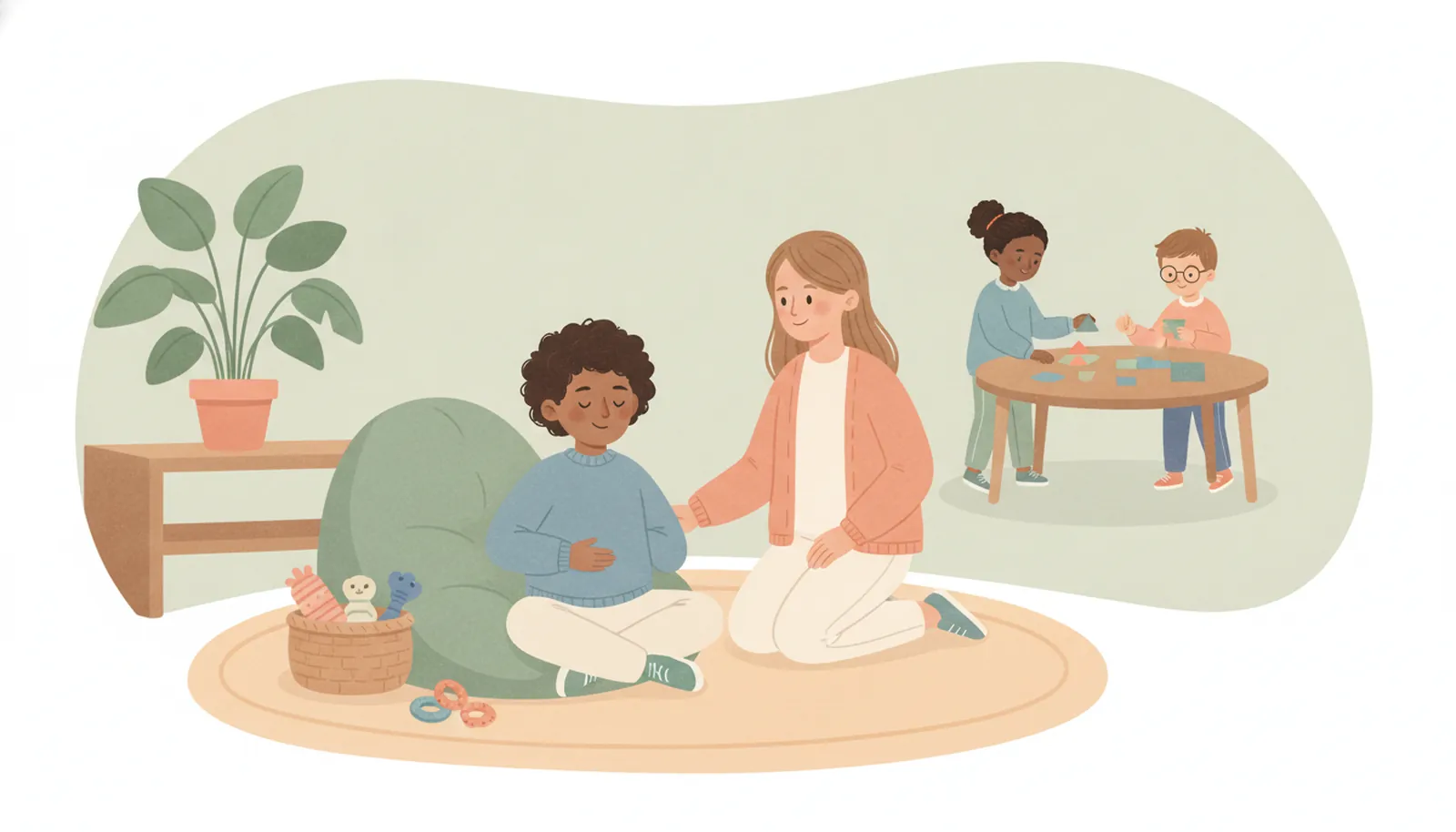
Calm Down Strategies for Kids: SEL Activities for 1st Grade
Get 30 days of free worksheet downloads
Key Takeaways
- By 1st grade, most kids can name basic feelings. The next step is noticing how big a feeling is and choosing a tool to bring it down.
- Good calm down strategies for kids are physical and simple: slow breathing, counting, a drink of water, a short walk or squeezing a soft ball.
- Size of the problem teaches kids to match their reaction to the problem: a broken crayon is small, a hurt friend is big.
- Growth mindset language ("I can't do it yet") helps 6- to 8-year-olds keep going when work gets hard.
- Practice every tool when your child is calm, and write a personal calm down plan together.
The math page is hard. The pencil breaks. A classmate takes the last red crayon. And suddenly your 1st grader is on the floor.
Sound familiar? By 6 and 7, most kids can name their feelings. What they're still learning is what to do with them. That's where calm down strategies, size of the problem and growth mindset come in. Our 1st grade social emotional learning worksheets cover all three, and they work for many 2nd graders too.
Here are the strategies that work best at this age, and how to teach them so they actually get used.
Grow the Feelings Vocabulary
First graders are ready for more than happy, sad and mad. Richer words help kids explain what's going on inside, and that makes the right tool easier to choose.
Words worth teaching now:
- Frustrated (when something is hard and won't work)
- Disappointed (when something you hoped for didn't happen)
- Nervous or worried (before something new)
- Embarrassed (when others saw a mistake)
- Proud (when you worked hard and did it)
A feelings thermometer is a great next step. Kids color in how big a feeling is, from a little bit annoyed at the bottom to really, really angry at the top. Our my feelings thermometer page makes this a quick daily check-in.
Why does size matter? Because a small feeling might need one deep breath, while a big one might need a walk and a talk with a grown-up.
Free 1st Grade SEL Worksheets


Calm Down Strategies That Work for Kids
The best calm down strategies for kids are simple, physical and quick. When a child is upset, the thinking part of the brain goes a bit offline. A tool needs to be easy enough to use anyway.
Our favorites for 6- to 8-year-olds:
- Star breathing. Trace the edges of a star with a finger: breathe in going up a point, out going down. Five points, five breaths. Try our star breathing trace.
- Count to ten slowly. Out loud or in your head. Count backward for an extra challenge.
- Get a drink of water. It's a reset and a break in one.
- Squeeze something. A stress ball, play dough or a pillow.
- Move. Ten wall push-ups, a walk to the window and back, or a few jumps.
- Draw it out. Scribble the feeling on paper, then fold it up.
- Ask for a break. "I need a minute" is a very grown-up skill.
Not every tool works for every child. Some kids calm down by moving, others by getting quiet. The calm down strategies: helpful or not? sort helps kids think through which choices really help (taking a breath) and which make things worse (yelling at a friend).
Teach Size of the Problem
Here's a skill that saves a lot of tears: size of the problem. Kids learn to sort problems into small, medium and big, then match their reaction to the size.
- Small problems: a broken crayon, losing a game, not getting the blue cup. You can fix these yourself.
- Medium problems: a friend won't let you play, you forgot your homework. You might need a little help.
- Big problems: someone is hurt, someone is unsafe, you feel sick. Get a grown-up right away.
The magic question is: "Is my reaction the same size as my problem?" Crying for ten minutes over a broken crayon is a big reaction to a small problem. That's a gentle, non-judgmental way to talk about it.
How to practice:
- Read problem cards aloud and sort them into three piles together.
- Talk about book characters: "Was that a small or big problem? How did he react?"
- Use our size of the problem: small, medium or big worksheet for independent practice.
Quick tip: never use size of the problem to dismiss a child's feelings. A problem that looks small to us can feel huge at 6. Validate first ("That's really disappointing"), then size it together.
Use Stop and Think
Once your child has a calming tool and can size a problem, put it together in a simple sequence:
- Stop. Freeze your body.
- Breathe. Take one or two slow breaths.
- Think. How big is this problem? What are my choices?
- Choose. Pick a choice that's safe and kind.
This works beautifully for friendship problems, too. Two kids want the same book? They can take turns, read it together, or pick another book. The friendship problems: pick the best solution page gives kids practice before the real moment happens.
Build a Growth Mindset
Growth mindset comes from the research of Stanford psychologist Carol Dweck. The big idea: our brains grow when we practice hard things. Mistakes are part of learning, not proof we can't do it.
For 1st and 2nd graders, this comes down to language. Help kids swap fixed-mindset words for growth-mindset words:
- "I can't do this." → "I can't do this yet."
- "I'm bad at reading." → "I'm getting better at reading."
- "This is too hard." → "This is going to take some work."
- "I made a mistake." → "Mistakes help me learn."
Try the power of yet worksheet, where kids rewrite sentences with "yet," or the fixed or growth mindset sentence sort.
Ways to make it real:
- Praise the process. "You tried three different ways to solve that!" beats "You're so smart."
- Share your own mistakes. Burned the toast? Say what you'll do differently next time.
- Show progress. Put a September writing sample next to a December one. Kids are amazed. 🙌
Honestly? Growth mindset doesn't mean pretending everything is easy. It means believing practice helps. Some days that's enough to get through one more math problem.
Make a Personal Calm Down Plan
A calm down plan is a short, written list of what helps this child. It turns all the practice into something they can use on their own.
Make it together when your child is calm:
- My warning signs: hot face, tight fists, wanting to cry
- My three best tools: for example, star breathing, a drink of water, squeezing my ball
- Who I can ask for help: my teacher, Mom, Dad, Grandma, the school counselor
- What I'll say: "I need a break."
Our my calm down plan page has spaces for each part. Keep a copy in a backpack folder and one on the fridge.
FAQ
What are some calm down strategies for kids? Simple calm down strategies for kids include star breathing or belly breathing, counting slowly to ten, getting a drink of water, squeezing a stress ball, a short walk, drawing, and sitting in a quiet corner. Practice them when your child is calm so they are easy to use when upset.
What is size of the problem? Size of the problem is a way to help kids sort problems into small, medium and big, and then match their reaction to the size. A lost pencil is a small problem with a small reaction. Someone getting hurt is a big problem that needs a grown-up's help.
How do you teach growth mindset to 1st graders? Use simple language and real examples. Add the word "yet" to "I can't" statements, praise effort and strategies rather than being smart, share your own mistakes, and look at work from the start of the year next to work from now so kids can see their own progress.
What SEL skills should a 1st grader have? Many 1st graders are learning to name a wider range of feelings, calm themselves with a strategy, take turns and share, solve small friendship problems with words, notice how others feel, and keep trying when work is hard. Every child develops at their own pace.
Keep Reading
- Feelings Activities for Preschoolers and Kindergarten
- Self-Assessment and Goal Setting With Elementary Students
Calm Is a Skill
Calming down isn't something kids are born knowing. It's a skill, built a little at a time, just like reading. Every breath practiced on a calm afternoon is one your child can reach for on a hard one.
Remember, every child is different. Pick one strategy this week, practice it together, and add more from our 1st grade SEL worksheets as you go.

Adi Ackerman
Head Teacher
Adi is the Head Teacher at ClassWeekly, with years of experience teaching elementary students. She designs our curriculum-aligned worksheets and writes practical guides for teachers and parents.
Keep Reading
Ready to download? Try ClassWeekly free for 30 days.
Unlimited worksheets for PreK through 5th grade. Cancel anytime.