
Feelings Activities for Preschoolers and Kindergarten
Get 30 days of free worksheet downloads
Key Takeaways
- Social emotional learning (SEL) at ages 4 to 6 starts with naming feelings: a child who can say "I'm mad" has a tool besides hitting or crying.
- Start with four feelings (happy, sad, mad, scared), then add words like worried, proud and frustrated as your child is ready.
- Teach calming tools like belly breathing when your child is already calm, so they are familiar when a big feeling shows up.
- Friendship, sharing and kindness grow through practice: role play, picture books and noticing kind acts out loud.
- Short, hands-on activities work best. A feelings worksheet takes 5 to 10 minutes and opens a real conversation.
Your little one throws a block across the room. Ask why, and you get a shrug. Or tears. Or both.
Here's what we know: at 4 and 5, big feelings often arrive before the words do. That's normal, and it's exactly where social emotional learning (SEL) begins. Our kindergarten social emotional learning worksheets cover feelings, friendship, kindness, calming down and good choices, and they work well for older preschoolers too.
Below are simple feelings activities for preschoolers and kindergartners, the order we like to teach them in, and a few things that make them stick.
Start by Naming Feelings
Naming a feeling is the first SEL skill, and it changes a lot. A child who can say "I'm mad" has a tool besides hitting or crying. Psychiatrist Daniel Siegel calls this "name it to tame it," and anyone who has watched a 4-year-old calm down after finding the right word knows it's real.
Start small. Four feelings is plenty at first:
- Happy
- Sad
- Mad
- Scared
Once those feel easy, add surprised, worried, proud and frustrated. Kids love big words, and "frustrated" is a very useful one.
Activity ideas:
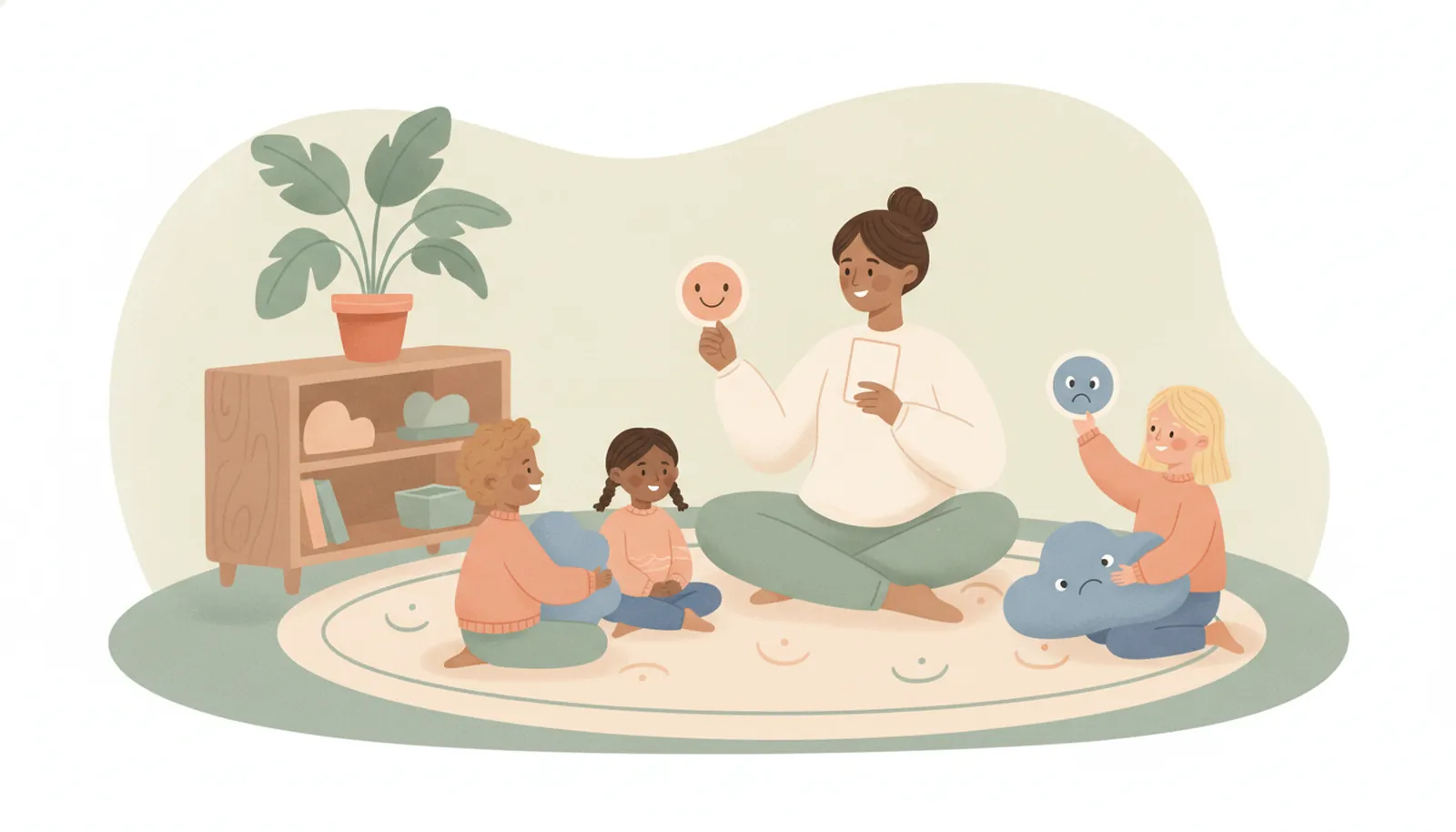
- Mirror faces. Sit in front of a mirror and make a happy face, then a sad face. Can your child guess yours?
- Feelings check-in. At breakfast or circle time, everyone points to a face that matches how they feel.
- Picture book pause. Stop mid-story and ask, "How do you think she feels? How can you tell?"
- Face sorting. Our circle the feeling face and draw the faces for four feelings pages make this a quiet table activity.
Quick tip: name your own feelings out loud, too. "I feel frustrated that the car won't start. I'm going to take a breath." Kids learn far more from watching us than from any lesson.
Free Feelings and SEL Worksheets


Connect Feelings to What Happened
Once your child can name a feeling, help them notice what caused it. This is the start of empathy, and it's easier than it sounds.
Try "how would you feel if" questions:
- How would you feel if your ice cream fell on the ground?
- How would you feel if a friend shared their crayons?
- How would you feel if you lost your teddy bear?
There are no wrong answers here. One child feels sad when it rains, another feels happy because puddles. That's a great conversation, not a mistake to correct.
A happy and sad pictures sort adds cutting and gluing practice, which most preschoolers love anyway.
Teach Calming Tools Before You Need Them
Here's the part that surprises many parents: calming tools don't work if you introduce them in the middle of a meltdown. A child who is already upset can't learn something new. Practice when everyone is calm, so the tool feels familiar later.
Three tools that work well at this age:
- Belly breathing. Put a stuffed animal on your child's tummy and watch it rise and fall. Slow breath in, slow breath out. Our belly breathing hills page turns it into a tracing activity: breathe in going up the hill, out going down.
- Five-finger breathing. Trace up one finger while breathing in, down while breathing out. Five fingers, five slow breaths.
- A calm down spot. A cozy corner with a pillow, a soft toy and a few books. Not a punishment, just a place to reset. Let your child help plan it with my calm down corner.
Practice one tool a day for a week. Then, when a big feeling shows up, you can say, "Let's do our hill breathing," and your child already knows what that means.
Honestly? It won't work every time. Some days a 4-year-old just needs a hug and a little time. That's okay too.
Practice Friendship and Sharing
Sharing is hard at 4. Really hard. Most preschoolers are still learning that other people have wants and feelings that are different from their own.
What helps:
- Role play with toys. Two stuffed animals both want the same ball. What could they do?
- Use a timer for turns. "You can have the swing for 3 minutes, then it's Maya's turn." Taking turns feels fairer than giving something up forever.
- Name it when it happens. "You gave Sam a turn with the truck. Look at his smile!"
The share the snack with a friend worksheet sneaks in a little math, too: splitting snacks fairly between two friends.
Notice and Grow Kindness
Kindness grows when kids see it, do it and hear about it. You don't need a big program. You need to notice.
Ideas for home and the classroom:
- Kindness spotting. At dinner or the end of the day, everyone shares one kind thing they saw.
- Helping jobs. Feeding the pet, setting out napkins, watering a plant. Small jobs build a big "I can help" feeling.
- Draw it. Ask your child to draw a kind act they did or saw this week, and hang it on the fridge.
Quick tip: thank your child specifically. "Thank you for holding the door for Grandpa" teaches more than "good job."
Build a "Not Yet" Mindset
Young children give up fast when something is hard. Psychologist Carol Dweck's research on growth mindset gave us a simple, powerful word for this age: yet.
"I can't zip my coat" becomes "I can't zip my coat yet."
Ways to practice:
- Share something you're still learning, like a new recipe or a song on the guitar.
- Celebrate effort out loud: "You kept trying that puzzle. You didn't give up!"
- Talk about things your child couldn't do as a baby but can do now: walk, talk, climb stairs.
The something I can't do yet page lets kids draw a goal they are working toward. It's a lovely one to revisit a month later.
Keep It Short and Playful
SEL for preschoolers works best in small, frequent doses. Five to ten minutes is plenty. Mix in worksheets, play, books and real moments.
A simple weekly rhythm:
- Monday: feelings check-in and a feelings worksheet
- Tuesday: a picture book with "how does she feel?" pauses
- Wednesday: practice one calming tool
- Thursday: role play sharing with toys
- Friday: kindness spotting and a drawing
If your child is in kindergarten or about to start, these same skills carry into school every day: waiting in line, sharing supplies, handling a lost game. For children who struggle with new situations, a social story can help too.
FAQ
What are good feelings activities for preschoolers? Good feelings activities for preschoolers include matching faces to feeling words, making faces in a mirror, sorting happy and sad pictures, reading picture books and asking how a character feels, and practicing belly breathing. Keep each activity short, about 5 to 10 minutes.
What are the five SEL skills? CASEL, the Collaborative for Academic, Social, and Emotional Learning, describes five core SEL competencies: self-awareness, self-management, social awareness, relationship skills and responsible decision-making. For preschoolers this looks like naming feelings, calming down, noticing how others feel, sharing and making good choices.
How many feelings should a 4-year-old know? There is no fixed number. Most families start with four clear feelings (happy, sad, mad and scared) and add new words like surprised, worried, proud and frustrated when those feel easy. The goal is having words to use, not a long list.
Should I stop my child from feeling angry? No. All feelings are okay, but not all actions are. You can say, "It's okay to feel mad. It's not okay to hit. Let's take a big breath together." This separates the feeling from the behavior and gives your child something to do instead.
Keep Reading
- Calm Down Strategies for Kids: SEL Activities for 1st Grade
- What Is a Social Story? Examples and How to Use One
Big Feelings, Small Steps
Feelings are a big deal when you're small. Every time you help your little one name a feeling, take a breath or share a toy, you're building skills they'll use for life.
Every child is different, and some days will be messier than others. Start with one activity from our social emotional learning worksheets and grow from there. 💕

Adi Ackerman
Head Teacher
Adi is the Head Teacher at ClassWeekly, with years of experience teaching elementary students. She designs our curriculum-aligned worksheets and writes practical guides for teachers and parents.
Keep Reading
Ready to download? Try ClassWeekly free for 30 days.
Unlimited worksheets for PreK through 5th grade. Cancel anytime.