
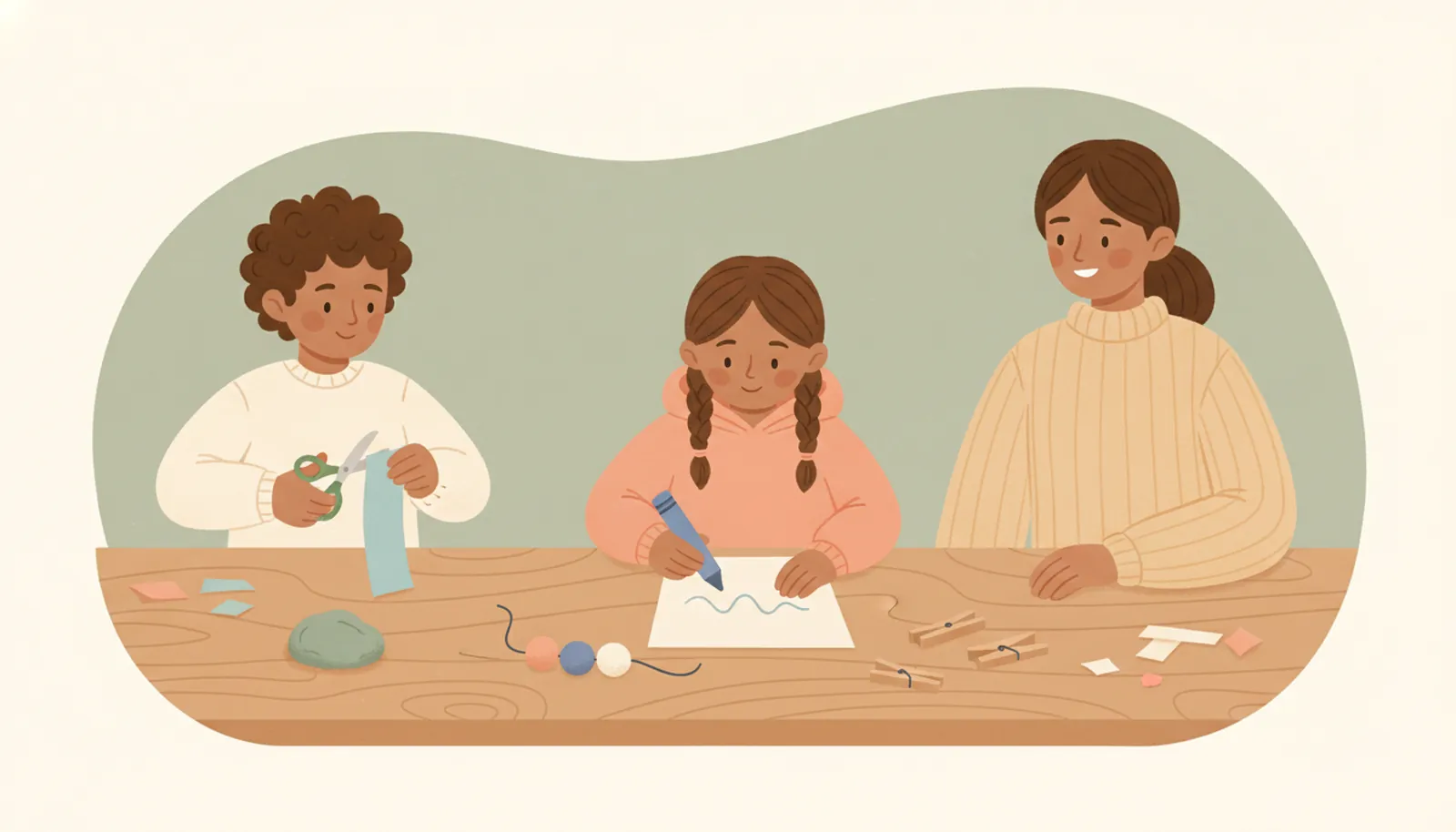
Fine Motor Activities for Preschoolers: Cutting and Tracing
Get 30 days of free worksheet downloads
Key Takeaways
- Fine motor skills are the small movements of the hands and fingers, and they come before neat handwriting, buttoning and using scissors.
- Build hand strength first with play dough, clothespins, tongs and beads, then move to paper activities.
- Teach scissor skills in steps: snipping, cutting across a strip, cutting straight lines, then curves, zigzags and simple shapes.
- Trace lines in the same order kids will later need them for letters: straight, slanted, curved, zigzag and loops.
- Mazes, dot to dot and coloring inside big shapes build pencil control while feeling like games.
Watch a 4-year-old try to hold a crayon, and you'll see the whole fist wrapped around it, tongue sticking out in concentration. Then watch them try to cut paper. Snip... rip... "Can YOU do it?"
Totally normal! Fine motor skills (the small movements of the hands and fingers) take time and lots of practice. The good news: the practice can be fun. Our Pre-K fine motor skills worksheets cover tracing lines, cutting, mazes, dot to dot and pencil control, ready to print.
Here are fine motor activities for preschoolers, in the order most kids are ready for them.
Why Fine Motor Skills Matter
Fine motor skills are behind so many everyday things: zipping a coat, opening a snack, turning a page, and later, writing letters. A child who has strong, steady hands finds handwriting much less frustrating when it comes.
You'll see fine motor skills at work when your child:
- Holds a crayon or pencil
- Uses scissors
- Strings beads or builds with small blocks
- Squeezes, rolls and pinches play dough
- Buttons, zips and snaps
Every child grows these skills at their own pace. Some 4-year-olds are snipping away happily, others are still figuring out how to open the scissors. Both are fine.
Once hands are warmed up, short paper activities are a great next step. These are some of our favorites to start with.
Free Pre-K Fine Motor Worksheets


Build Hand Strength First
Before paper and pencil, little hands need strength. Many preschoolers tire quickly when they write or cut because the small muscles in their hands are still developing.
Hands-on activities that build strength:
- Play dough. Squeeze, roll snakes, pinch tiny balls, poke holes with a finger.
- Clothespins. Clip them around the edge of a paper plate or a box.
- Tongs and tweezers. Move pom-poms, cotton balls or cereal from one bowl to another.
- Tearing paper. Tear scrap paper into small pieces and glue them into a mosaic.
- Stickers. Peeling stickers is great pinch practice.
- Spray bottles. Water the plants or "wash" the outside window.
Quick tip: work on a vertical surface sometimes, like taping paper to the wall or using an easel. It helps build wrist and shoulder strength, which supports the hand.
Teach Scissor Skills in Steps
Scissor skills for preschoolers go much better in small steps. Jumping straight to cutting out a circle is a recipe for tears (theirs and ours).
Start with child-safe scissors that fit small hands. Teach thumbs up: the thumb goes in the top hole, and the thumb stays on top while cutting. The other hand holds the paper and turns it.
Then follow this order:
- Snipping. Make single snips into the edge of a thin strip of paper. Fringe is fun!
- Cutting across a strip. One snip cuts the strip in two. Kids love making "confetti."
- Cutting a straight line. Start with thick lines on short strips. Try our cutting strips: straight lines.
- Curves and zigzags. Wavy lines first, then zigzags, which need turning the paper.
- Spirals and shapes. A spiral is a fun challenge, like our cut the spiral snake. Then big circles, squares and triangles.
A few safety reminders: always sit at a table while cutting, walk with closed scissors, and supervise closely. Cardstock is easier to hold steady than thin printer paper for beginners.
Trace Lines Before Letters
Tracing lines is the bridge between scribbling and writing letters. Every letter is made of a few kinds of lines, so practicing the lines first makes letters much easier later.
Trace in this order:
- Straight lines across the page, left to right. Our trace the straight paths page helps animals get home.
- Up and down lines, top to bottom, like rain falling.
- Slanted lines, like going down a slide.
- Wavy lines, like fish swimming in trace the wavy lines.
- Zigzags and loops, which need the most control.
Make it multisensory, too. Trace lines with a finger in a tray of salt or sand, with a wet paintbrush on a chalkboard, or with a toy car on a big paper road.
Mazes and Dot to Dot
Mazes and dot to dot pages feel like puzzles, but they're secretly great pencil control practice. Kids have to plan a path, stay inside the lines and stop at the right spot.
For preschoolers:
- Start with wide, simple mazes that have one or two turns, like our puppy to the bone maze.
- Let them trace with a finger first, then a crayon.
- Try dot to dot with only a few dots. Connect the dots: big shapes has big, clear dots that make a shape when joined.
Bonus: dot to dot sneaks in number order practice, and mazes build problem solving. Honestly? Many kids ask for "one more maze," which is the best sign there is. 😊
Practice Pencil Control
Pencil control is the ability to move a crayon or pencil exactly where you want it, and stop when you want to. It's what makes neat letters possible later.
Activities that help:
- Stay on the road. Drive the pencil along a wide road without going off the edge. Try stay on the road pencil control.
- Circles and spirals. Trace bubbles and snail shells, round and round. Our trace the circles page is a favorite.
- Color inside big shapes. Big, simple shapes are better than detailed coloring pages at this age.
- Finish the picture. Draw the missing lines on a simple drawing.
Quick tip: short crayons, broken in half, encourage a better grip. With less crayon to hold, kids naturally use their fingertips instead of a fist.
Keep It Short and Fun
Fine motor practice works best in short, playful sessions. Five to ten minutes at a time is plenty for a preschooler. Stop while it's still fun.
Some ideas for a week:
- Monday: play dough and a tracing page
- Tuesday: cutting strips into "confetti"
- Wednesday: a maze and a dot to dot
- Thursday: clothespins and stickers
- Friday: a cut and glue puzzle
When your child is ready to move from lines to letters, our guide to handwriting for preschoolers picks up right where this one leaves off.
FAQ
What are fine motor skills in preschoolers? Fine motor skills are the small, controlled movements of the hands and fingers. In preschoolers they show up as holding a crayon, using scissors, stringing beads, building with blocks, opening containers, buttoning and squeezing play dough.
How do I teach my preschooler to use scissors? Start with child-safe scissors and short snips on thin strips of paper. Teach thumb on top ("thumbs up"), with the other hand holding and turning the paper. Then move to cutting across strips, along straight lines, along curvy and zigzag lines, and finally around big simple shapes.
What comes first, tracing or writing letters? Tracing lines and shapes usually comes first. Straight, slanted and curved lines are the building blocks of letters, so kids who can trace them with some control find letter formation much easier.
How long should fine motor practice last for a 4-year-old? Short sessions work best. Five to ten minutes of a focused activity, a few times a week, is plenty, and a lot of fine motor practice happens through play like play dough, blocks and crafts.
Keep Reading
Strong Little Hands
Every snip, squeeze and squiggly line is building something. Before long, you'll watch your little one go from a fist around the crayon to a careful, steady line.
Every child gets there on their own timeline. Pick one activity, keep it playful, and grab a few pages from our fine motor skills worksheets when you're ready for paper practice.

Adi Ackerman
Head Teacher
Adi is the Head Teacher at ClassWeekly, with years of experience teaching elementary students. She designs our curriculum-aligned worksheets and writes practical guides for teachers and parents.
Keep Reading
Ready to download? Try ClassWeekly free for 30 days.
Unlimited worksheets for PreK through 5th grade. Cancel anytime.