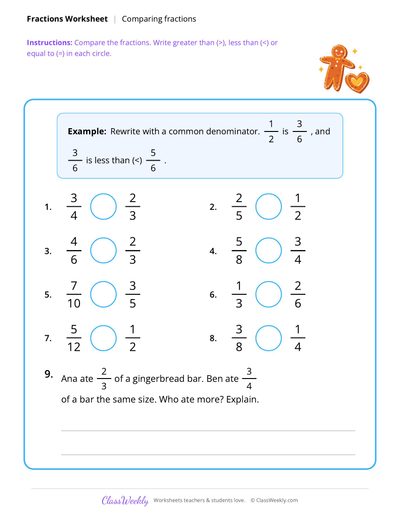
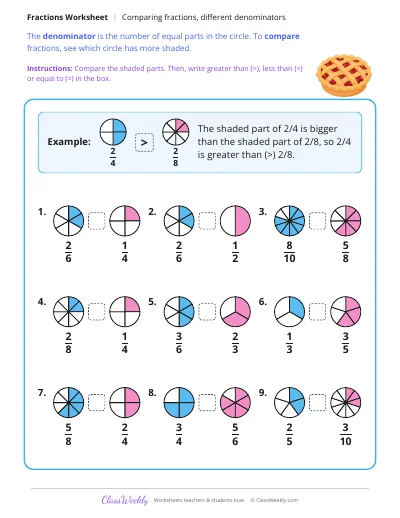
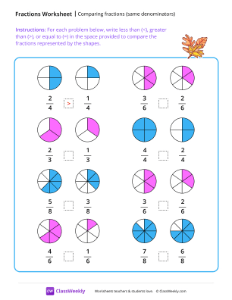
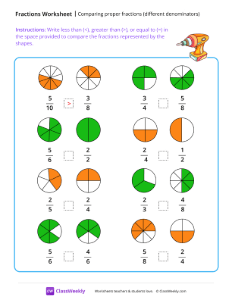
Explore all of our 4th grade fractions worksheets, covering add like fractions, add fractions and mixed numbers, add mixed numbers, completing whole numbers (improper fractions), and more.
Fourth graders should understand equivalent fractions, compare fractions with different numerators and different denominators, add and subtract fractions with like denominators, multiply fractions by whole numbers, and convert between mixed numbers and improper fractions (CCSS 4.NF.A-B). They should understand that two fractions are equivalent if they represent the same point on a number line. Students learn to generate equivalent fractions by multiplying or dividing both the numerator and denominator by the same number. Worksheets that combine visual models (fraction bars, number lines) with symbolic operations help children see why equivalent fractions are equal and why the procedures for adding and comparing fractions work the way they do.
Start with visual models: show that 1/2 and 2/4 cover the same amount of a fraction bar. Then use number lines to show both fractions at the same point. Introduce the rule: multiplying both numerator and denominator by the same number creates an equivalent fraction (1/2 times 2/2 equals 2/4). Practice with fraction strips that children can fold and compare makes the concept tangible. Worksheets that ask students to find equivalent fractions using both visual models and the multiplication rule build the connection between the concrete and the abstract. Practice with many different fraction pairs helps children generalize the concept. Simplifying fractions by dividing numerator and denominator by their greatest common factor is the reverse process and should be taught alongside generating equivalents.
Explain that the denominator names the size of the pieces (fourths, sixths, eighths) and the numerator tells how many pieces you have. Adding 2/5 plus 1/5 means combining 2 pieces of size one-fifth with 1 more piece of the same size, giving 3 pieces or 3/5. The denominator stays the same because the piece size does not change. Visual models with fraction bars or circles that show the pieces being combined make this clear. Worksheets that pair visual fraction addition with the symbolic equation help children see that they are counting same-sized pieces. Practice with results greater than 1 (like 3/4 plus 3/4 equals 6/4 or 1 and 2/4) introduces improper fractions and mixed numbers naturally in the addition context.
What is ClassWeekly?
ClassWeekly offers free worksheets and printable learning resources for kids, from preschool up. All worksheets are aligned to Common Core, NGSS, and C3 Framework standards and designed by educators. We also have free online learning games for thousands of skills, and kids' answers turn into a progress report for the grown-up. Start a free 30-day trial to download the worksheets.