Table of 5
Written by Adi Ackerman, Head Teacher
"Table of 5 - missing factor" is written for 2nd Grade (Ages 7-8), and it covers Common Core 2.OA.C.4. If your little one is a year younger but already steady on multiplication, the page still works. You may just need to read the instructions out loud. And if they are older and table of 5 - missing factor never quite stuck, this is a short review rather than busywork.

Free printable table of 5 (missing factor) worksheet for 2nd grade students. Part of our table of 5 - missing factor multiplication collection. Aligned to Common Core standards.
How do I use this worksheet?
Before handing out the worksheet, briefly introduce the concept with a short oral warm-up or a visual model on the board. Let students work through it independently after a quick group example, checking in with a partner if they get stuck, encouraging them to talk through their thinking: "What strategy are you using? How do you know that is right?" After completing the worksheet, review any missed problems together and discuss the reasoning rather than just the answer. For extra support, let students use manipulatives or draw pictures alongside the written problems. These table of 5 - missing factor worksheets work well as daily practice, homework, or a focused review activity.
What students will practice
- Students will recognize and apply table of 5 - missing factor concepts using number lines and place-value models.
- Students will solve problems involving table of 5 - missing factor with increasing accuracy and confidence.
- Students will connect table of 5 - missing factor skills to real-world situations and explain their reasoning clearly.


Curriculum Links
Common Core State Standards
Operations and Algebraic Thinking · 2nd Grade
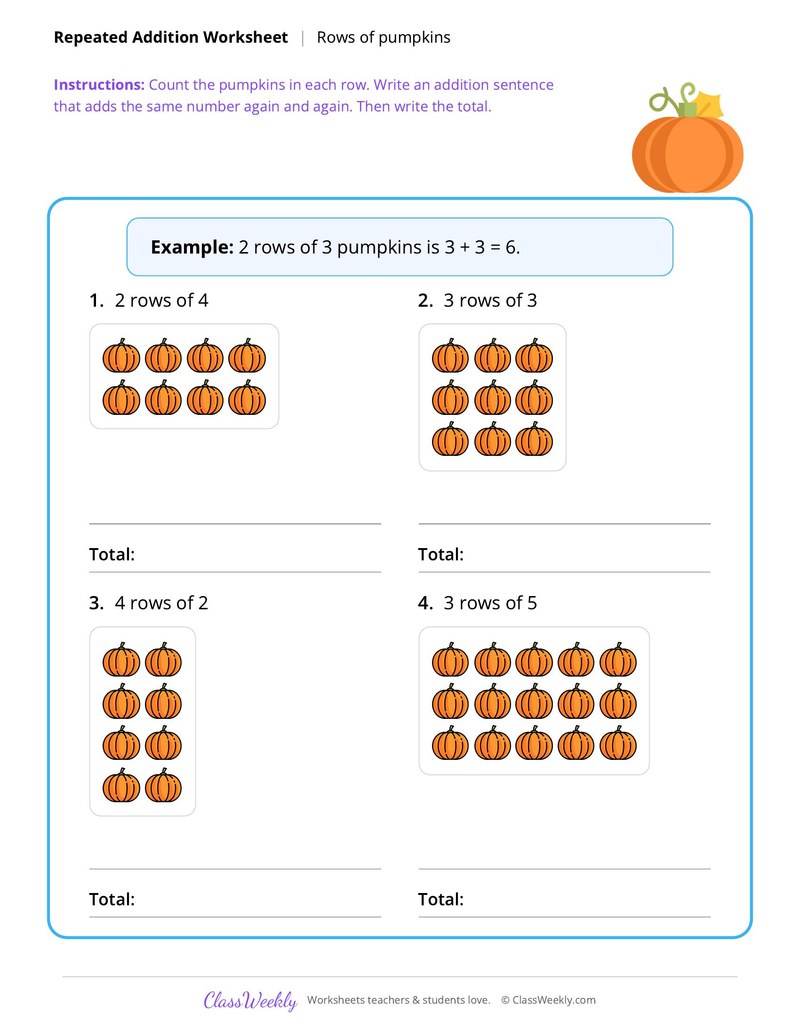
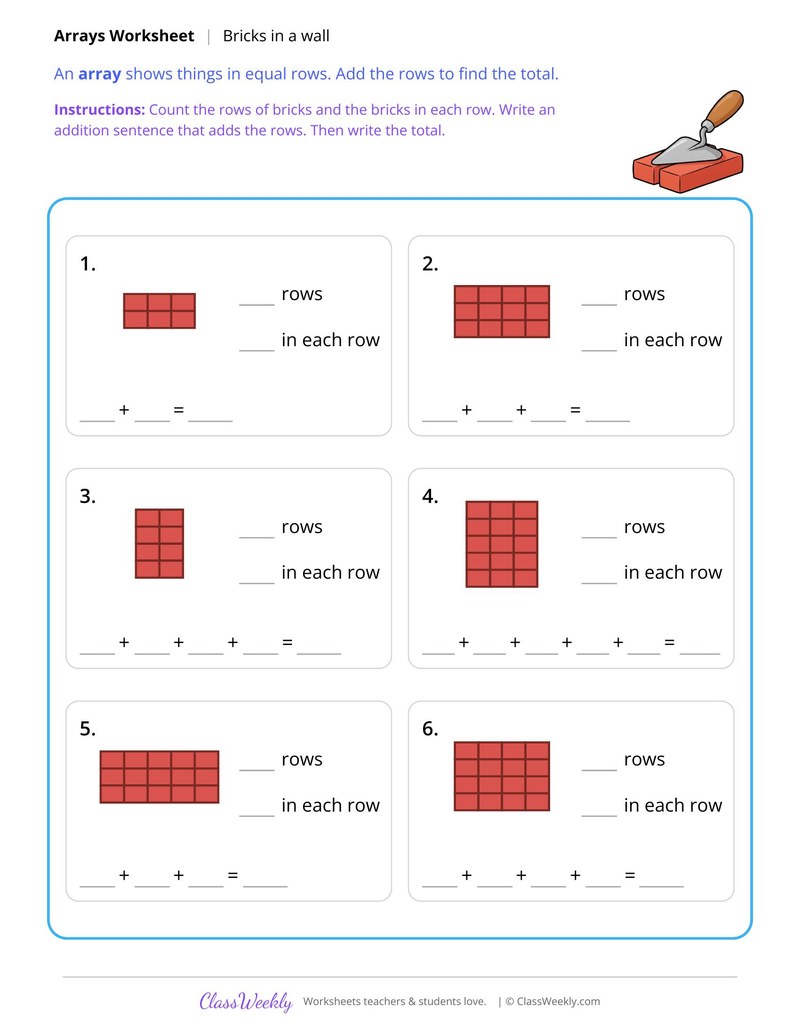
Standard: Use addition to find the total number of objects arranged in rectangular arrays with up to 5 rows and up to 5 columns; write an equation to express the total as a sum of equal addends.
View all 2.OA.C.4 worksheets →Find this in the curriculum
Browse the grade, subject, and topic this belongs to.
FAQ
How do I use this table of 5 - missing factor worksheet?
⌄
Before handing out the worksheet, briefly introduce the concept with a short oral warm-up or a visual model on the board. Let students work through it independently after a quick group example, checking in with a partner if they get stuck, encouraging them to talk through their thinking: "What strategy are you using? How do you know that is right?" After completing the worksheet, review any missed problems together and discuss the reasoning rather than just the answer. For extra support, let students use manipulatives or draw pictures alongside the written problems. These table of 5 - missing factor worksheets work well as daily practice, homework, or a focused review activity.
What does this worksheet teach?
⌄
These table of 5 - missing factor worksheets for 2nd grade give students the structured, hands-on practice they need to build confidence and fluency. Students work through a range of problem formats, from visual models and diagrams to written equations and word problems, so they encounter table of 5 - missing factor from every angle. Each worksheet is designed to build on prior knowledge while introducing the level of challenge appropriate for 2nd grade. Practicing table of 5 - missing factor at this stage strengthens the mathematical foundations that support more advanced concepts in later grades.
Can I use this table of 5 - missing factor worksheet for homeschool or classroom?
⌄
Yes, both. We made it for 2nd Grade multiplication, and the page works the same whether it lands on a kitchen table or a center rotation. At home, most families go through it together and talk the answers out loud, and that talking is where most of the learning happens with table of 5 - missing factor. In class it runs well as independent work while you pull a small group. Print one copy or thirty, whichever the day needs.
How do table of 5 missing factor problems support division readiness?
⌄
When students find a missing factor (e.g., 5 × __ = 35), they are essentially dividing 35 by 5 - directly building division intuition.
What strategies can students use to find missing factors in the 5s table?
⌄
Students can count by 5s up to the product, use the pattern that multiples of 5 end in 0 or 5, or recall known 5s facts to solve missing factor equations.
Do these worksheets help with 3rd grade multiplication readiness?
⌄
Yes - fluency with missing factors in the 5s table accelerates readiness for the full multiplication and division fact families taught in 3rd grade.
How is multiplication introduced in 2nd grade?
⌄
Children first count equal groups, such as 2 baskets with 3 oranges in each. Then they add the same number again and again, which is repeated addition. Arrays and equal jumps on a number line show the same idea.
What is an array?
⌄
An array puts things in equal rows and columns. Adding the rows, like 5 + 5 + 5, and adding the columns gives the same total. 2.OA.C.4 asks 2nd graders to use addition to find the total in arrays of up to 5 rows and 5 columns.
Do the repeated addition story pages have answer keys?
⌄
No. On the story pages children write their own stories, so answers vary and there is no key. Most other multiplication sheets come with an answer key.
Ratings & Reviews
No reviews yet. Be the first to share what you think.
Reviews are for ClassWeekly members.
Make a Request
Spotted something to fix, or want a worksheet we don't have yet? Tell us and we'll make it.
Worksheet Details
| Grade | 2nd Grade |
| Subject | Math |
| Topic | Multiplication |
| Standard | 2.OA.C.4 |
| Pages | 1 page |
| Difficulty | Medium |
Learn More
What is ClassWeekly?
ClassWeekly offers free worksheets and printable learning resources for kids, from preschool up. All worksheets are aligned to Common Core, NGSS, and C3 Framework standards and designed by educators. We also have free online learning games for thousands of skills, and kids' answers turn into a progress report for the grown-up. Start a free 30-day trial to download the worksheets.