Polygon Path From 3 to 12 Sides
Written by Adi Ackerman, Head Teacher
"Polygon Path From 3 to 12 Sides" is written for 3rd Grade (Ages 8-9). If your little one is a year younger but already steady on geometry, the page still works. You may just need to read the instructions out loud. And if they are older and types of polygons never quite stuck, this is a short review rather than busywork.
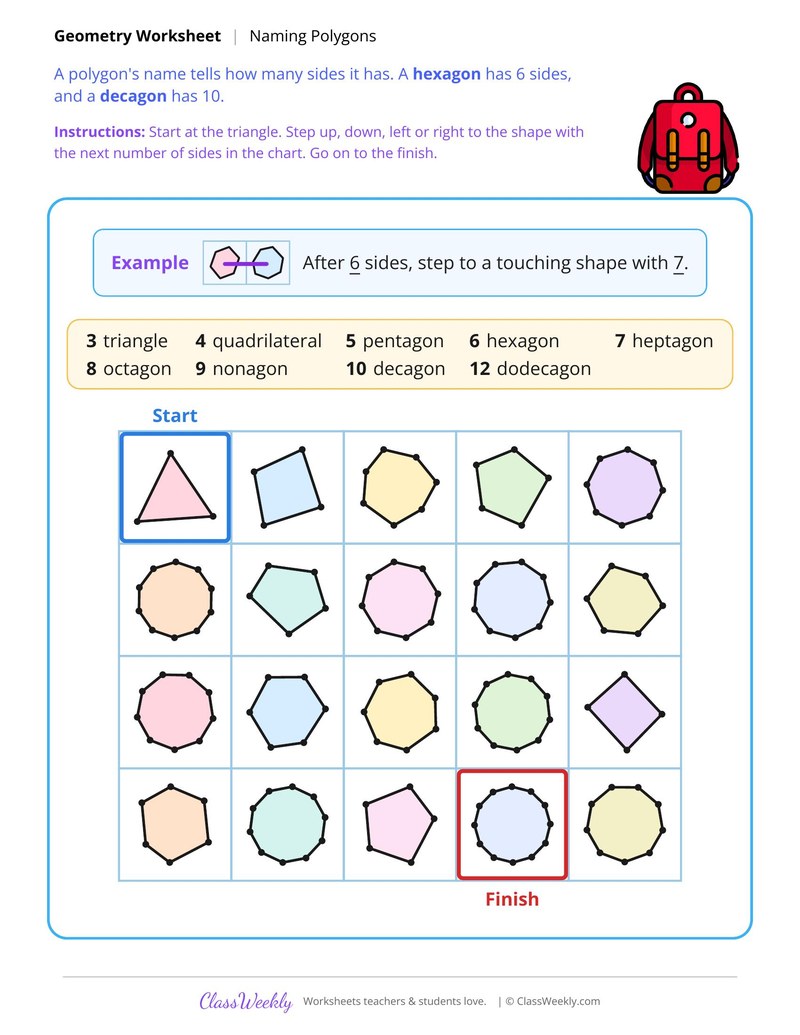
3rd grade math worksheet: follow a path from a triangle to the finish, stepping to the shape with the next side count in the chart. Answer key included. Part of our types of polygons geometry collection.
How do I use this worksheet?
Before handing out the worksheet, briefly introduce the concept with a short oral warm-up or a visual model on the board. Let students work through it independently, using a partner or small group only if they want to talk through their thinking, encouraging them to talk through their thinking: "What strategy are you using? How do you know that is right?" After completing the worksheet, review any missed problems together and discuss the reasoning rather than just the answer. For extra support, let students use manipulatives or draw pictures alongside the written problems. These types of polygons worksheets work well as daily practice, homework, or a focused review activity.
What students will practice
- Students will count the sides of touching shapes in a grid.
- Students will use a chart of polygon names from 3 to 12 sides.
- Students will step from shape to shape in side count order to the finish.
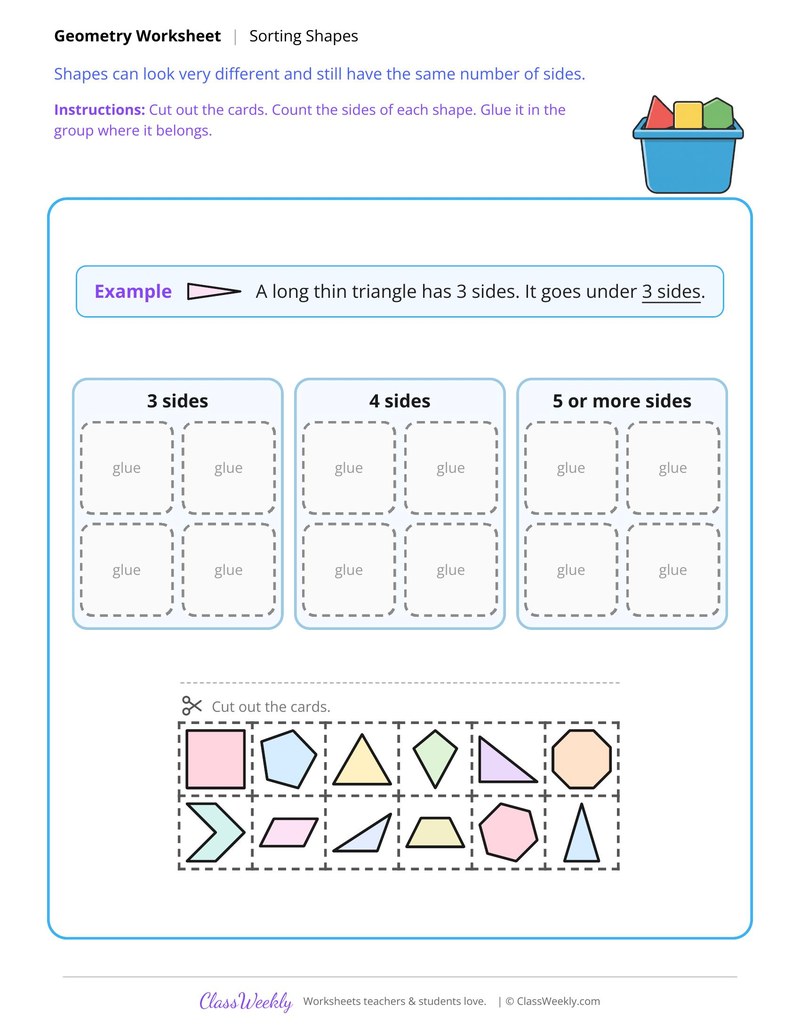
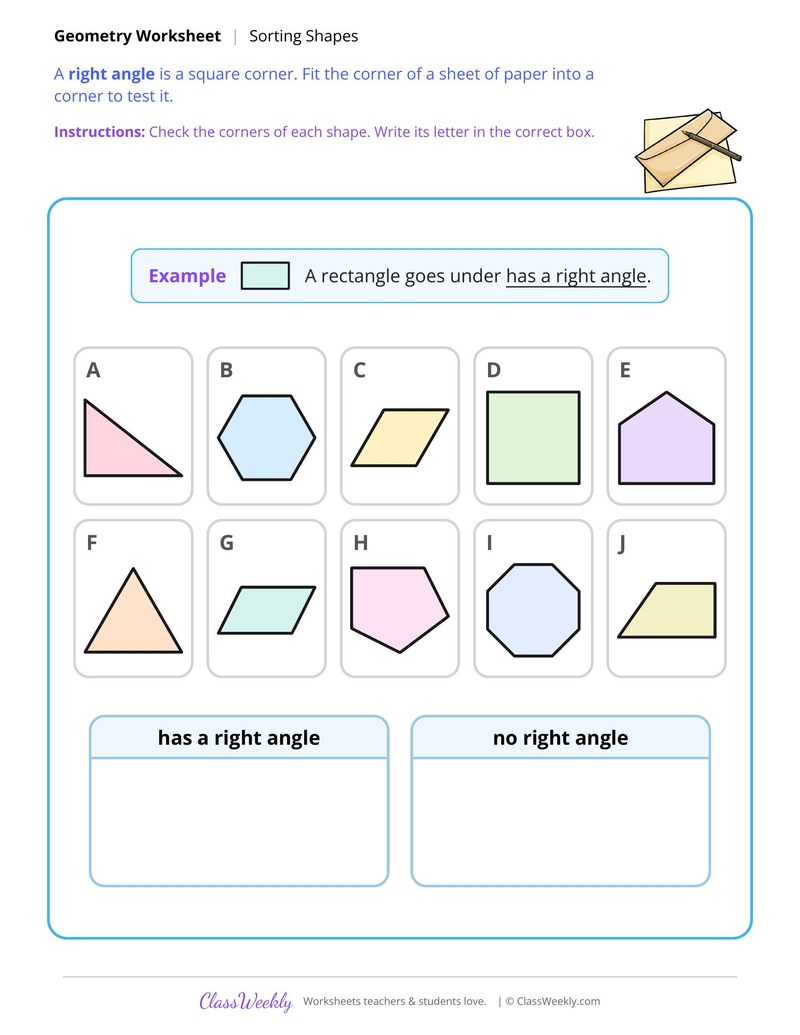
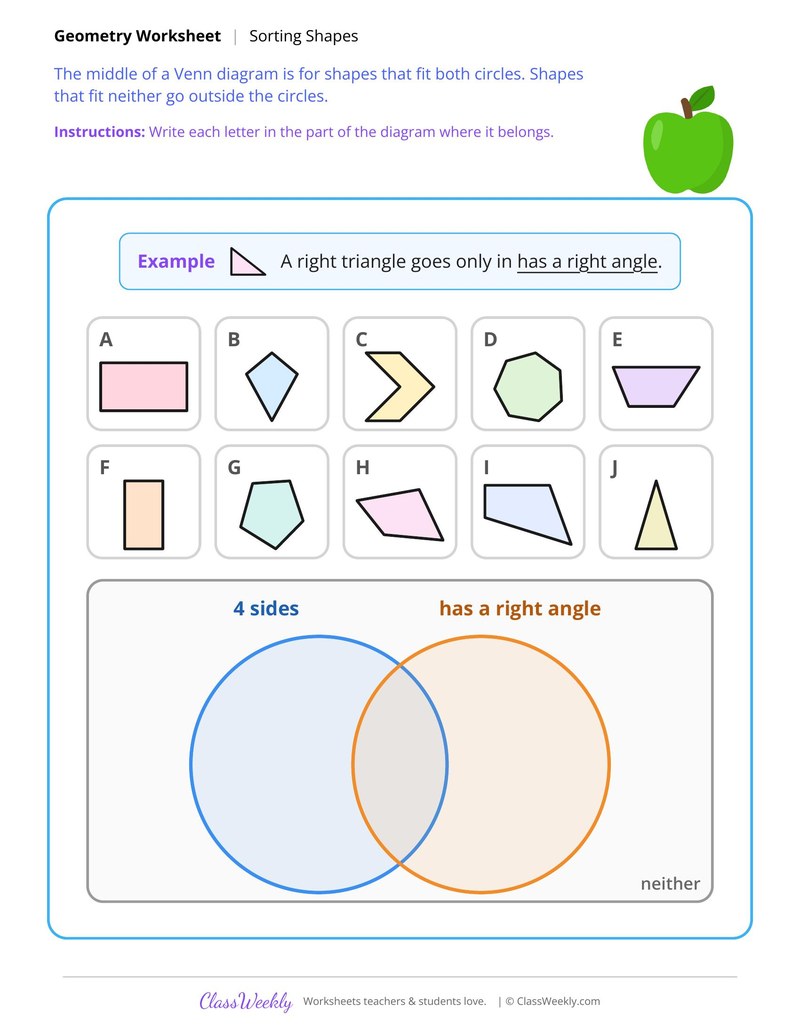
Curriculum Links
Find this in the curriculum
Browse the grade, subject, and topic this belongs to.
FAQ
How do I use this types of polygons worksheet?
⌄
Before handing out the worksheet, briefly introduce the concept with a short oral warm-up or a visual model on the board. Let students work through it independently, using a partner or small group only if they want to talk through their thinking, encouraging them to talk through their thinking: "What strategy are you using? How do you know that is right?" After completing the worksheet, review any missed problems together and discuss the reasoning rather than just the answer. For extra support, let students use manipulatives or draw pictures alongside the written problems. These types of polygons worksheets work well as daily practice, homework, or a focused review activity.
What does this worksheet teach?
⌄
Follow a path from a triangle to the finish, stepping to the shape with the next side count in the chart. The directions on the page read: Start at the triangle. Step up, down, left or right to the shape with the next number of sides in the chart. Go on to the finish. The page opens with a worked example, and an answer key is included.
Can I use this types of polygons worksheet for homeschool or classroom?
⌄
Yes, both. We made it for 3rd Grade geometry, and the page works the same whether it lands on a kitchen table or a center rotation. At home, most families go through it together and talk the answers out loud, and that talking is where most of the learning happens with types of polygons. In class it runs well as independent work while you pull a small group. Print one copy or thirty, whichever the day needs.
What polygon types by side count do 3rd graders learn to name?
⌄
Students learn triangle (3), quadrilateral (4), pentagon (5), hexagon (6), heptagon (7), octagon (8), nonagon (9), and decagon (10) - connecting Greek/Latin number prefixes to shape names.
How does learning polygon names help with vocabulary in other subjects?
⌄
Many polygon names use Greek or Latin number roots (tri-, quad-, pent-, hex-) that appear in science, social studies, and everyday language - reinforcing cross-curricular vocabulary skills.
What activities in these worksheets make polygon classification engaging?
⌄
Students match shapes to names, count sides on irregular polygons, sort shapes by type, and sometimes draw their own examples - varied tasks that keep the practice active.
What geometry do 3rd graders learn?
⌄
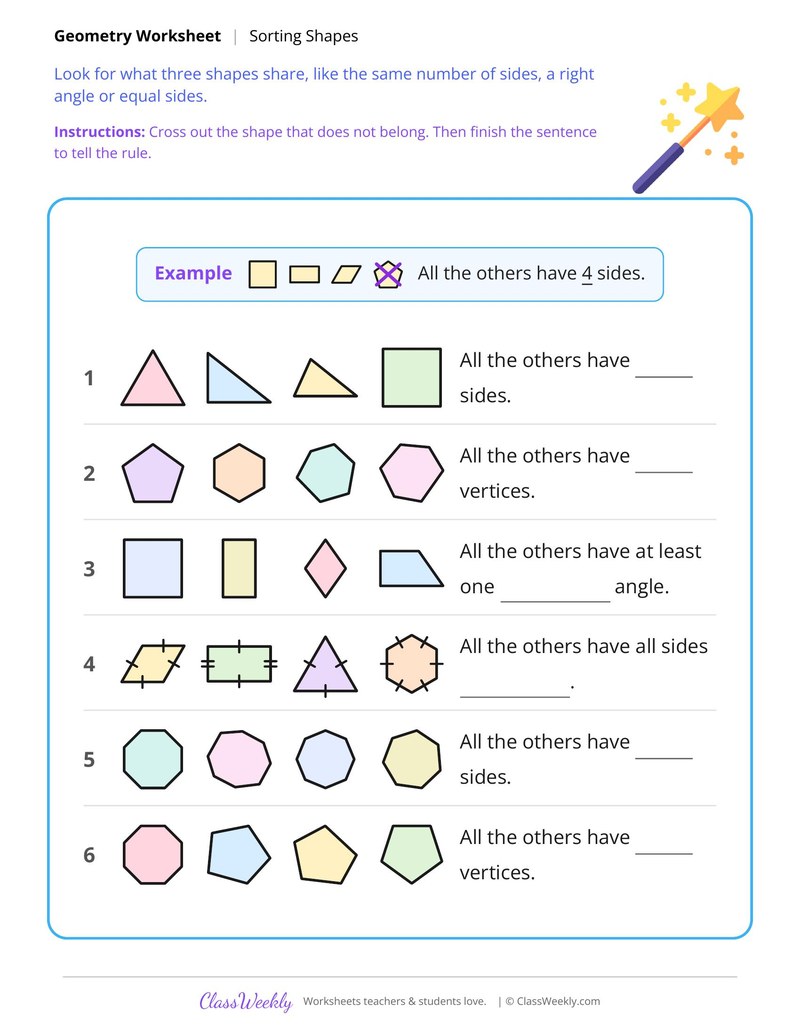
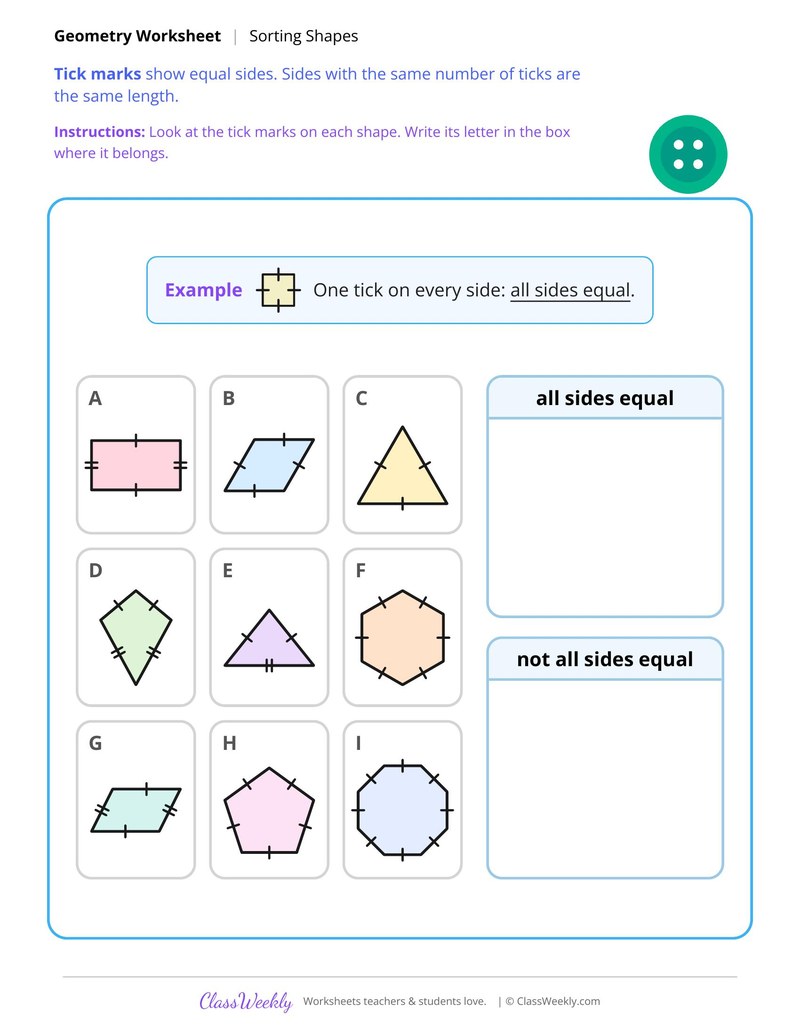
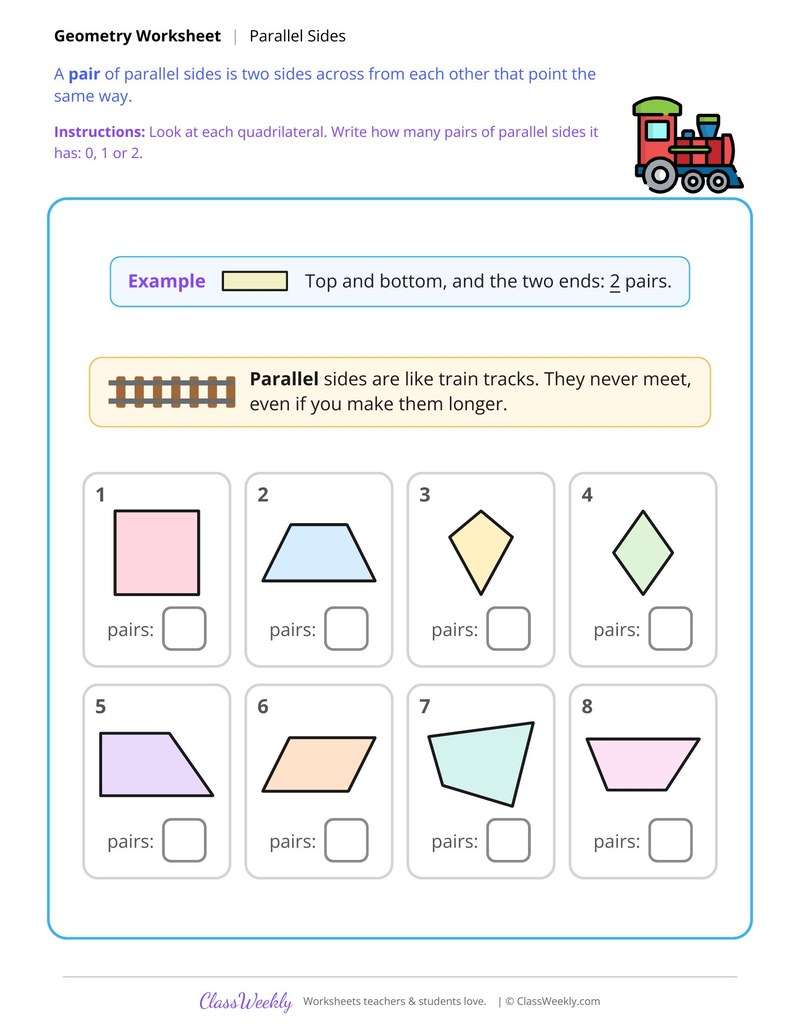
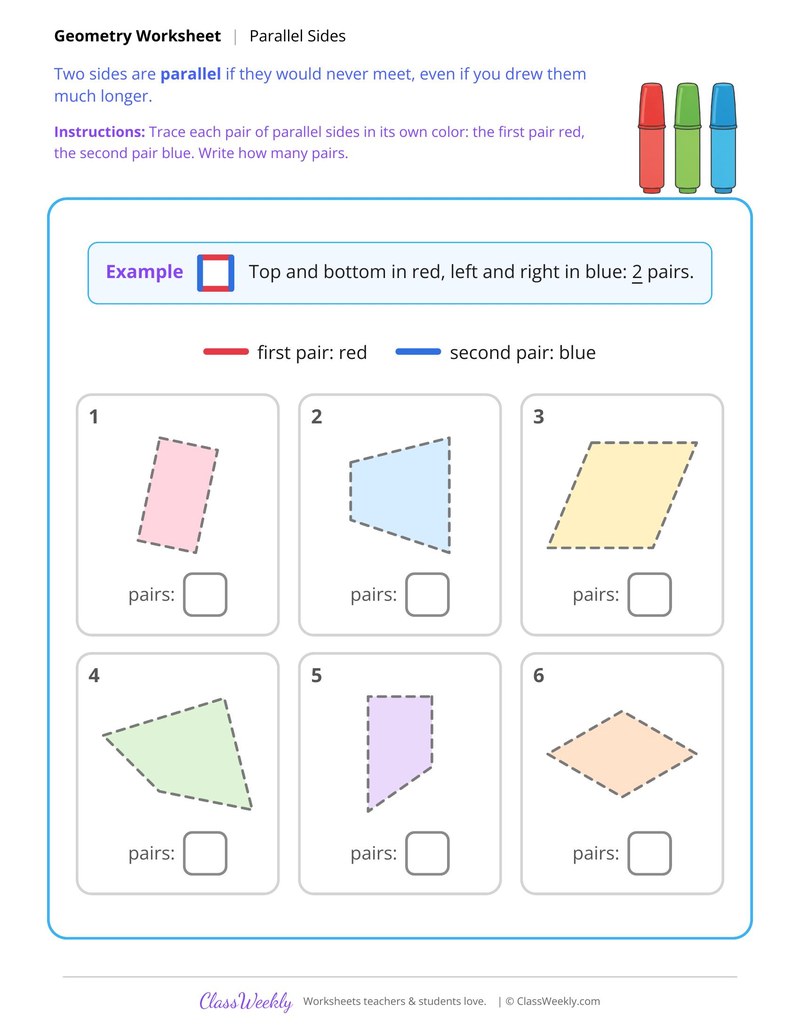
3rd graders sort shapes by their attributes and see that squares, rectangles and rhombuses are all quadrilaterals (CCSS 3.G.A.1). They find area by counting unit squares and by multiplying length and width (3.MD.C.7) and find the perimeter of polygons and missing side lengths (3.MD.D.8). These pages also cover lines, rays, right angles and symmetry.
How do you find the area of a shape made of rectangles?
⌄
Split the shape into rectangles, find the area of each part and add. On Split the L Shape Into Two Rectangles, parts of 2 and 5 square units make a shape with an area of 7 square units. Story pages such as Pool Deck Area Problems also subtract a part that is cut out.
What is the difference between area and perimeter?
⌄
Area is the space a shape covers, counted in square units. Perimeter is the distance around its edge. On Area or Perimeter, Circle One, grass seed for a lawn needs area and a fence around a yard needs perimeter.
Can two rectangles have the same area but different perimeters?
⌄
Yes. Both a 1 by 6 rectangle and a 2 by 3 rectangle cover 6 squares, but their perimeters are 14 and 10 units. The Same area, different perimeter pages show that the rectangle closest to a square has the shortest perimeter.
Do these geometry worksheets have answer keys?
⌄
Most sheets come with an answer key. A few drawing pages, such as Draw a Figure With Each Area and Draw Parallel and Perpendicular Lines, are open tasks without one.
Ratings & Reviews
No reviews yet. Be the first to share what you think.
Reviews are for ClassWeekly members.
Make a Request
Spotted something to fix, or want a worksheet we don't have yet? Tell us and we'll make it.
What is ClassWeekly?
ClassWeekly offers free worksheets and printable learning resources for kids, from preschool up. All worksheets are aligned to Common Core, NGSS, and C3 Framework standards and designed by educators. We also have free online learning games for thousands of skills, and kids' answers turn into a progress report for the grown-up. Start a free 30-day trial to download the worksheets.