Change One Number to Make It True
Written by Adi Ackerman, Head Teacher
"Change One Number to Make It True" is written for 3rd Grade (Ages 8-9), and it covers Common Core 3.OA.C.7. If your little one is a year younger but already steady on multiplication, the page still works. You may just need to read the instructions out loud. And if they are older and multiply and divide facts never quite stuck, this is a short review rather than busywork.
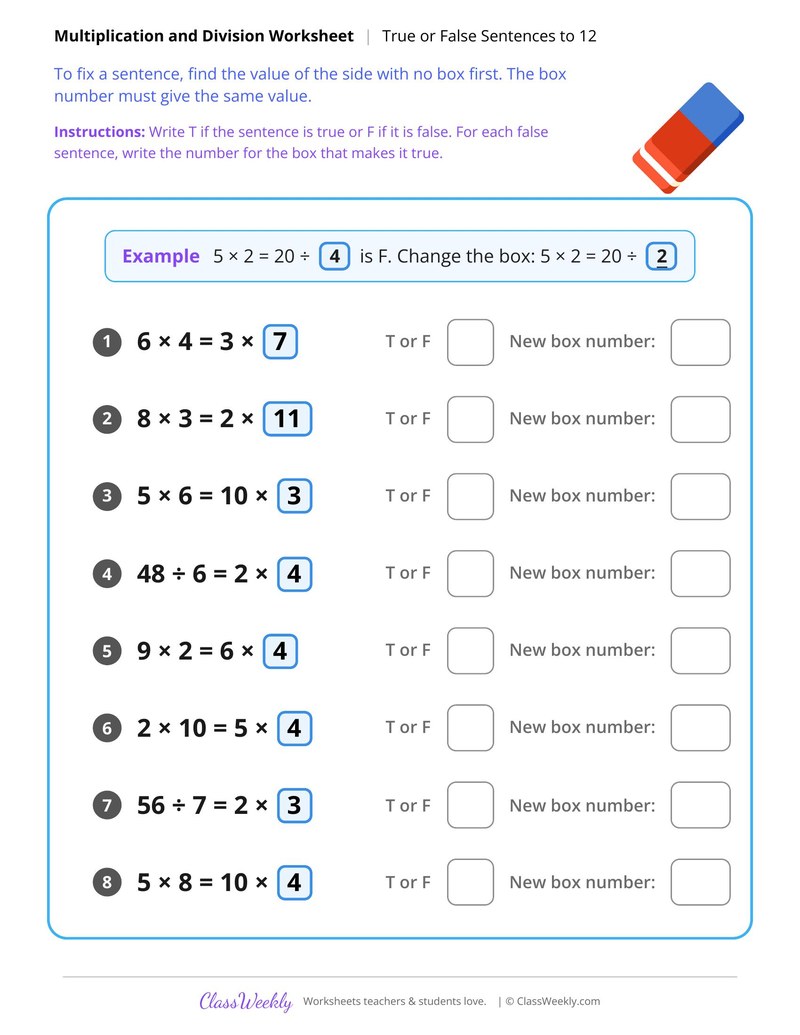
3rd grade math worksheet: mark each sentence T or F, then write the box number that makes a false one like 6 × 4 = 3 × 7 true. Answer key included. Part of our multiply and divide facts multiplication collection. Aligned to Common Core standards.
How do I use this worksheet?
Read the example box together. If your child is stuck on a division fact, ask for the matching multiplication fact. Time a second try of a drill a few days later to build speed. Check with the answer key.
What students will practice
- Students will write T or F for multiplication and division sentences.
- Students will find the value of the side with no box first.
- Students will write the box number that makes a false sentence true.
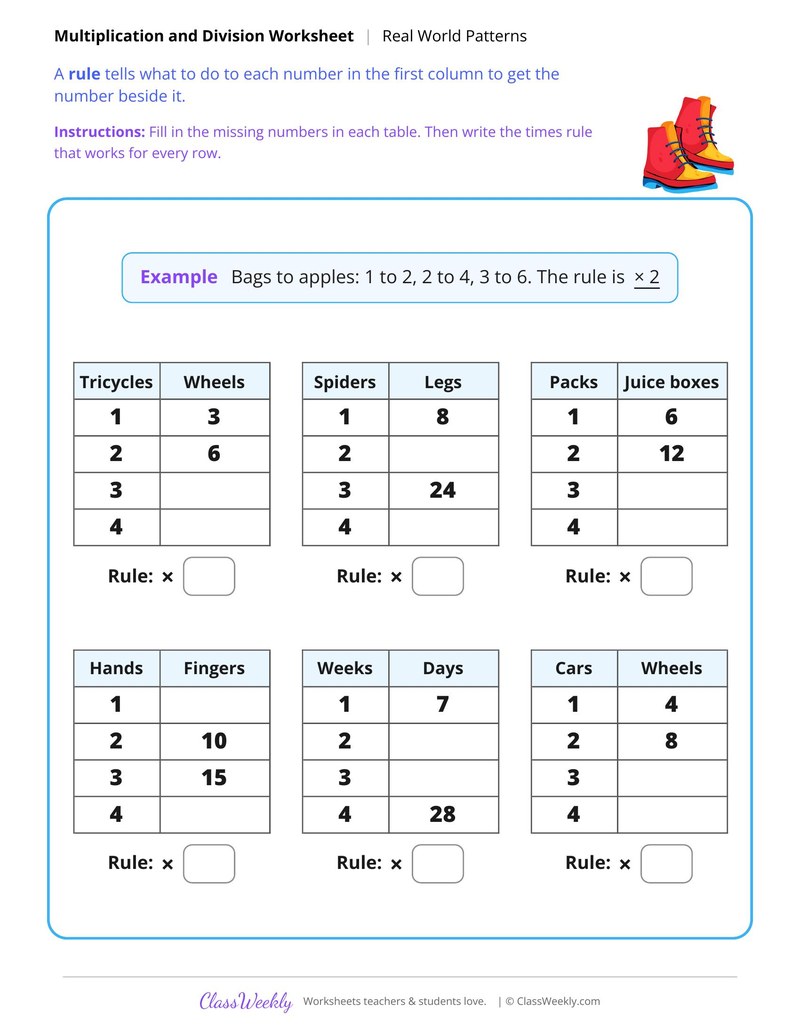
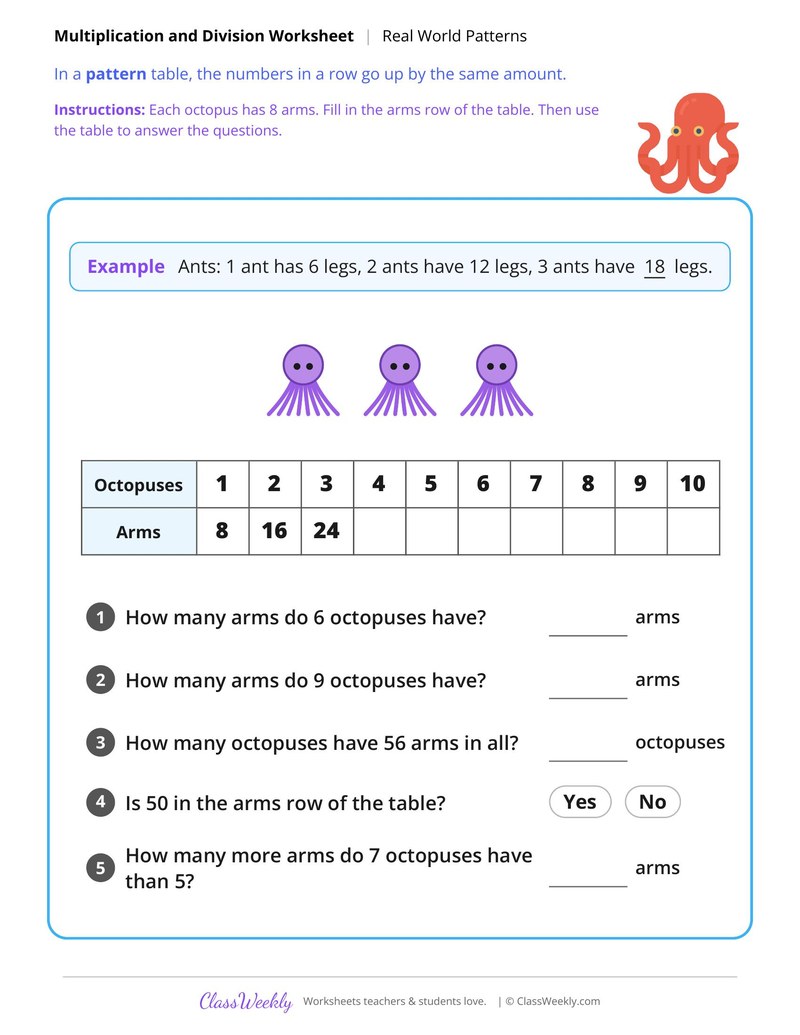
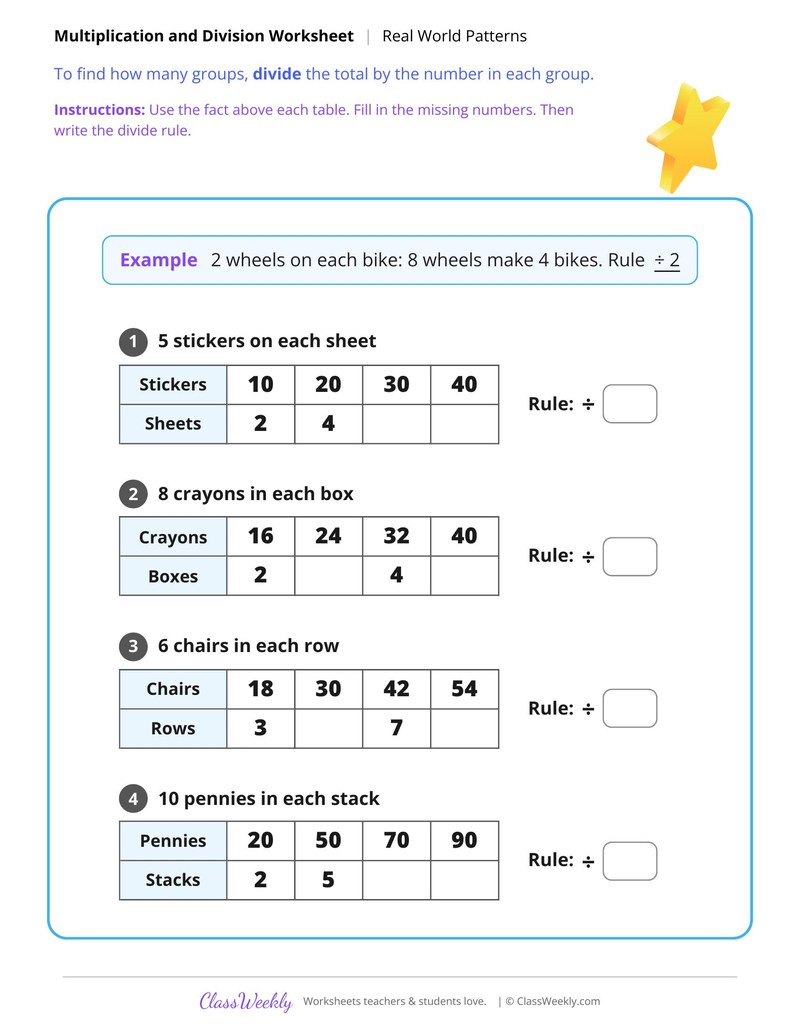
Curriculum Links
Common Core State Standards
Operations and Algebraic Thinking · 3rd Grade
Standard: Fluently multiply and divide within 100, using strategies such as the relationship between multiplication and division or properties of operations. By the end of Grade 3, know from memory all products of two one-digit numbers.
View all 3.OA.C.7 worksheets →Find this in the curriculum
Browse the grade, subject, and topic this belongs to.
FAQ
How do I use this multiply and divide facts worksheet?
⌄
Read the example box together. If your child is stuck on a division fact, ask for the matching multiplication fact. Time a second try of a drill a few days later to build speed. Check with the answer key.
What does this worksheet teach?
⌄
Mark each sentence T or F, then write the box number that makes a false one like 6 × 4 = 3 × 7 true. The directions on the page read: Write T if the sentence is true or F if it is false. For each false sentence, write the number for the box that makes it true. The page opens with a worked example, and an answer key is included.
Can I use this multiply and divide facts worksheet for homeschool or classroom?
⌄
Yes, both. We made it for 3rd Grade multiplication, and the page works the same whether it lands on a kitchen table or a center rotation. At home, most families go through it together and talk the answers out loud, and that talking is where most of the learning happens with multiply and divide facts. In class it runs well as independent work while you pull a small group. Print one copy or thirty, whichever the day needs.
Why practice multiplication and division facts together?
⌄
Division is the inverse of multiplication. Once a child knows 6 times 7 is 42, they also know 42 divided by 7 is 6, so learning the facts together means fewer facts to memorize.
In what order should my child do these pages?
⌄
Start with 2, 5 and 10, which follow skip counting, then 3 and 4. The 6, 7, 8 and 9 facts are the hardest, so they have pages of their own, and the drills for 3, 6 and 9 and for 4, 7 and 8 come after.
What are the number chains?
⌄
Each chain starts with one number and follows arrows that multiply or divide: 4 times 6 is 24, divided by 3 is 8, times 9 is 72 and divided by 8 is 9. One wrong step changes every box after it, so children check each one.
Is there an answer key for each worksheet?
⌄
Yes. Every sheet has an answer key that shows every fact.
When should 3rd graders know their multiplication tables?
⌄
By the end of 3rd grade, students should know all products of two one-digit numbers from memory (3.OA.C.7). Most classes build up to that with repeated addition, arrays and equal groups first.
What is the best order to teach multiplication facts?
⌄
Start with 2s, 5s and 10s, which follow easy patterns, then 3s and 4s, and finish with 6s, 7s, 8s and 9s. The true or false fact sheets are split the same way, with facts for 2, 3, 4, 5 and 10 and facts for 6, 7, 8 and 9.
What are square numbers in 3rd grade?
⌄
A square number is a number times itself, like 6 × 6 = 36. Square Arrays has the child color a grid with the same number of rows and columns, and Shade the Squares on the Times Chart finds them on a times chart.
What does times as many mean?
⌄
Times as many compares two amounts with multiplication. If Ben found 4 shells and Cal found 3 times as many, Cal found 3 × 4 = 12, and the times as many sheets show this with pictures and strips.
Do the multiplication sheets have answer keys?
⌄
Most multiplication sheets come with an answer key, and many open with a worked example to copy.
Ratings & Reviews
No reviews yet. Be the first to share what you think.
Reviews are for ClassWeekly members.
Make a Request
Spotted something to fix, or want a worksheet we don't have yet? Tell us and we'll make it.
Worksheet Details
| Grade | 3rd Grade |
| Subject | Math |
| Topic | Multiplication |
| Standard | 3.OA.C.7 |
| Pages | 1 page |
| Difficulty | Medium |
Learn More
What is ClassWeekly?
ClassWeekly offers free worksheets and printable learning resources for kids, from preschool up. All worksheets are aligned to Common Core, NGSS, and C3 Framework standards and designed by educators. We also have free online learning games for thousands of skills, and kids' answers turn into a progress report for the grown-up. Start a free 30-day trial to download the worksheets.